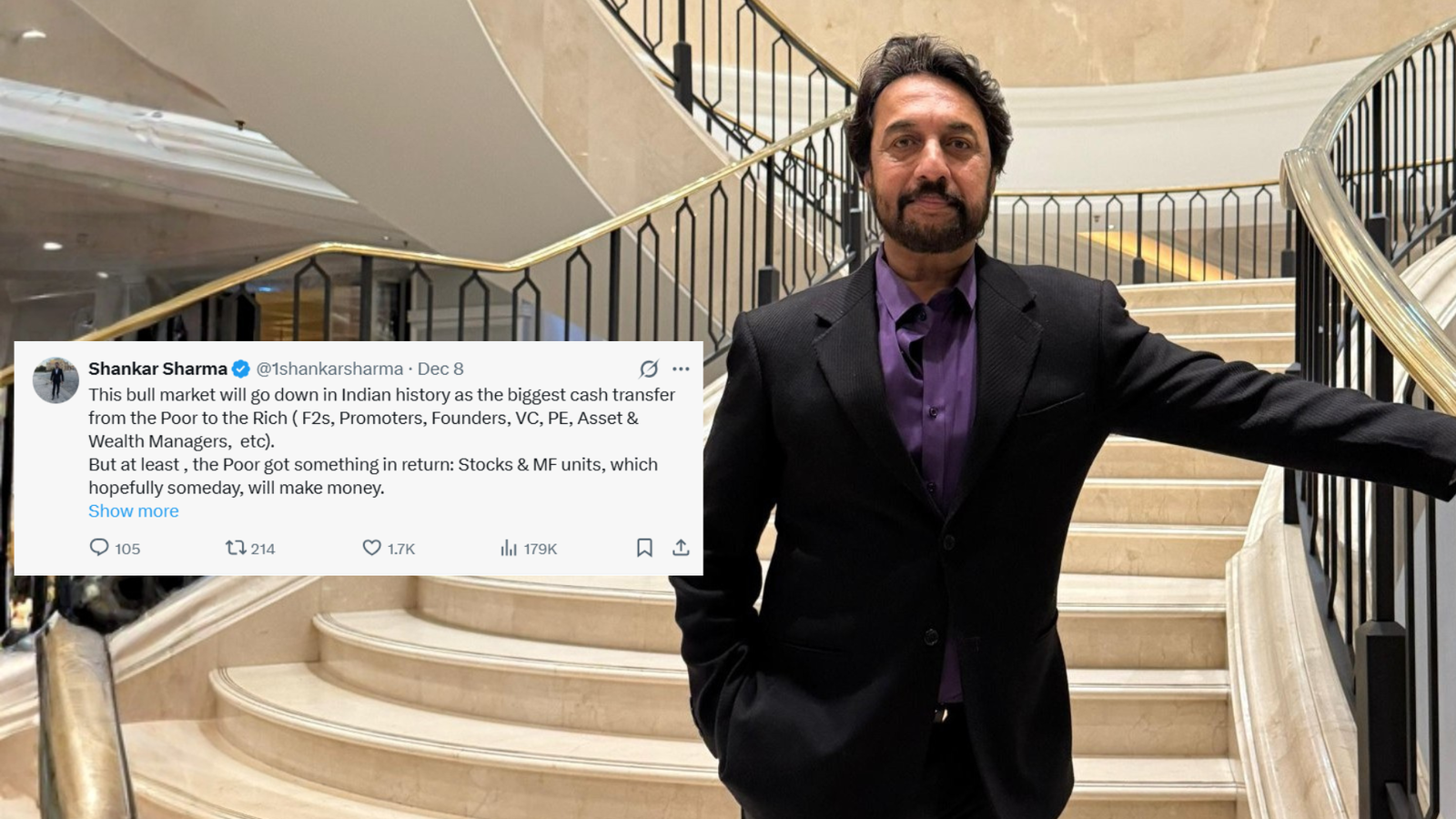
A record-breaking rally in the Indian stock market has sent Dalal Street into ecstasy, but market veteran Shankar Sharma thinks exactly the opposite. In an X post, Sharma said that this bull market would " go down in Indian history as the biggest cash transfer from the poor to the rich (F2S, Promoters, Founders, VC, PE, Asset & Wealth Managers, etc)," largely fueled by aggressive equity dilution, IPO fundraising, and the surge in F&O trading losses among retail investors.
Also Read | Meesho makes stellar market debut, lists at 46% premium on strong investor demand
Equity dilution and IPO boom benefit promoters
Backing his argument with recent market trends, Sharma pointed to the massive fundraising cycle in 2025. In the year so far, IPO proceeds via offer for sale have touched 96,984.50 crore, nearly double the 57,071.66 crore raised through fresh capital.
He said that promoters, founders, venture capital firms, private equity funds, and asset managers have all booked considerable gains during these OFS-heavy listings. Data from Nuvama Alternative Quantitative Research further showed that from January 1 to September 16, 2025, market insiders have offloaded shares worth ₹25,500 crore, while insider buying during the same period stood at a mere ₹3,860 crore.
Sharma says that despite all this imbalance, retail investors who subscribed to IPOs or invested in equities at least received shares or mutual fund units, assets that may appreciate over time.
F&O traders bear the harshest blow
The steepest concern, however, lies in the derivatives segment. Sharma says F&O activity among retail investors is a “permanent loss of capital” mechanism, positing this is where the most severe wealth transfer occurs.
Also Read | Vidya Wires surges 12% post-listing despite flat IPO debut
As per a report by the Mint, his caution comes in harmony with what SEBI has found: nearly 91% of individual traders in the equity derivatives segment generated net losses in FY25, a trend continuing from the previous fiscal. Sharma opined that commissions collected by brokers from these predominantly losing traders lead to " irreparable, non-returnable, non-recoverable" shifts of wealth from retail participants to brokerages, emphasising that it’s a "Permanent Loss of Capital" type Transfer.