The Total Fertility Rate (TFR) of India is now less than the replacement level, which marks a new milestone in the demographic landscape of the nation and indicates that there will be a deceleration in India's population growth.
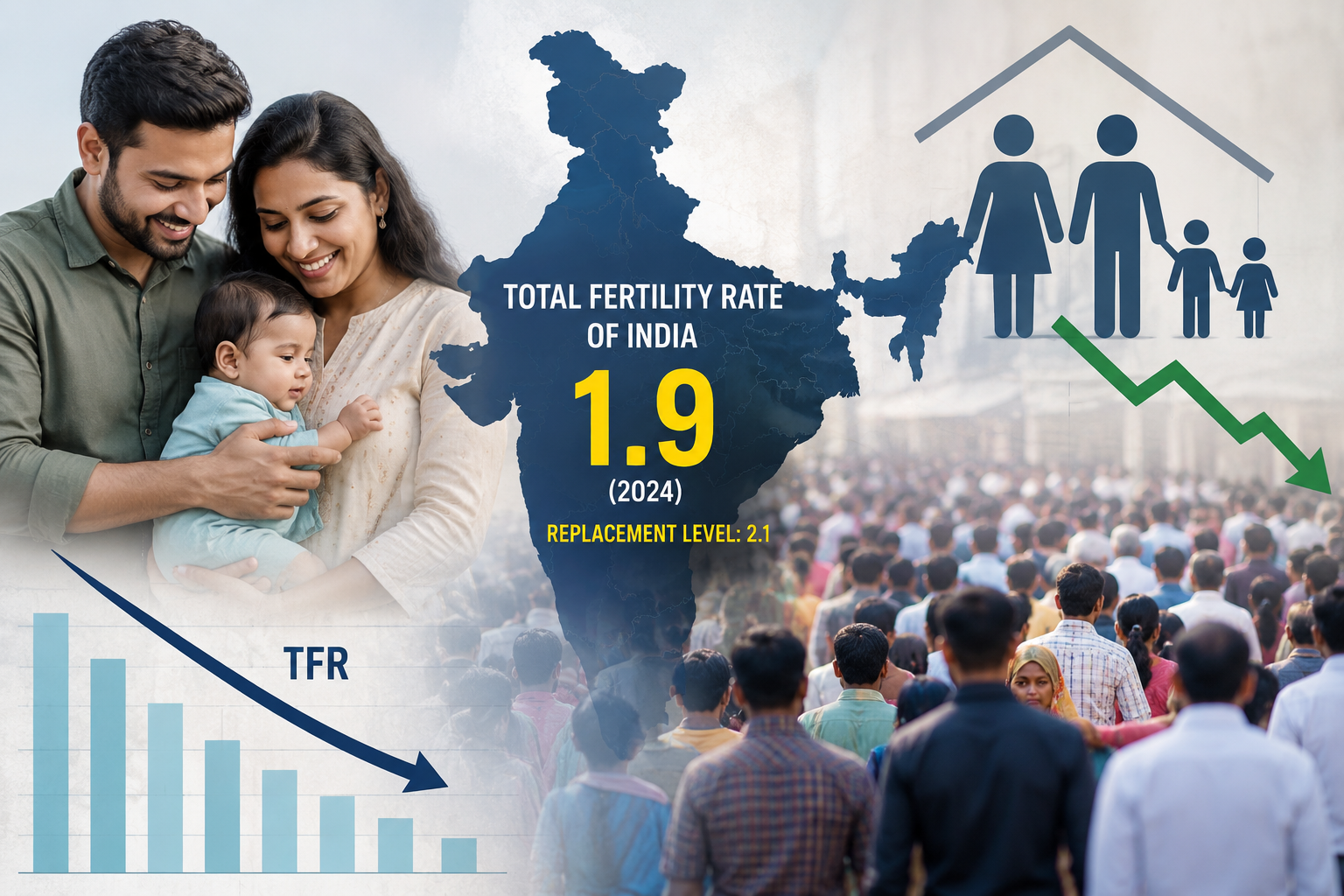
As per the Sample Registration System (SRS) Statistical Report 2024 published by the Office of the Registrar General and Census Commissioner working under the Ministry of Home Affairs, the Total Fertility Rate of India is 1.9, less than the replacement level of 2.1 in 2024.
A major turning point in demographics
The Total Fertility Rate is defined as the average number of children a woman bears during her lifetime. While the replacement fertility rate refers to 2.1, i.e., the rate at which the population will remain stable without any immigration.
Also Read | Strong solar storm sparks aurora buzz, but chances of getting a glimpse in India remain slim
Over the past few decades, India's Total Fertility Rate has been on the decline. Data reveals that the Total Fertility Rate of India has fallen from 5.2 in the 1970s to 1.9 in 2024.
Though India's population is still growing, mainly because of a large proportion of young people, however, it is anticipated that the population will stabilize and eventually fall in the coming years.
Sharp differences across states
The national average masks significant regional variation. Bihar recorded the highest fertility rate in the country at 2.9, followed by Uttar Pradesh at 2.6, Madhya Pradesh at 2.4 and Rajasthan at 2.3. These states remain above the replacement level and continue to contribute significantly to population growth.
 AI Generated
 At the other end of the spectrum, Delhi recorded the lowest fertility rate at 1.2. Tamil Nadu, Kerala and West Bengal each reported a TFR of 1.3, while several other states, including Maharashtra and Punjab, stood at 1.4.
The figures highlight a widening demographic divide between northern states with relatively higher fertility and more urbanised regions where family sizes have shrunk considerably.
Urbanisation and rising costs reshape family choices
There is also a noticeable divide between the urban and rural areas. While the fertility rate among rural Indian females was estimated to be 2.1, that among urban females came in at just 1.5 in 2024.
The reason behind the fall in the fertility rate among Indian women has been attributed to several factors, including increased education expenditure, urbanization, changed social attitudes, higher employment rate of women, and growing trend towards nuclear families.
With increasing living expenses and changing aspirations, couples are increasingly inclined towards having smaller families and spending on a few numbers of offspring. It is also found that greater access to education, media and health care is associated with lower fertility rates.
Also Read | Can newspaper-wrapped food make you sick? Here's what FSSAI says
Population growth not ending yet
Although there has been a decrease, India’s population is not likely to decrease anytime soon. According to demographers, the momentum of demographic growth will carry on due to the fact that a large number of people in India are still young and in their reproductive ages.
Nevertheless, the future estimates indicate that India might take the same path followed by many developed countries, with an aging population as well as low birth rate becoming critical issues in policymaking. The new figures on the fertility rate demonstrate how fast the demographics in India is changing.
FAQs
Q1. What is India's current Total Fertility Rate (TFR)?
According to the SRS Statistical Report 2024, India's TFR stood at 1.9, below the replacement level of 2.1.
Q2. Does a lower fertility rate mean India's population will start shrinking immediately?
No. India's population is expected to continue growing for years due to its large young population, although the pace of growth is slowing.