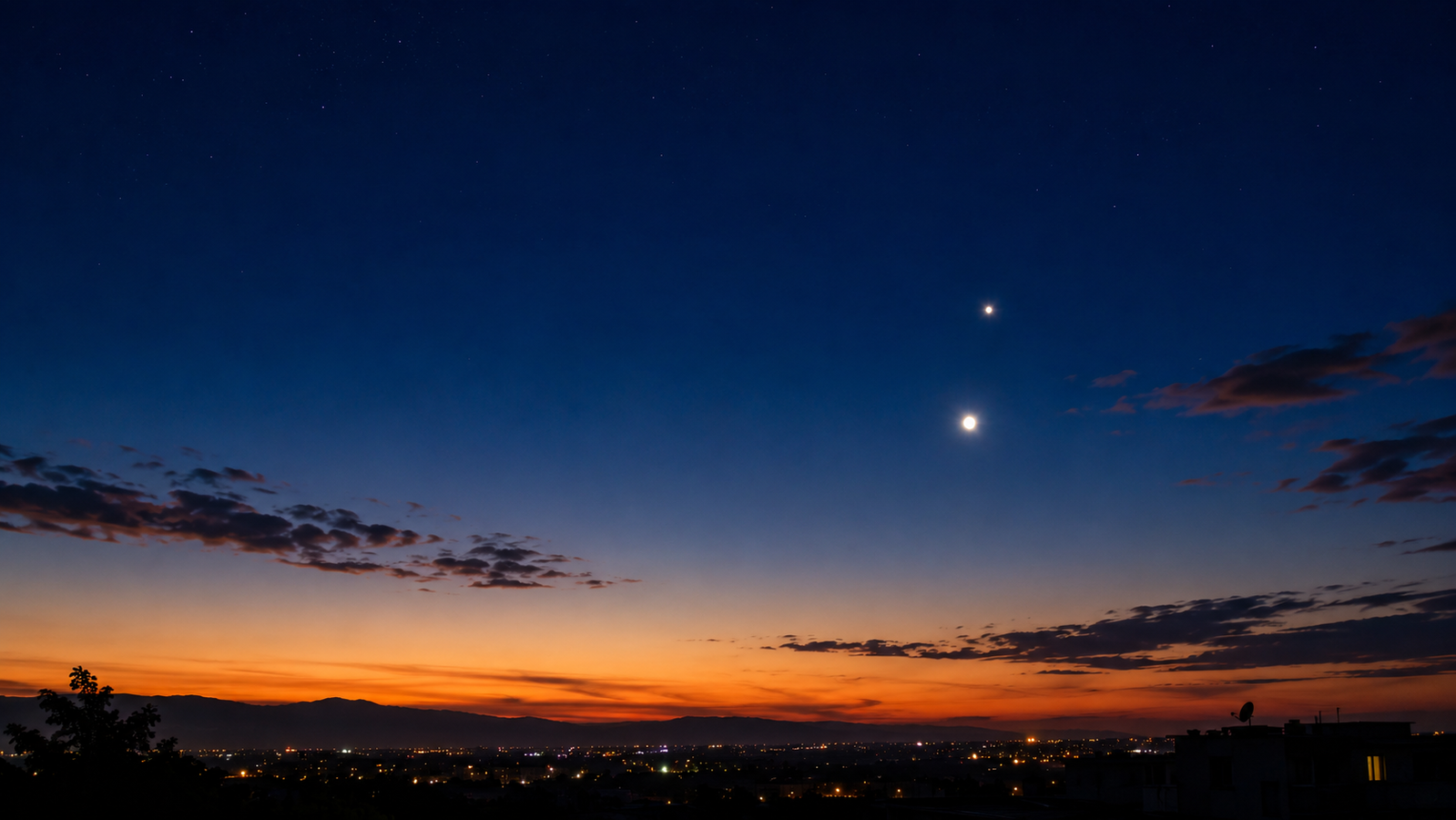
A spectacular celestial display is set to unfold tonight as Venus and Jupiter appear side by side in the evening sky in a rare planetary conjunction that has already captured the attention of astronomy enthusiasts worldwide. The event, often described on social media as a "cosmic kiss", will see the two brightest planets visible from Earth appear remarkably close to one another shortly after sunset.
Although the planets will seem almost touching from Earth's perspective, the phenomenon is purely an optical effect. Venus and Jupiter remain separated by hundreds of millions of kilometres in space, but their positions along Earth's line of sight create the illusion of a close encounter.
A rare alignment visible across the Northern Hemisphere
According to NDTV, astronomers say the two planets will appear just 1.5 to 1.6 degrees apart in the western sky. To put that into perspective, the gap between them will be roughly equal to the width of a little finger held at arm's length.
The conjunction is particularly noteworthy because it represents the closest visible approach between Venus and Jupiter for observers in the Northern Hemisphere until late 2028. Such alignments occur periodically as planets orbit the Sun at different speeds, but not all are easily visible from Earth.
Venus, often referred to as the Evening Star, will shine brighter and appear slightly higher than Jupiter during the event.
Also Read | Deadly unrest rocks PoK as anti-government protests turn violent, dozens reported killed
Best time and location to watch
According to NDTV, experts recommend heading outdoors around 45 minutes after sunset and looking toward the western or northwestern horizon. A clear and unobstructed view is essential because both planets will appear relatively low in the sky.
The pair should remain visible for up to two hours before gradually sinking below the horizon. No special equipment is needed to enjoy the spectacle, as both planets are bright enough to be seen with the naked eye.
However, binoculars can enhance the experience by allowing viewers to see both planets together in a single field of view. Those using small telescopes may also catch additional details, including some of Jupiter's most famous satellites.
Also Read | Israel to install Chhatrapati Shivaji Maharaj statue, seeks Maharashtra's support for landmark project
More celestial sights may accompany the conjunction
According to NDTV, astronomy enthusiasts could be rewarded with more than just the Venus-Jupiter pairing. Under favourable viewing conditions, Mercury may also become visible lower on the horizon, adding a third planet to the evening display.
Observers equipped with binoculars or telescopes may also be able to glimpse Jupiter's four largest moons — Io, Europa, Ganymede and Callisto. Known collectively as the Galilean moons, they can appear as tiny star-like points lined up near the giant planet.