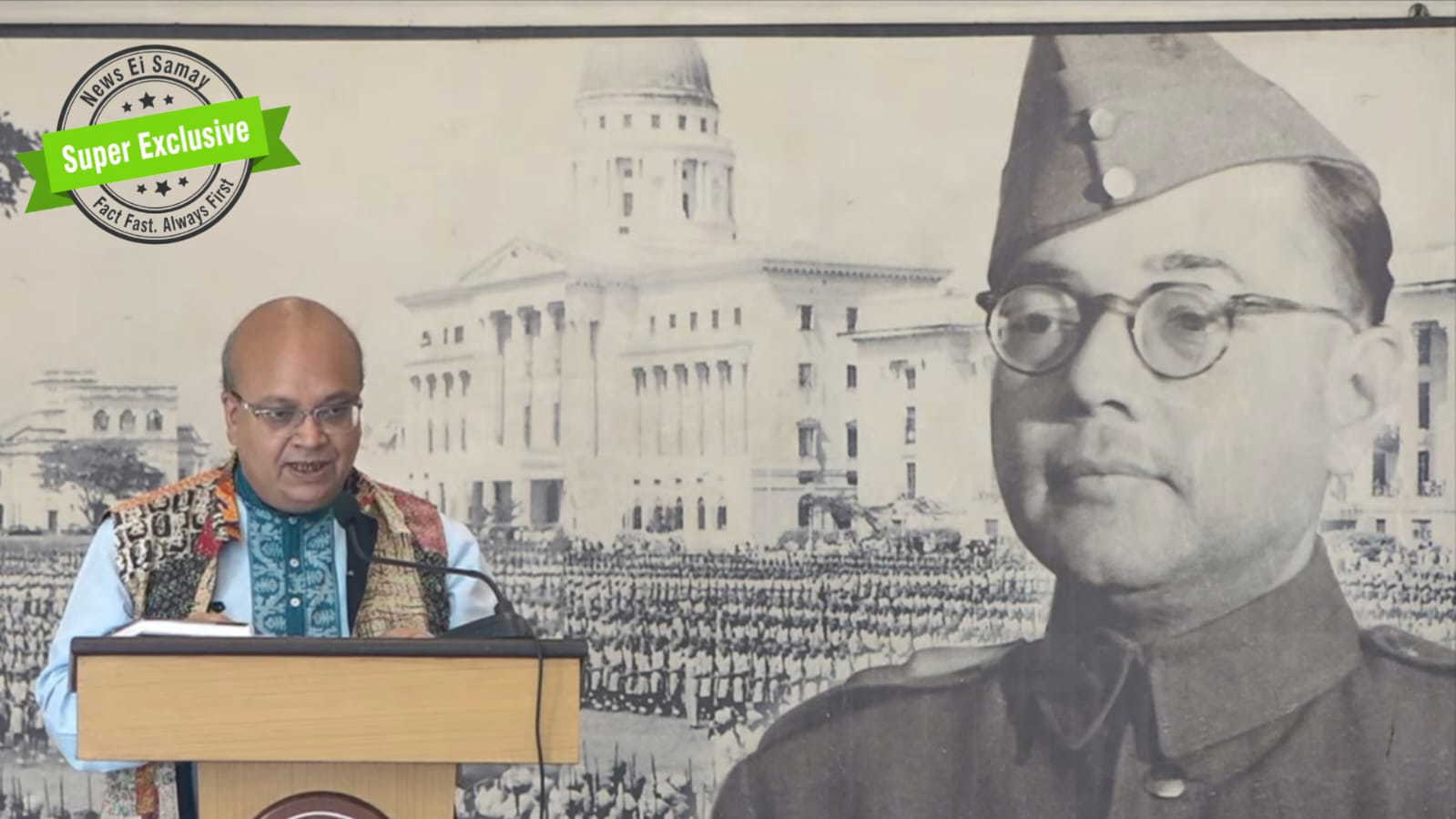
The 129th birth anniversary of Netaji Subhas Chandra Bose was observed at Kolkata's Netaji Bhawan with the traditional morning assembly. The programme included addresses, lectures, and recitations.
News Ei Samay spoke to eminent political scientist, professor, and Netaji's grand-nephew Dr. Sumantra Bose. Dr. Bose spoke on two important issues. One was the renewed demand to bring Netaji's supposed remains from Japan, and the other was about Netaji's political vision and how it is remembered today.
Bringing Netaji's remains from Japan: A matter for governments
There have been renewed demands to bring Netaji's supposed remains from the Renko'ji Temple in Japan to India. Dr. Bose said this issue should be handled with dignity and seriousness. "Netaji's remains should have been brought home a long time ago," he said. According to him, this is not a personal or family matter, but of national importance. "It should be done, if at all, at the highest level of the two governments, the Government of Japan and the Government of India," he said.
"This is about one of the most iconic leaders of India in the 20th century," he added. "He was also, as we heard today in the programme at Netaji Bhawan, one of the greatest statesmen of Asia." Dr. Bose added that if the repatriation is done now, it must be done in a befitting manner. He said it should happen through proper coordination between the two governments.
"So, if it is to be done, it should have been done a long time ago," he said. "But it should now be done in a befitting manner through the highest level coordination between the governments of Japan and India," Dr. Bose added.
Also Read | ‘Research itself is a thriller for me’: Srijit Mukherji spills why unanswered pasts excite him
Netaji's secular vision
Dr. Bose also spoke about Netaji's political ideals. "He stood for very robust secularism," Dr. Bose said. He added that this idea is especially relevant in present-day India. "His conception of secularism was uncompromising," he said. "It was much more robust than the Nehruvian secularism that we saw after independence."
According to Dr. Bose, Netaji believed strongly in a shared national identity. Religion, he said, should not come before the idea of India. "Netaji believed that India's national identity should be above, should transcend all religious identities," he said. He explained that Netaji never denied individual identities, But believed that being Indian must come first.
Also Read | Can Dayaan Farooqui’s PWL become India’s next IPL but for wrestling? A bite-by-bite walkthrough
"You have to be an Indian first," Dr. Bose said. "You can be many other things, second, third, fourth, fifth - there is nothing wrong with that. But the Indian national identity should transcend all other identities and stand above them," he concluded.