A fresh wave of layoffs at major US technology companies is placing Indian workers on H-1B visas under immediate strain, with the latest cuts at Meta and Amazon sharpening concerns over how artificial intelligence is reshaping employment in the sector.
Meta chief executive Mark Zuckerberg told employees in an internal memo that he did not expect further company-wide layoffs this year, even as the company laid off 10% of its global workforce and moved 7,000 employees into AI-related initiatives.
Amazon said it would reduce its corporate workforce by about 14,000 jobs in a restructuring that the company linked in part to its AI strategy. For H-1B holders, the stakes are unusually high: once employment ends, the clock starts on a 60-day grace period to secure a new job or change status.
The strait of immigration
The H-1B visa is designed for highly skilled foreign professionals in specialty occupations, mainly in science, technology, engineering, and mathematics (STEM) fields, and it requires employer sponsorship.
The program caps new visas at 65,000 a year, with an additional 20,000 reserved for applicants who earned a US master’s degree or higher. India was the largest beneficiary of H-1B visas last year, a USCIS congressional report said 71% of H-1B petitions approved in FY2024 were for beneficiaries whose country of birth was India.
That concentration means any downturn in US tech hiring tends to hit Indian workers especially hard, because a large share of their jobs is tied directly to employer sponsorship and continued legal status in the country.
Restructuring by algorithm
The latest layoffs are part of a broader corporate shift in which AI is no longer being sold only as a product feature but also as a way to strip out layers of management and automate routine work.
Amazon’s cuts were meant to offset over-hiring during the pandemic. Chief executive Andy Jassy had earlier flagged AI tools and agents as a driver of future job reductions. At Meta, the reshuffle is part of a wider overhaul aimed at centring AI agents in both products and internal operations. The company’s changes are affecting about 20% of its workforce when layoffs and transfers are combined.
In Amazon’s case, the cuts are the deepest since late 2022 and early 2023. Together, the moves underscore that AI-linked restructuring is no longer a theoretical threat for workers; it is already changing staffing patterns across the biggest names in US tech.
Also Read | 50,000 evacuated in California as chemical tank threatens explosion, Orange County declares emergency
Sixty days to make a life pivot
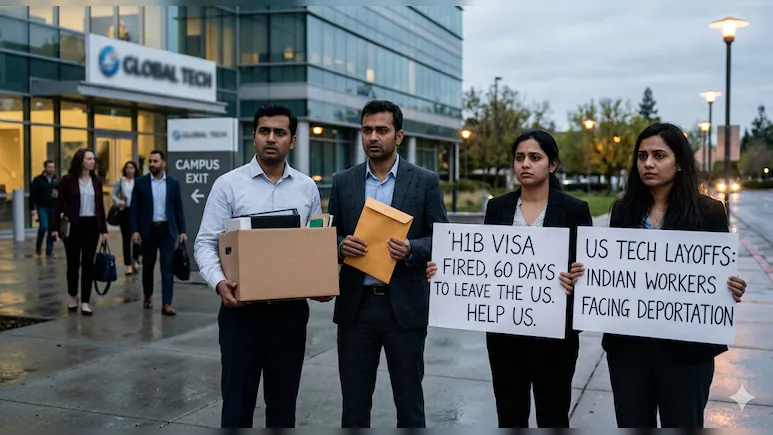
For workers on H-1B visas, the employment shock is compounded by immigration deadlines. Laid-off H-1B workers can face the prospect of leaving the United States within 60 days unless they find another job or change their immigration status.
When job cuts and visa dependency overlap, workers can lose income, stability, and time at once.
The pressure on H-1B workers is also drawing wider policy attention. Reuters reported in September 2025 that US lawmakers sought answers from major companies over their use of H-1B visas amid other job layoffs, reflecting a sharper political debate around foreign talent.
That scrutiny is likely to intensify as companies continue to pour money into AI while trimming human headcount elsewhere. Meta’s memo and Amazon’s latest cuts point to a familiar corporate line: efficiency, flatter structures, and faster innovation.
For workers whose right to stay in the country depends on a single job, however, the meaning is more immediate. A restructuring decision in California or Washington can quickly become a family and immigration crisis in Seattle, San Jose, or any other city where an H-1B worker is trying to build a life.