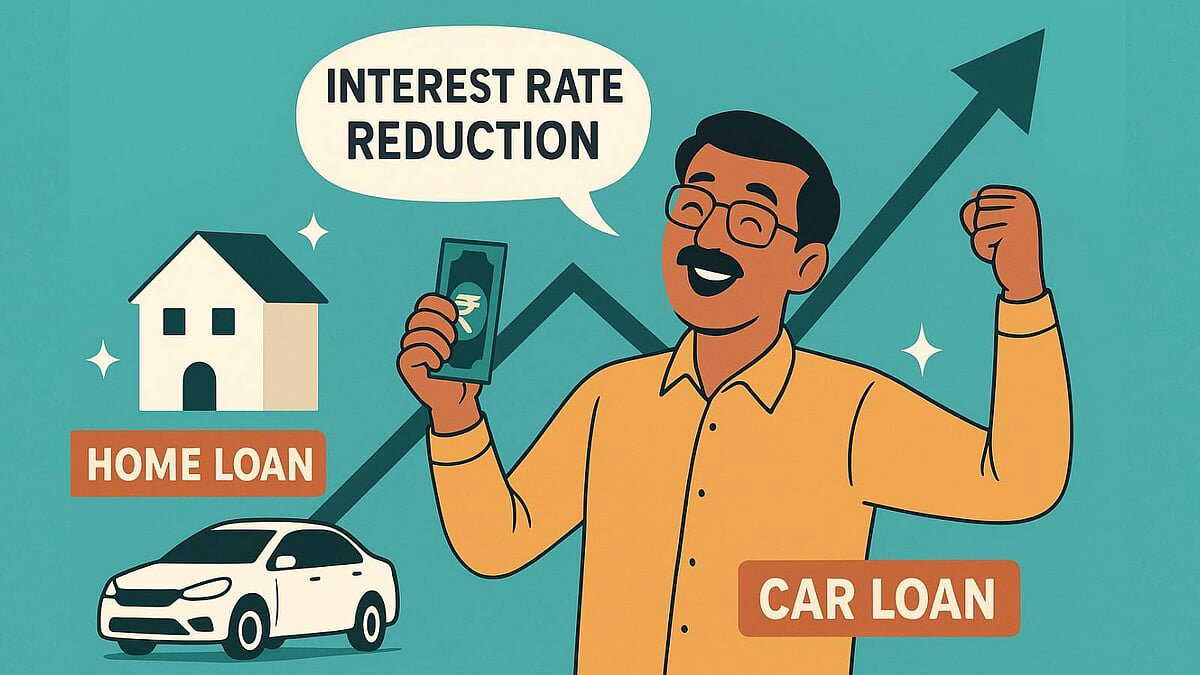
The Reserve Bank has cut the repo rate in four phases this year. After the Monetary Policy Committee meeting on Friday, the RBI reduced it by 25 basis points, bringing the total repo rate reduction this year to 1.25 per cent. As a result, it has come down to 5.25 per cent. In which areas will common people benefit from the repo rate cut? Who will face difficulties?
Also Read | Rupee hits record low even as RBI cuts repo rate to 5.25% — Here's what it means for you
Following the Reserve Bank's repo rate cut, interest rates on loans from various banks may decrease. Economics experts say that interest rates will particularly fall on loans linked to the External Benchmark Lending Rate. Since the beginning of this year, home loans and car loans from various banks have become cheaper. After Friday's 25 basis point cut, all these loans are expected to become even cheaper. EMI costs are also set to decrease.
On this matter, former Chairman of ICAI's Eastern Regional Branch Anirban Dutta said, "A repo rate cut means banks will be able to borrow money from the Reserve Bank at lower interest rates. As a result, banks will be able to offer loans to customers at lower interest rates. This will make various types of loans cheaper. EMI costs will decrease." Ashtech Group Director Sumit Agarwal said on this matter, "Last year, home loan rates had risen above 9 per cent. This year, due to multiple repo rate cuts, it has come down below 7.5 per cent."
Experts hope that the country's industrial sector will be boosted by this decision of the Reserve Bank. Because when interest rates fall, the interest in taking loans will increase. This can help expand new industries or increase production. On this matter, Anirban Dutta said, "When home loan and car loan costs decrease, people will have extra money in hand. With this, people can increase their shopping. As a result, demand in the market will increase. Businessmen will be able to increase production by taking cheaper loans. Overall market transactions will increase." Anarck Group Chairman Anju Puri said on this matter, "RBI's decision to cut the repo rate could be a blessing for India's real estate sector."
Along with events like a reduction in interest rates on various loans, cheaper EMIs, and economic growth due to the repo rate cut, interest rates on various savings schemes may also decrease. For instance, banks may reduce interest rates on savings schemes like Fixed Deposits and Recurring Deposits. Since the beginning of this year, interest rates on such schemes have decreased significantly. As a result, senior citizens or those who depend on interest from various bank savings schemes may face difficulties. On this matter, economics expert Anirban Dutta said, "Senior citizens are largely dependent on bank interest rates. But when interest rates fall, they may face some problems. Their livelihood will become somewhat difficult."
Also Read | India's big EV dream stalls as zero global automakers apply for key incentive scheme
Mr Mahesh Agarwal, Managing Director, Purti Realty, told News Ei Samay, "With the RBI cutting rates and growth projections rising, the real-estate market stands at the threshold of a renewed upswing - where lower borrowing costs, record-low inflation, and a strengthening economic outlook together create one of the most favourable environments for homebuyers and long-term investors in years."
"As financing becomes more accessible and sentiment improves, demand across residential and commercial segments is set to accelerate. Lower EMIs will encourage first-time buyers, while stable prices and improved GDP visibility enhance the appeal of real estate as a durable asset class. For salaried individuals, reduced interest rates and lighter EMIs significantly improve the affordability of buying homes, lowering monthly financial burden, boosting eligibility for higher loan amounts and enabling smoother long-term planning without straining household budgets. This moment marks a powerful opportunity for sustainable, broad-based sectoral growth."