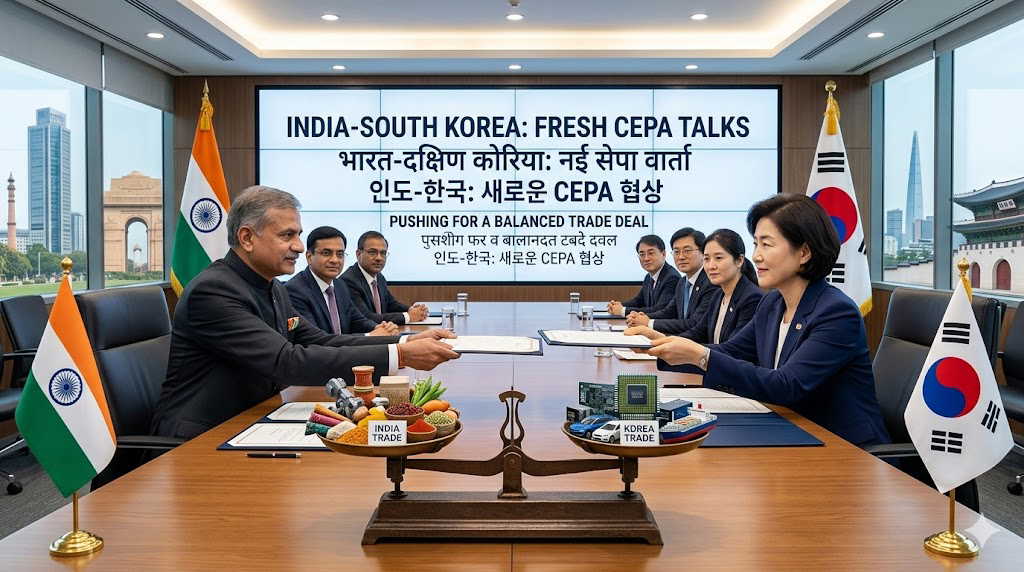
India and South Korea on Monday began the 12th round of negotiations to upgrade their existing Comprehensive Economic Partnership Agreement (CEPA), with both sides aiming to expand trade and modernise the decade-old pact.
The discussions, which will continue until May 27, are expected to focus on improving market access, addressing trade imbalances, and updating the agreement to reflect changing global trade realities. Officials indicated that the two countries could also consider negotiating an entirely new agreement that may eventually replace the existing CEPA framework.
India and South Korea signed the CEPA in 2009, and it came into force the following year. However, New Delhi has long argued that the agreement has disproportionately benefited South Korea, leading both countries to agree on a review mechanism in 2016. Despite 11 rounds of talks since then, negotiators have yet to finalise an upgraded pact.
Also Read | Twisha Sharma death case heads for CBI probe amid allegations of institutional bias
India seeks more balanced trade relationship
According to Financial Express, the latest push to fast-track negotiations follows the April 2026 state visit of South Korean President Lee Jae Myung to India, during which both nations agreed to conclude the upgrade process within a year.
The two sides have set an ambitious target of doubling bilateral trade to USD 54 billion by 2030 from the current level of around USD 27 billion.
Trade figures show why India wants changes to the agreement. Since CEPA came into effect, India’s exports to South Korea have risen from USD 3.7 billion in 2010-11 to USD 5.8 billion in 2024-25. However, imports from South Korea have surged far more sharply, climbing from USD 10.4 billion to USD 21.3 billion over the same period.
Indian negotiators are therefore pushing for more favourable conditions, broader market access, and updated provisions that better protect domestic industries while encouraging exports.
Also Read | Arvind Kejriwal, Manish Sisodia rejoin Delhi excise policy proceedings after HC bench change
ASEAN trade pact also under review
According to Financial Express, alongside the Korea talks, India is also reviewing the Association of Southeast Asian Nations trade agreement, formally known as the ASEAN-India Trade in Goods Agreement or AITIGA.
India has repeatedly expressed concerns that the agreement has mainly benefited ASEAN economies while contributing to widening trade deficits for New Delhi.
The 13th round of Joint Committee discussions on AITIGA is scheduled for July following earlier meetings held in March. Although the review was agreed upon in 2020, formal negotiations began only after a joint committee was established in 2022.
Also Read | Panic in Gulmarg as gondola service stalls mid-air, nearly 300 tourists rescued
India pushes for stricter trade rules
According to Financial Express, as part of the AITIGA review, India is seeking wider tariff liberalisation and wants nearly 80 percent of tariff lines brought under the agreement’s framework.
New Delhi is also demanding product-specific Rules of Origin to prevent misuse of trade concessions. At present, the agreement follows a uniform 35 percent local value addition rule across product categories to qualify for preferential tariffs.
Trade data reflects India’s concerns. When AITIGA came into effect in 2010, India’s exports to ASEAN stood at USD 18.11 billion, while imports were around USD 25.79 billion. By 2025-26, exports had grown to USD 38.4 billion, but imports had surged dramatically to nearly USD 89.9 billion.
The ongoing negotiations with both South Korea and ASEAN signal India’s broader effort to recalibrate older trade agreements and secure more balanced outcomes for domestic industries and exporters.