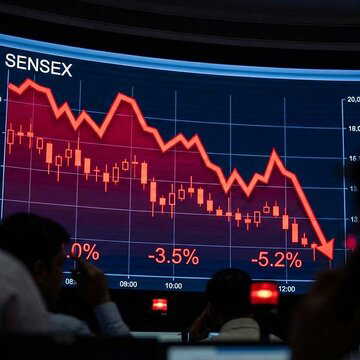
India posted one of the world’s strongest growth prints with real GDP expanding 8.2% in Q2 FY25. The Nifty and Bank Nifty briefly hit fresh all-time highs on the announcement. But within hours, the rally fizzled out. Frontline indices surrendered all gains, mid-caps and small- caps continued their steep decline, and retail portfolios remain under pressure for a third consecutive quarter.
Market veteran and GQuant founder Shankar Sharma, speaking to Business Today, said the muted reaction has a simple cause: the headline GDP number masks a distorted real picture that markets have already priced in.
Also Read | Is Centre planning a new app-cab service to benefit both passengers and drivers?
The deflator gap: “The market is not stupid”
The official data shows nominal GDP up 8.7% while real GDP rose 8.2%, implying a GDP deflator of just 0.5–0.7%. Sharma pointed out that India has never recorded such an anomaly in modern data. A realistic deflator aligned with CPI, bond yields and inflation expectations would be closer to 4–4.5%.
With that adjustment, he said, true real growth falls to 4–4.5%.
“The market is not stupid. It sees through the deflator trick,” Sharma told Business Today. “That’s the real cause for concern.”
Market breadth tells the real story
Despite upbeat GDP prints, the equity market has been steadily weakening:
Nifty: up just 2% in rupee terms over three months
Nifty (USD): down 6%
Nifty Midcap 100: down 18%
Nifty Smallcap 100: down 23%
MSCI India vs MSCI EM: underperformance of 32% YTD
Sharma described it as a “classic relative bear market,” arguing that in dollar terms and compared to global peers, India is down 30–50%.
Consumers stretched as retail lending peaks
As per the report, Shankar Sharma warned that India’s consumption engine is sputtering. Private banks have relied almost entirely on retail lending including personal loans, credit cards, vehicle and durable loans while corporate credit growth stagnated.
Key stress signals:
Household debt-to-GDP: 33% (2019) - 42% now
Retail loan CAGR: 23% over five years
Corporate credit (non-food): 6% CAGR
Fastest-rising NPAs: personal loans and credit cards (RBI FSR 2025)
“Consumers are saturated,” Sharma said. “How much more debt can they take to buy the next iPhone or washing machine?”
GST cuts helped cars, not everything else
The September 2024 GST cuts created a ₹2–4 lakh saving on cars, driving passenger-vehicle sales to record highs. But white goods and air conditioners saw 8–12% YoY declines despite a scorching summer. The consumption boost stayed limited to big-ticket items.
Global flows have already rotated away
Sharma reminded that 18 months ago he had predicted that India and the US would be the two worst-performing major markets, an outlook that has materialised.
He said Indian investors should expect index-level returns to struggle to beat fixed-deposit rates. The current IPO frenzy, he added, is just the “latest circus,” similar to the SME and 2021–24 small-cap bubbles.
Also Read | What will be the market situation on Tuesday? Experts are placing their trust in THESE four stocks
Sharma believes that genuine outperformance will return only through bottom-up selection in quality small-caps, not by staying with large-cap indices.
“Small-caps will eventually save the Indian market and take it higher. Not large-caps,” he said.
Until household leverage cools, corporate capex revives, and GDP accounting improves, Sharma said the message from the markets is clear: celebrate the 8.2% headline at your own peril.