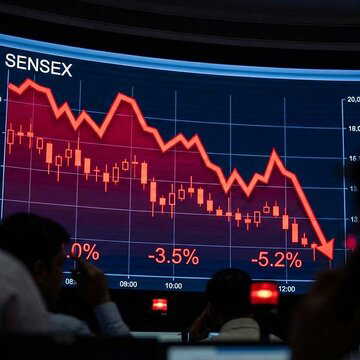
The country's stock market plunged into a pit of decline in the very first trading session of the week. From the moment the market opened on Monday, the Sensex and Nifty50 began losing points. As the day progressed, the magnitude of the fall also increased. Along with the two benchmark indices, small-cap, mid-cap and sectoral indices also collapsed. On Friday itself, the Reserve Bank Governor had announced a 25 basis point cut in the repo rate. Following this announcement, the market had recovered on Friday. But that growth did not last.
Why did Dalal Street crash on Monday?
In Monday's intra-day trading, the Sensex and Nifty50 lost nearly 1% in points. The Sensex had fallen by more than 800 points. But at market close, the country's two benchmark indices are somewhat higher than that level. At Monday's market close, the Nifty50 stood at 25,960 points. This National Stock Exchange index fell by 225 points or 0.86%. The Sensex stands at 85,102 points at market close. On Monday, the Bombay Stock Exchange index fell by 609 points or 0.71%. As a result, the combined market capitalisation of companies listed on the Bombay Stock Exchange decreased by 7 lakh crore rupees to 464 crore rupees.
Also Read | Gold prices show marginal rise while silver stayed almost unchanged on Monday after volatile week
The mid-cap and small-cap indices of the Bombay Stock Exchange fell by more than 2%. All sectoral indices declined on both stock exchanges. On Nifty, the India Defence, Realty and India Tourism sectoral indices fell by more than 3%. The Nifty PSU Bank sectoral index fell by 2.81%. However, Nifty Bank fell by 0.90%. Besides, important sectoral indices like FMCG, Auto, Pharma, Energy, Capital Market, and Metal fell between 1 to 2 per cent.
Various factors have emerged in market analysts' analysis for Monday's market decline. The first among them is the weakness of the rupee. The exchange rate of the rupee against the US dollar has reached 90.15. The price of crude oil has also increased in the international market. Therefore, despite strong GDP growth, the fall in the rupee's value has created negative sentiment in the market, according to analysts.
This week itself, the US Federal Reserve may make a decision regarding interest rates. Speculation has arisen that this American policy-making bank may cut interest rates by 25 basis points. Looking towards that, the country's investors are taking cautious steps. Its impact on the market has already started to surface.
Also Read | What will drive the market this week? Key stocks to watch today
Experts believe that the lack of any agreement on trade deals between India and America and the absence of related updates are increasing market disappointment. The Sensex and Nifty50 cannot escape this impact either. Along with this, the tendency of foreign investors to withdraw investments from India's market has continued since the middle of this year. Even at the end of the year, there has been no change in this. In the first five sessions of December alone, they have withdrawn investments worth 10,404 crore rupees from India's market. Experts believe this is adding fuel to the fire of market decline.
{News Ei Samay does not provide investment advice anywhere. Investment and trading in the share market or any field involve risk. Proper study and expert advice are recommended beforehand. This news is published for educational and awareness purposes.}