
India has become the centre of an extraordinary global heat emergency, with vast stretches of the country now recording temperatures that rival and even surpass some of the harshest deserts on Earth. On Friday, global weather monitoring systems showed that 97 of the world’s 100 hottest cities were located inside India, painting a disturbing picture of how severe the ongoing heatwave has become.
The cities and towns across the Indo-Gangetic plains and central India are now hotter than regions traditionally associated with extreme desert climates. Towns like Balangir and Banda have recorded temperatures crossing 48 degrees Celsius, surpassing even traditional global hotspots like the Sahara and Death Valley. Experts point to a massive heat dome, disappearing western disturbances, and worsening environmental degradation as the key reasons behind the unprecedented climate emergency unfolding across northern and central India.
 In India’s case, the dome has remained unusually stagnant, preventing cooler winds or cloud systems from entering the region (ANI)
The heat dome locking India inside a furnace
According to News 18, the immediate reason behind this relentless heat is a massive atmospheric system known as a heat dome. The phenomenon occurs when a high-pressure layer settles over a large area and traps hot air beneath it for prolonged periods.
In India’s case, the dome has remained unusually stagnant, preventing cooler winds or cloud systems from entering the region. Instead of allowing heat to escape upward, the pressure system continuously forces hot air back toward the surface, intensifying temperatures day after day. Dry northwesterly winds sweeping in from the western borders have only added fuel to the crisis. With no meaningful interruption from rainfall or cloud cover, the heat has continued to build across the plains without relief.
Also Read | 'Suppressing it is foolish': Shashi Tharoor backs Cockroach Janata Party, calls for lifting ban on X account
 Unlike desert regions, where temperatures often fall sharply after sunset, Indian cities retain heat because of concrete surfaces (ANI)
Why India’s plains are now hotter than deserts?
The current conditions are also exposing how fragile India’s weather balance has become. Northern India receives periodic relief through western disturbances, weather systems originating near the Mediterranean that bring moisture, clouds, and occasional storms before the monsoon. This year, those systems have been largely absent.
Without that protective buffer, solar radiation has directly battered exposed agricultural land and densely populated urban centres. Unlike desert regions, where temperatures often fall sharply after sunset, Indian cities retain heat because of concrete surfaces, asphalt roads, and dry soil conditions.
This has created dangerously high nighttime temperatures as well, leaving residents with little opportunity to recover from the daytime heat. The result is a cycle where the land remains continuously overheated around the clock.
Also Read | Delhi High Court grants Umar Khalid 3-day interim bail for mother’s surgery
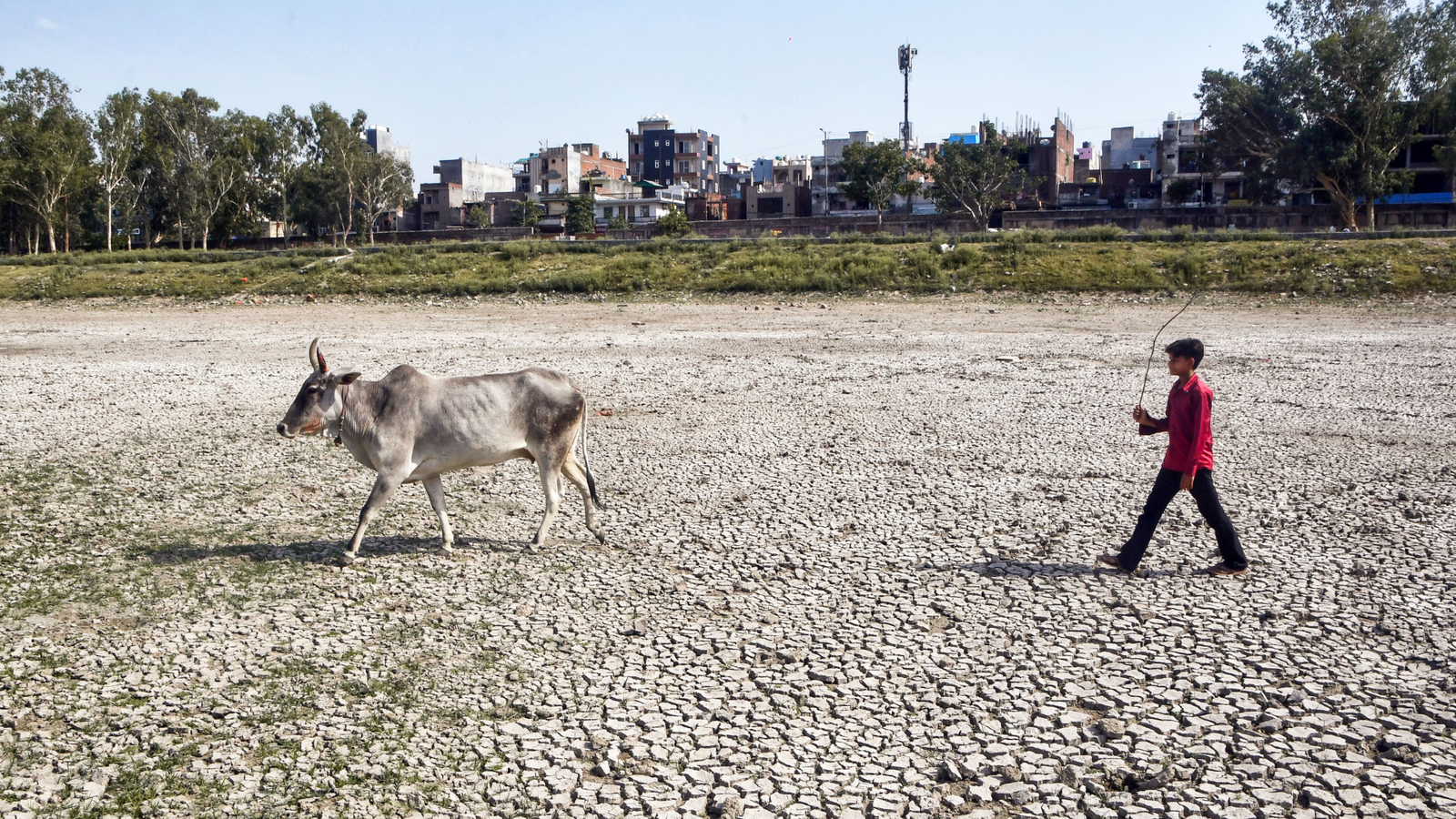 Dry rivers, exposed rocky surfaces, and barren fields now absorb and reflect solar radiation into the atmosphere (ANI)
Human activity has worsened the crisis
According to News 18, the experts also warn that environmental degradation has amplified the disaster in several regions. The areas such as Bundelkhand have witnessed years of unchecked riverbed sand mining, deforestation, and overexploitation of land resources. In districts around Banda, green cover has reportedly shrunk to critically low levels, removing natural cooling mechanisms that once helped regulate local temperatures.
Dry rivers, exposed rocky surfaces, and barren fields now absorb and reflect enormous amounts of solar radiation into the atmosphere. When combined with the effects of El Niño and global warming, these local ecological collapses are turning many Indian districts into severe heat islands.