









Union minister Pralhad Joshi on Sunday assumed charge as the Union education minister, a day after President Droupadi Murmu accepted Dharmendra Pradhan’s resignation and assigned Joshi the additional responsibility of the ministry.
Rashtrapati Bhavan said the president acted on the prime minister’s advice and directed that Joshi be given charge of the education ministry in addition to his existing portfolios.
Joshi will continue to handle consumer affairs, food and public distribution, and new and renewable energy while also overseeing education.
Also Read | PM Modi announces Nandan Nilekani-led panel to make exams ‘reliable’ and ‘transparent’
Today, I assumed charge as the Union Minister for Education.
— Pralhad Joshi (@JoshiPralhad) July 26, 2026
I am grateful to Hon’ble Prime Minister Shri @narendramodi ji for placing his faith in me and entrusting me with this responsibility. I accept it with humility and a deep sense of duty.
ಇಂದು ಭಾರತ ಸರ್ಕಾರದ ಕೇಂದ್ರ ಶಿಕ್ಷಣ… pic.twitter.com/Ge2ulvf3L8
Joshi’s first day in office
After taking charge, Joshi told reporters that he would spend time understanding the ministry’s structure, ongoing work, and pending decisions before making detailed comments.
He described education as “a new subject” and “a new area of work” for him and said the ministry was “a very big department” that required close review.
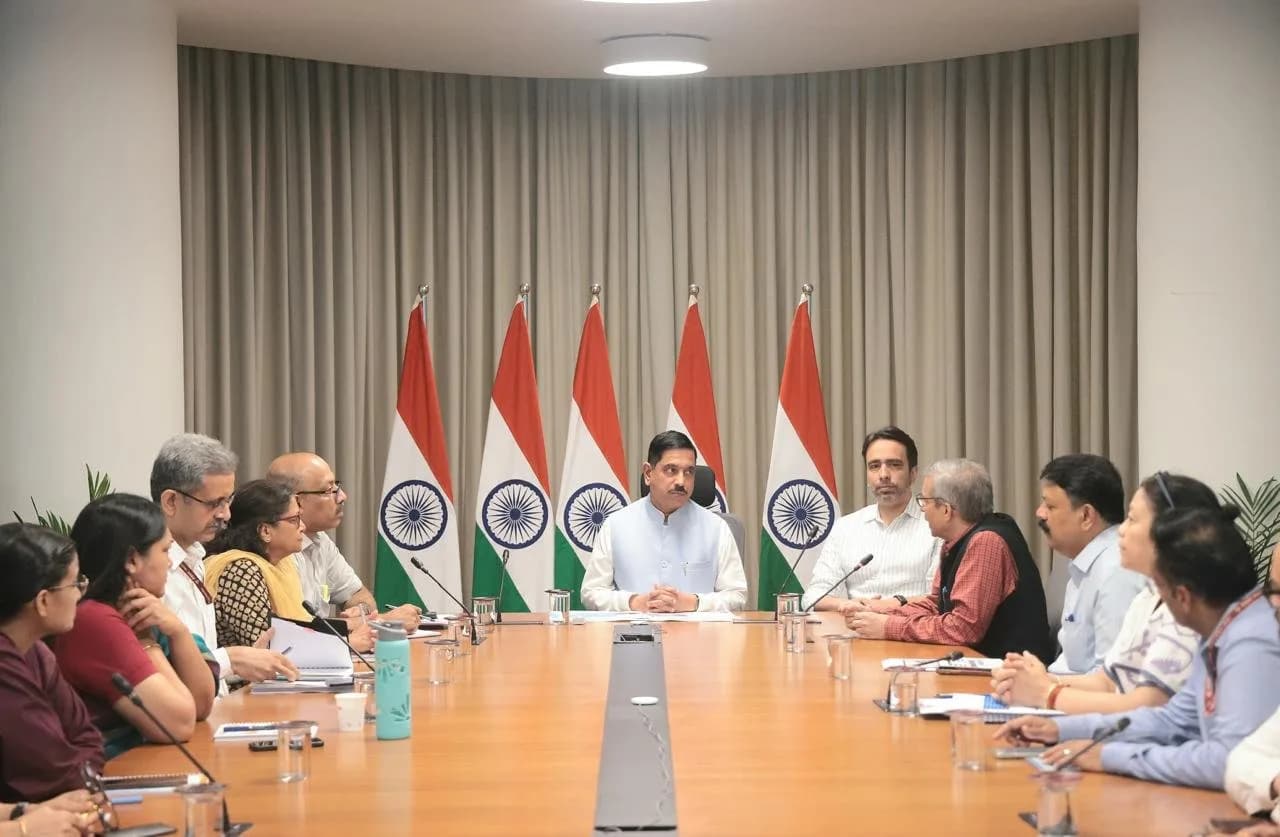
He arrived in Delhi from Karnataka on Sunday morning, began meetings soon after, and interacted with senior officials to familiarize himself with the department’s functioning.
VIDEO | Delhi: Newly appointed Union Education Minister Pralhad Joshi (@JoshiPralhad ) says, "I thank Prime Minister for giving such a huge responsibility and with great trust he has assigned this responsibility to me. I can only say at this moment, under his guidance, under his… pic.twitter.com/eOja0ZYChN
— Press Trust of India (@PTI_News) July 25, 2026
Gratitude meets a weighty assignment
Joshi also thanked Prime Minister Narendra Modi for entrusting him with the ministry, saying the responsibility had been given to him “based in trust and belief.”
In a post on X, he said he accepted the charge “with humility and a deep sense of duty.”
The transition comes at a sensitive moment for the education ministry, with student anger over the NEET paper leak still shaping the public conversation around exams, accountability, and reform.
#WATCH | Delhi: Union Minister Pralhad Joshi takes additional charge of the Ministry of Education.
— ANI (@ANI) July 26, 2026
(Source: Ministry of Education) pic.twitter.com/7qJoZfDZJh
A ministry under the microscope
The change in charge follows weeks of protests over alleged irregularities in competitive examinations, including NEET.
Pradhan resigned amid nationwide student protests over the paper leak, while Joshi’s first public remarks made clear that his immediate priority would be to understand the ministry rather than set out a detailed policy line.
His appointment, therefore, places an experienced cabinet minister, but one new to the education brief, at the center of one of the government’s most politically sensitive files.
Paper leaks remain the elephant in the room
Joshi had already spoken publicly about the paper leak issue before taking charge.
In comments on June 23, he said the government was “very much concerned” about students’ future and that 14 people involved in paper leaks had been arrested.
He also said the revised Public Examinations Amendment Bill would create stronger convictions and more fear around paper leaks and argued that the NEET re-examination had been conducted within 40 days, after which the result was declared and counseling would follow.
Also Read | PM Modi’s silence after Dharmendra Pradhan’s exit: What he said in the next 24 hours
FAQs
Q1: Why was Pralhad Joshi given charge of the education ministry?
Pralhad Joshi was assigned the education ministry after President Droupadi Murmu accepted Dharmendra Pradhan’s resignation on the Prime Minister’s advice.
Q2: What did Pralhad Joshi say after taking charge as education minister?
Joshi said education was a new subject for him and that he would first understand the ministry before making decisions.
