The escalating conflict between the United States, Israel, and Iran has begun to disrupt international aviation across West Asia. Airspace closures, flight cancellations, and rising fuel costs are affecting airlines, airports, and passengers across the region.
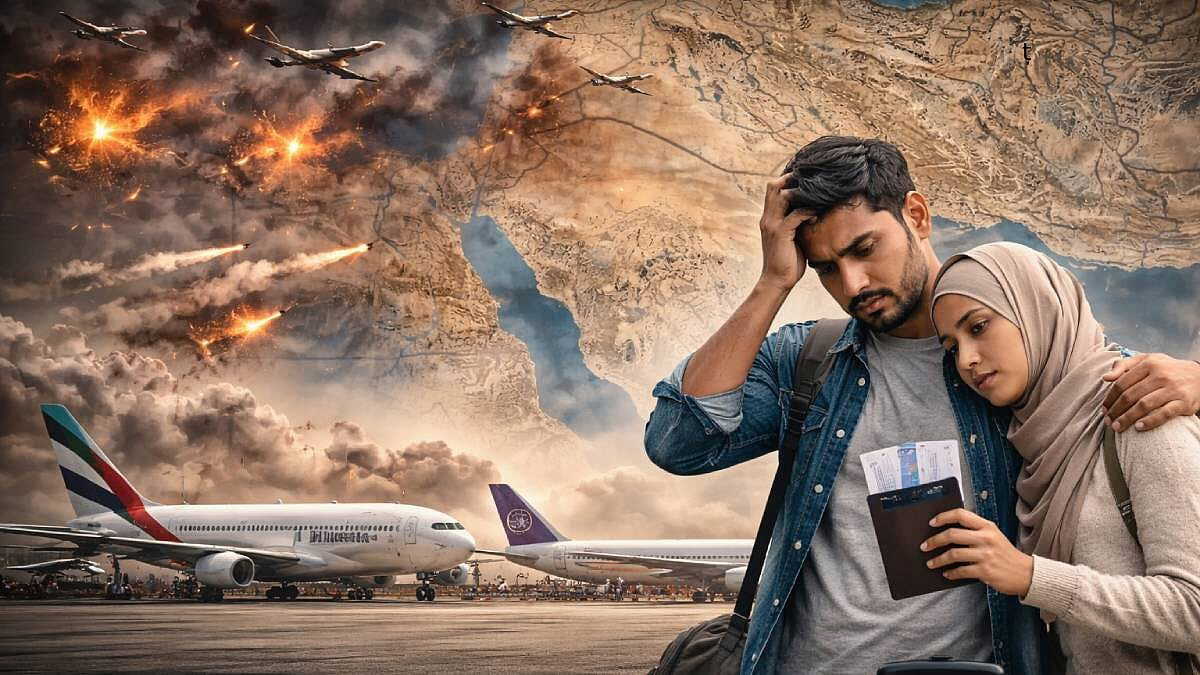
After US and Israeli strikes on Iran, Tehran launched retaliatory attacks. Several countries in West Asia reported impacts. American military bases were targeted. Major transit hubs such as Dubai and Abu Dhabi in the United Arab Emirates were also affected. Within hours, multiple countries began restricting or closing their airspace. Hundreds of flights were cancelled, and thousands of passengers were stranded.
Airports and airlines under pressure
Analysts say the attacks carry economic implications beyond military objectives. Aviation is a key pillar of Gulf economies. Cities such as Dubai, Abu Dhabi, and Doha serve as global transit hubs linking Europe, Asia, Africa, and the Americas.
Aviation expert Andrew Charlton said Iran understands the strategic importance of Gulf carriers. Airlines such as Emirates, Etihad Airways, and Qatar Airways are central to international trade, tourism, and financial services.
According to aviation data group OAG, Emirates and Qatar Airways rank among the world's largest international airlines by seat capacity and distance. In 2025, Dubai International Airport handled around 95 million international passengers, making it one of the busiest global hubs.
These airlines operate on a "super-connector" model. Long-haul passengers are routed through Gulf hubs and transferred onward. Disruption in one segment affects the entire network.
Data from Cirium showed that on March 2, about 3,800 flights were scheduled to arrive in the Gulf region. Around 40 per cent were cancelled. Route diversions were even higher.
Also Read | Iran-Israel tensions threaten India’s tea exports; Assam, Darjeeling traders fear losses
Longer routes, higher costs
Since the Russia-Ukraine war, many airlines have avoided Russian airspace and relied more heavily on Middle Eastern routes. With new restrictions, aircraft are now forced to take longer detours. This increases travel time and fuel consumption.
Fuel accounts for 25 to 30 per cent of airline operating costs. Rising crude oil prices, linked to the conflict, are adding pressure. An additional hour of long-haul flying can require thousands of litres of extra fuel.
On March 2, shares of major European carriers declined sharply. International Airlines Group, parent of British Airways, fell more than 12 per cent at one point before partially recovering.
Thousands of transit passengers were stranded at Gulf hubs. Business travel and cargo operations were also affected, as passenger aircraft carry significant freight.
Also Read | Gold nears record high as US-Iran tensions boost safe-haven demand; silver jumps over 2%
Long-term impact and historical context
US President Donald Trump indicated that operations could continue for weeks. Analysts warn that prolonged conflict may lead to higher fares, reduced demand, and complex network rebuilding.
Past crises, including the September 11 attacks, the 2008 financial crisis, and the COVID-19 pandemic, sharply reduced air travel before a gradual recovery. However, experts note that the current situation combines geopolitical conflict, fuel volatility, and airspace disruption.
Industry observers say the conflict highlights the role of aviation as a critical component of the global economy. Continued instability could force airlines to reassess risk and route strategies in the months ahead.