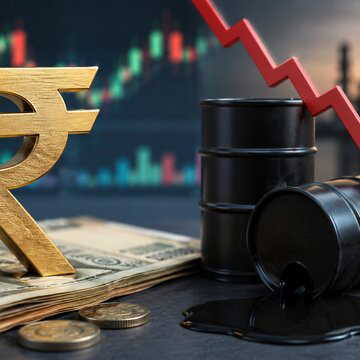
In 2026, the rupee in India has been subjected to intense pressure leading to worries regarding the possibility of inflation, household budgets, and investment plans. Despite a slight recovery in the value of the rupee in 2026 to 95.38 against the US dollar amid indications of reduced tensions in West Asia, the rupee is still much lower than its value at the beginning of the year.
According to market reports, the rupee has fallen by 6.5 per cent in 2026 after losing 10.4 per cent in 2025. According to financial analysts, even if exchange rates do not have any direct impact on people’s lives, they always have an influence via high costs of foreign trips and studies abroad.
Why the rupee is falling
Analysts attribute the recent decline to a combination of global and domestic factors. Rising crude oil prices linked to geopolitical tensions in West Asia have increased pressure on India's import bill, while a strong US dollar and foreign investor outflows from emerging markets have added to the challenge.
Also Read | How big is SpaceX's IPO? Elon Musk's company shatters global fundraising record
India imports more than 85 per cent of its crude oil requirements, making the economy particularly sensitive to fluctuations in global energy prices. As oil becomes more expensive, demand for dollars rises, placing additional pressure on the rupee.
Financial experts note that such currency movements are common during periods of global uncertainty and are not unusual for emerging economies.
What it means for households
A weaker rupee can eventually translate into higher costs for consumers. Imported products such as smartphones, laptops, electronics, medical equipment and certain automobile components may become more expensive.
The impact is also significant for families with international financial commitments. Overseas education, foreign travel and expenses denominated in dollars, euros or pounds become costlier when the rupee loses value.
Industry estimates suggest international travellers may now spend tens of thousands of rupees more on the same trip compared with earlier periods, particularly for destinations in Europe and North America.
Experts warn that if higher import costs persist, inflationary pressures could gradually spread across sectors, affecting transportation, fuel and everyday expenses.
Investors advised against panic
Market analysts emphasize that short-term changes in currency do not affect big investments. India has had instances when the rupee fell in value before; still, it continued to build wealth in the long run through growth in its economy and corporate sector and involvement in the stock market.
A disciplined approach is advised in investing according to financial planners. Another important technique is diversifying your investments. Portfolio diversification in equities, bonds, gold, and others has been suggested by experts.
Gold investment becomes a choice in case of geopolitical instability and weakening of currency owing to the fact that the price of gold is based in dollars worldwide.
The Infrastructure Investment Trusts, hybrid funds, and good quality debt securities have caught the attention of some financial planners as potential investments.
Who benefits from a weak rupee?
Everyone is not losing in case the currency falls. Industries that export products, especially sectors like information technology, pharmaceutical, and automobile components manufacturing, benefit greatly from falling rupee due to the increased value of dollars earned through exports.
Also, people whose family members have moved to work outside the country will benefit since every dollar sent by them becomes equivalent to more rupees.
Also Read | Why are final air crash reports delayed? AI-171 case puts spotlight on pending probes
Role of RBI in handling volatility
Despite being hit by the volatility in rupee value, RBI continues to intervene where required to avoid extreme volatility in the markets. India still holds $680 billion in its foreign exchange reserves. This gives policymakers a good amount of leeway to handle any drastic changes in the market.
However, economists argue that central banks can never be able to control the rate of exchange. They are just reflections of larger trends such as trade balance, inflation, and international investment sentiment. Thus, for individuals and investors, experts advise against paying too much attention to currency volatility.