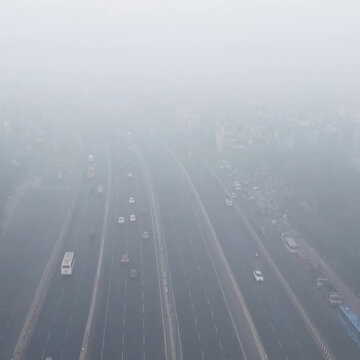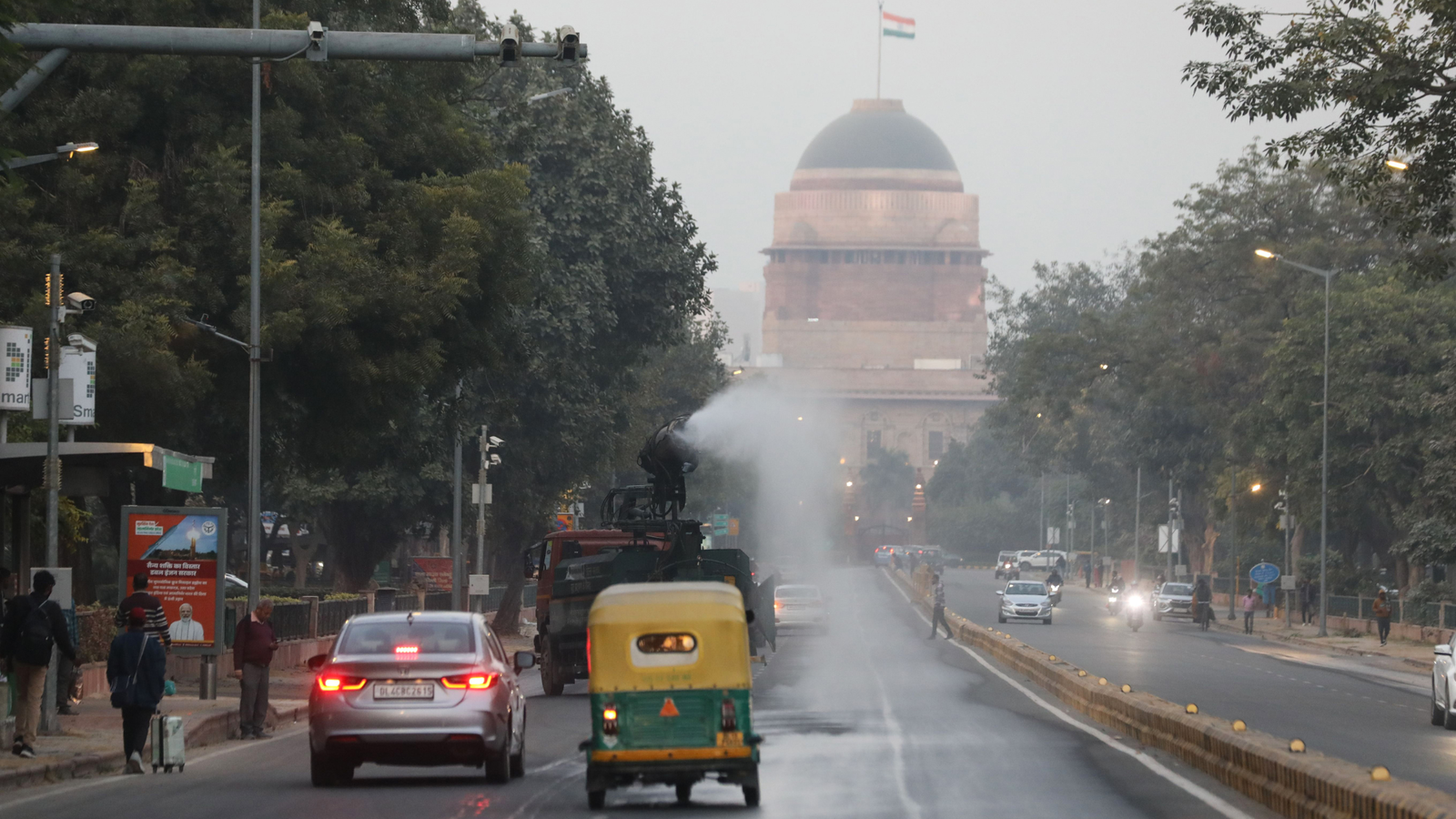
There was a slight improvement in the air quality of Delhi on Monday morning, but the levels of pollution were still in the ‘severe’ category. According to the data provided by the Central Pollution Control Board (CPCB), the Air Quality Index (AQI) was 418, which is a slight improvement from Sunday’s reading of 439. However, the levels of particulate matter were still much higher than the hazardous levels.
The AQI value ranging from 0 to 50 is labelled as ‘good,’ 51 to 100 as ‘satisfactory,’ 101 to 200 as ‘moderate,’ 201 to 300 as ‘poor,’ 301 to 400 as ‘very poor,’ and 401 to 500 as ‘severe’.
Fog worsens visibility, compounds pollution impact
A thin layer of fog covered major areas of the city early Monday, and this further worsened the effects of pollution on the lives of people. Commuters had to face tough conditions while travelling due to the combined effects of fog and smog. Weather forecasts indicated that there were chances of dense fog at isolated places during the morning hours.
Also Read | 5.7-magnitude earthquake rocks Leh-Ladakh, no causalities reported
The India Meteorological Department (IMD) issued a yellow alert for dense fog at most places in Delhi. The maximum and minimum temperatures would remain around 25 degrees Celsius and 7.7 degrees Celsius, respectively.
Poor dispersion conditions keep pollution trapped
Both the IMD and CPCB forecasts indicated that the air quality in the Delhi region is expected to continue in the ‘very poor’ category until January 21. The reasons attributed to the sustained air pollution include adverse meteorological factors, with a ventilation index of 6,000 units and average wind speeds of 10 kmph. These factors are not sufficient to disperse the air pollutants in the region.
Also Read | Operation Trasi: Indian Army launches counter-terror operation in Jammu and Kashmir following Kishtwar clash
Rain likely later this week as Western Disturbance approaches
There may be some relief in store as a Western Disturbance is expected to become active, followed by another system. The IMD has forecasted heavy snowfall in Jammu and Kashmir, Himachal Pradesh, Uttarakhand, Leh, and Ladakh from January 20. Rain is also expected in the plains, including Delhi, from January 23 to 25.
The Himalayas have received very little snow this year, with some regions in Himachal Pradesh and Uttarakhand still awaiting their first snowfall. Although the initial Western Disturbances that originated from the Mediterranean were weak and less frequent, the next ones are likely to be stronger and more frequent.