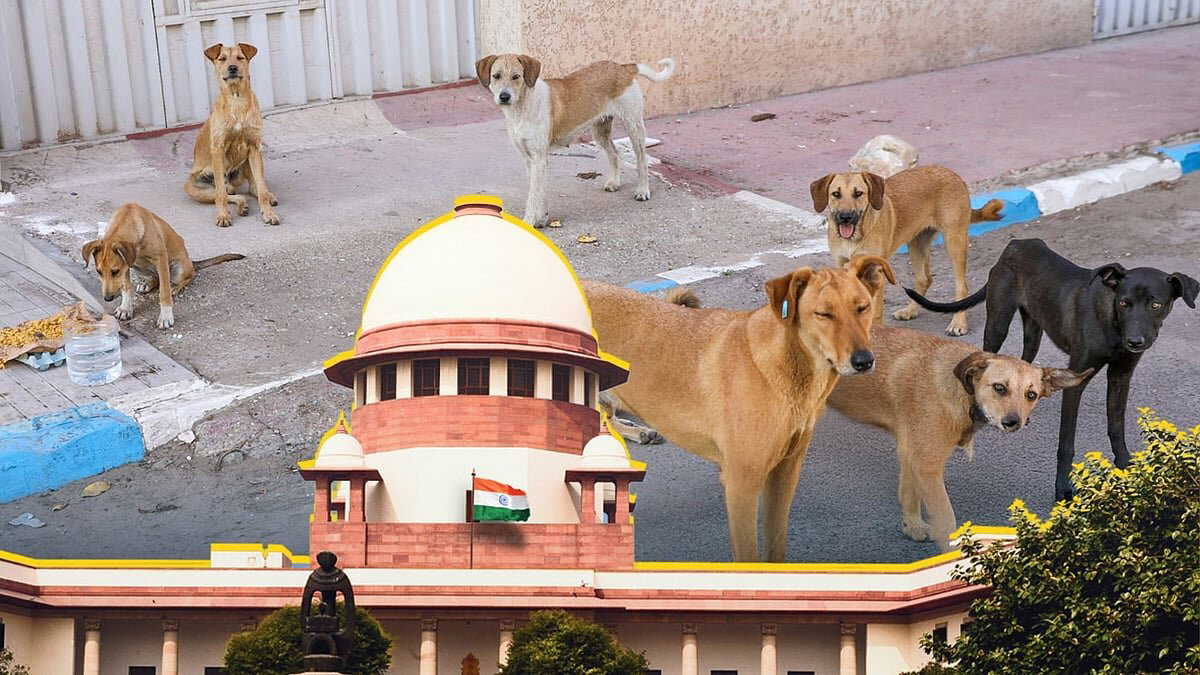
During the Supreme Court hearing on case related to stray dogs, the issue of other animals also came under discussion. The three-judge bench questioned why the debate was confined only to stray dogs, observing that the lives of other animals also merit consideration. The judges referred to animals such as chickens and goats, asking whether their lives held any less value.
The court also noted that it is not possible to determine how dangerous a dog may be based solely on its behaviour. The bench observed that no one can predict animal behaviour with certainty, including when a dog might bite, and emphasised that preventive measures are always preferable to remedial action.
Also Read | Supreme Court surprised at surge in applications against stray dog order
The hearing was conducted before a bench comprising Justice Vikram Nath, Justice Sandeep Mehta, and Justice N.V. Anjaria. Several issues concerning stray dogs were raised during the proceedings. At one point, a petitioner attempted to show a photograph depicting a pack of stray dogs attacking a 90-year-old man who later died, to illustrate the potential dangers of such incidents. The court, however, declined to view the image, stating that it was unnecessary.
Arguing on behalf of victims, it was submitted that people continue to suffer due to stray dog attacks and that the protection of human rights must remain paramount. Reference was also made to practices in countries such as Japan and the United States, where structured systems exist to shelter homeless dogs. It was pointed out that Japan has not recorded any rabies-related deaths since 1950.
Also Read | Judge can’t be presumed biased just because a petitioner’s relative is police or court staff: Supreme Court
Senior advocate Kapil Sibal, appearing for the petitioners, told the court that they had approached the matter as animal lovers and environmentalists. On the issue of animal safety more broadly, he spoke about concerns over the treatment of chickens in captivity and drew a parallel by saying that the actions of one animal cannot be used to justify harm to an entire species.
Sibal also referred to the Capture-Sterilise-Vaccinate-Release (CSVR) model, noting that it is followed internationally. During the hearing, another petitioner’s counsel informed the court that his client, a senior citizen, had suffered dog bites. He clarified that the petitioners were not opposed to dogs or dog lovers, but were seeking effective measures to control the stray dog population.