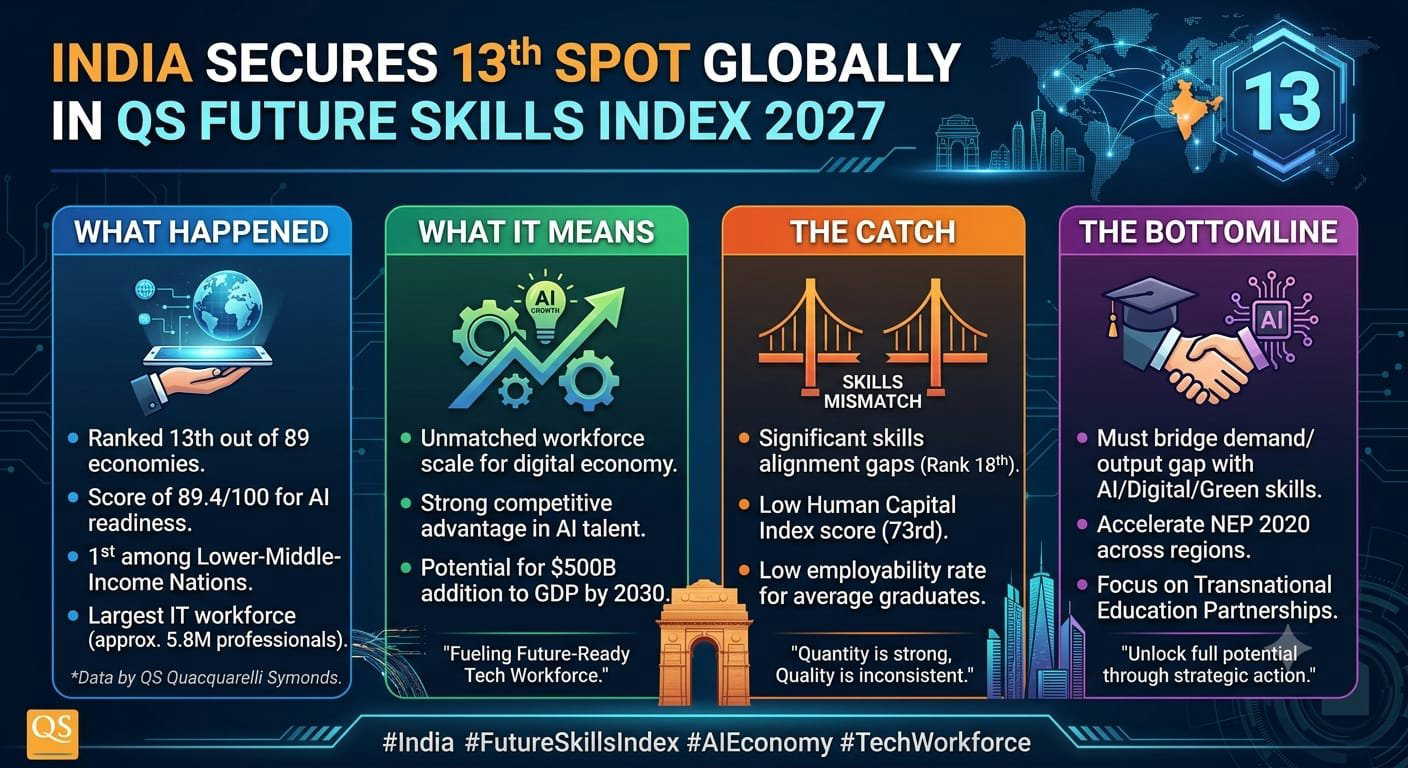
India’s ambition to become a global talent powerhouse has received another boost after the country secured the 13th position in the QS World Future Skills Index 2027. The ranking reflects India’s expanding focus on artificial intelligence, digital literacy and preparing its workforce for a rapidly evolving job market.
The report also placed India as the highest-performing lower-middle-income economy, signalling the country's growing ability to compete with advanced economies in developing future-ready talent. As industries worldwide undergo massive technological shifts, the ranking offers a glimpse into India's efforts to align education with the demands of tomorrow’s workplaces.
India’s AI and technology ecosystem is driving growth
Artificial intelligence, automation and data-driven technologies are reshaping industries globally. India’s improved standing in the index indicates that the country is actively investing in creating a workforce equipped for these changes.
Over the past few years, the government, universities and private companies have expanded programmes focused on AI, machine learning, cybersecurity, data science and digital innovation.
The ranking also reflects India's strong position as a global technology hub, supported by its thriving startup ecosystem and vast pool of engineering and IT professionals.
However, experts believe that maintaining this momentum will require sustained investments in research, innovation and high-quality technical education.
Also Read | Air India under scrutiny after flight briefly strays into Pakistan airspace near Amritsar
Stronger industry-academia partnerships remain essential
One of the key messages from the QS report is the growing need for educational institutions and industries to work closely together.
Traditional academic curricula are often slower to adapt to rapidly changing industry requirements. Closer partnerships can help ensure students graduate with practical skills that employers are actively seeking.
Internships, industry-led training programmes, research collaborations and specialised certification courses could become increasingly important in narrowing this gap.
Experts have repeatedly emphasised that future employability will depend not only on technical knowledge but also on adaptability, problem-solving and continuous learning.
Also Read | New FCRA rules restrict foreign nationals from key NGO roles
What this means for students and young professionals
The ranking presents a positive outlook for Indian students entering higher education and the workforce.
Opportunities are expected to grow significantly in fields such as artificial intelligence, robotics, cloud computing, data analytics, biotechnology and advanced manufacturing.
At the same time, the report serves as a reminder that learning will no longer end with a university degree. Professionals will need to consistently upgrade their skills throughout their careers to remain competitive.
As global economies continue to transform, India’s performance in the QS World Future Skills Index 2027 suggests the country is steadily positioning itself as a major supplier of future-ready talent on the world stage.