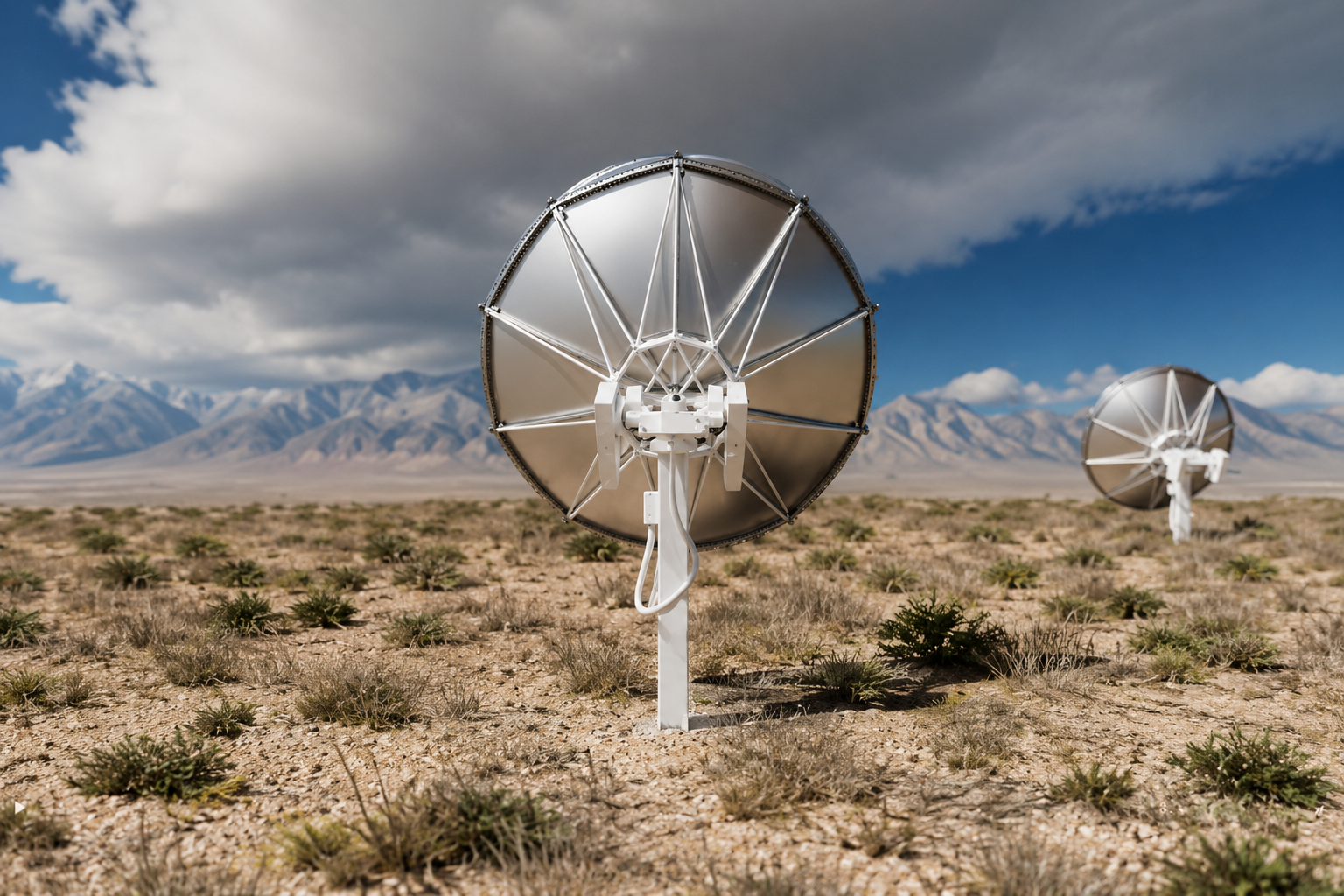
Caltech researchers are preparing to move ahead with the Deep Synoptic Array (DSA), a radio telescope project planned for a remote valley in Nevada, after it completed its final design review with Schmidt Sciences, which is funding the build.
Per Caltech, the array will comprise 1,650 radio dishes, each just over 6 meters across, spread over an area of about 20 by 16 kilometers. The institute said construction is now expected to begin, with the telescope slated for completion by 2029 and science operations to follow soon after.
Also Read | China may launch Mythos-class AI model before 2027, says Zai founder
Caltech Readies to Build World's Most Sensitive Radio Telescope.
— Caltech (@Caltech) June 11, 2026
Schmidt Sciences has greenlit the construction of the @deepsynoptic, a game changer for radio astronomy. https://t.co/iZ4hFZjf8b pic.twitter.com/p0cVaHrhOa
DSA's unprecedented scale and sensitivity
The project is being presented by Caltech as a major leap in radio astronomy because it aims to combine high sensitivity with the ability to make sharp images.
The DSA will be “the most sensitive radio telescope ever built” and will survey the sky “100 times faster than any other radio telescope worldwide.”
Gregg Hallinan, the project’s principal investigator and a Caltech astronomy professor, said the DSA will survey the visible sky several times in its first five years. He added that while radio telescopes together have found about 20 million radio sources so far, the DSA is expected to match that figure on its first day of operations and eventually identify about 1 billion new radio sources.
Worlds most sensitive radio telescope array set to be built in Nevada deserthttps://t.co/Ncl0a3Jg4y "Funding for the project came from Schmidt Sciences, a philanthropic organization created in 2024 by Eric Schmidt, the former CEO of Google, and his wife, Wendy. Schmidt last
— NASA Watch (@NASAWatch) June 21, 2026
Science goals and the world's first 'radio camera'
The telescope is designed to look for a wide range of cosmic phenomena, including emissions from stars and galaxies, black holes, pulsars, and fast radio bursts.
It will also probe dark matter, gravity, and the expansion of the universe. Vikram Ravi, the project’s co-principal investigator, said, “Radio astronomy is about to go from sketch to photograph,” describing the DSA as looking at a much larger volume of the universe much more often than current instruments.
The array will also be able to generate images in real time, which is the basis for the world’s first “radio camera.” Those images will be available immediately to the global astronomical community without a proprietary period.
Data challenges and computing power
The real-time imaging system is central to making the project feasible, since 1,650 dishes will generate a volume of raw data too large to store conventionally.
Hallinan said, “Without the radio camera, we would have to store 100 exabytes of data,” adding that this would require “5 million hard drives” in a facility “the size of multiple football fields.”
The data will instead be processed by an off-site supercomputer using Nvidia-built GPUs, with annual archiving reduced to tens of petabytes. The Deep Synoptic Array is part of the Eric and Wendy Schmidt Observatory System; it is being led by the institute with funding from Schmidt Sciences.
Also Read | Colombia presidential runoff: Cepeda, de la Espriella battle over Petro's legacy
FAQs
Q1: What is the Deep Synoptic Array radio telescope?
Ans: The Deep Synoptic Array is a planned 1,650-dish radio telescope in Nevada designed to become the world's most sensitive radio observatory.
Q2: When will the Deep Synoptic Array begin operations?
Ans: According to Caltech, the telescope is expected to be completed by 2029, with scientific observations starting shortly afterward.