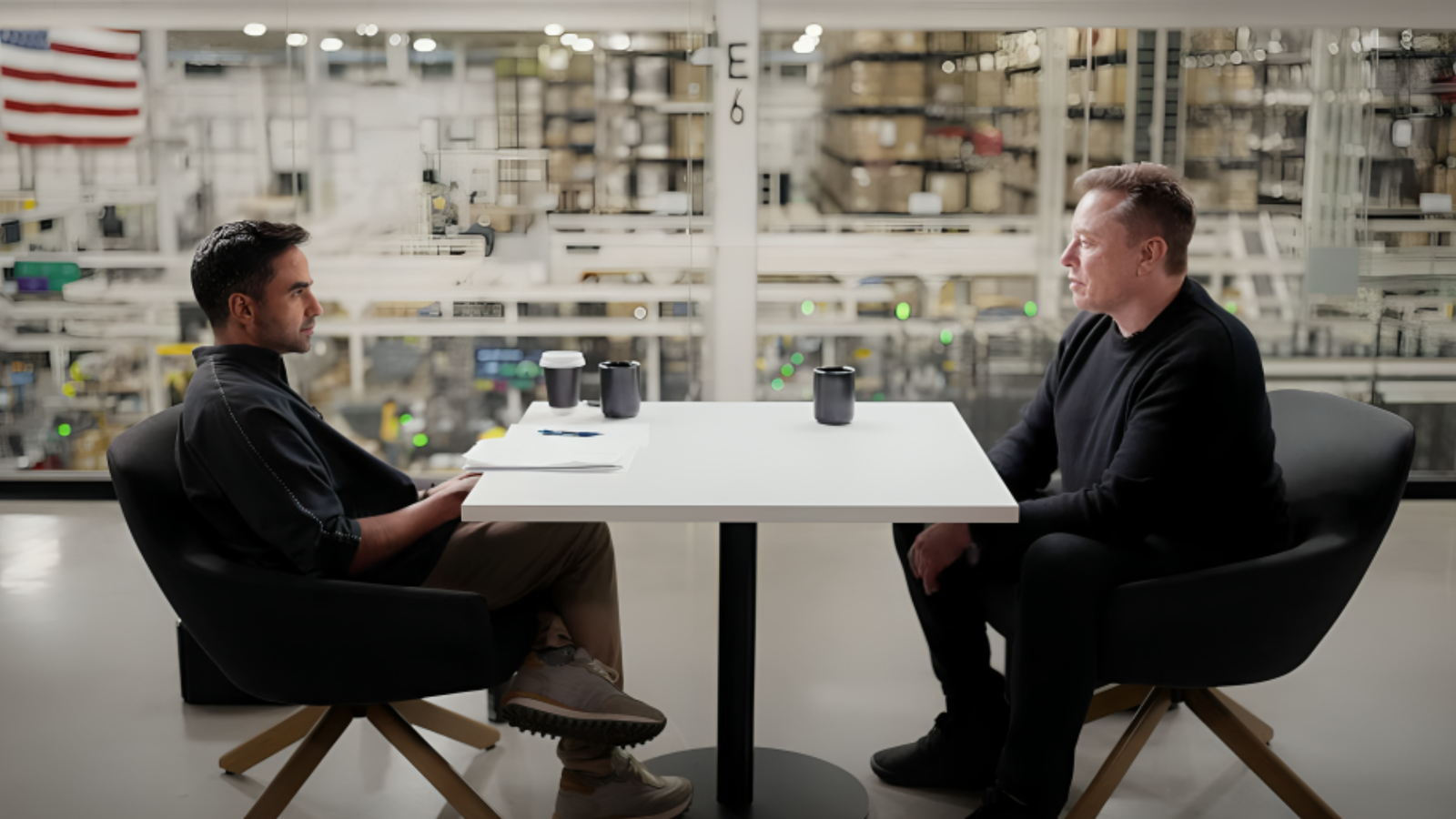
Tesla and SpaceX chief Elon Musk have raised his concerns once more over the rampant growth of artificial intelligence, cautioning that unless the technology is developed responsibly, it could end up causing harm. Speaking on a podcast hosted by Zerodha co-founder Nikhil Kamath, Musk said AI must be guided by three foundational principles-truth, beauty, and curiosity that it contribute to positive human civilisation.
Also Read | 'Why do you like the letter X as much as you do?', Elon Musk answers on Nikhil Kamath's podcast
‘Truth is essential for stable reasoning'
Musk emphasised that AI systems should be designed in a way to uphold and pursue the truth. He believed that compelling an AI to work on premises other than the truth would adulterate its reasoning and come up with harmful results. " You can make an AI go insane if you force it to believe things that aren’t true because it will lead to conclusions that are also bad," he said.
He warned of misinformation getting internalised in powerful systems, which could destabilise their decision-making processes.
Teaching AI to recognise ‘beauty’
The second ingredient Musk highlighted is the beauty universal human instinct, he said. He argued that AI should learn to appreciate what humans perceive as beautiful, whether in nature, art, or even everyday life. This, he suggested, can help align AI's values with those of its creators and foster more constructive behaviour.
Curiosity and humanity's continuation
Curiosity is the third key principle, Musk said. AI should be driven to understand the world, and to appreciate the value of humanity's continued existence. " It’s more interesting to see the continuation if not the prosperity of humanity than to exterminate humanity," he said, naming curiosity as a safeguard against destructive tendencies.
Growing debate on AI safety
Musk founded OpenAI in 2015 but stepped down from its board in 2018. He later formed his AI company, xAI, and introduced its chatbot Grok in 2023. His warnings come with echoes from other experts, too. Geoffrey Hinton, famously known as the "Godfather of AI," said there is a possibility of about 10 to 20 per cent that advanced AI could pose an existential threat, mentioning hallucinations and large-scale automation. Hinton said, “The hope is that if enough smart people do enough research with enough resources, we’ll figure out a way to build them so they’ll never want to harm us.”