
















“But he isn’t wearing anything at all.”
Few stories have captured the dangers of absolute power and unquestioning praise as memorably as Hans Christian Andersen’s The Emperor’s New Clothes. For generations, it has served as a reminder that when rulers surround themselves with flatterers instead of truth-tellers, reality eventually catches up with them.
The story came to mind as I watched Mamata Banerjee address this year’s July 21 rally at Cathedral Road near Kolkata’s Birla Planetarium.
The same day, a year apart, told two very different stories.
July 21 has long been more than a date on Bengal’s political calendar. It has been central to Mamata Banerjee’s political journey, and, in many ways, to the state’s contemporary political narrative. A year ago, the stage near Victoria House was filled with celebrities, public figures and loyalists. What began as a remembrance of martyrs had, over time, gradually transformed into a spectacle of adulation for the then Chief Minister. In many ways, it reflected the political culture that had taken root after the Trinamool Congress came to power in 2011.
This year, though, the atmosphere told a very different story. Standing on the stage at Cathedral Road, Mamata Banerjee appeared unusually isolated. The irony is difficult to miss. The very authority that once appeared unshakeable gradually insulated itself from contradiction. At the height of her influence, power seemed unquestioned, and with it came the belief that the party, the administration, the police and, at times, even sections of the media would ultimately move at her command. It was this growing distance from dissent that gradually became a distance from reality itself. Recent events suggest that acknowledging that reality remains far from easy. Which is also why this year’s July 21 gathering deserves closer attention.
Also Read | THE PARTY THAT MISTOOK POWER FOR IDEOLOGY
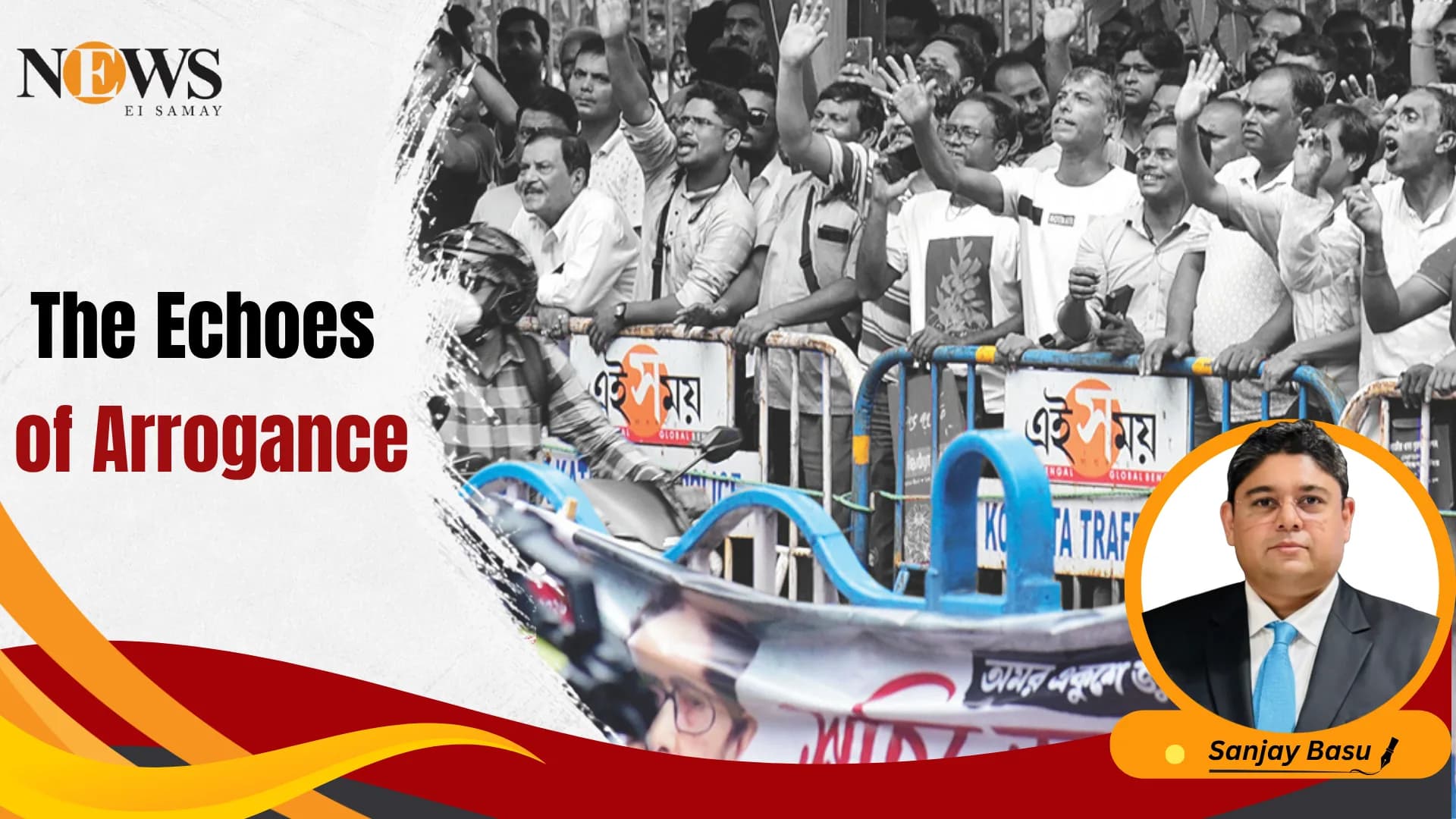
As few thousands gathered along Cathedral Road, the police barricades erected to manage the crowds prominently carried the logo of Ei Samay, the very newspaper, that had once become inconvenient for the then Chief Minister simply because it chose facts over favour.
Whether it was the horrific rape and murder at RG Kar Medical College and Hospital, the police action against protesting teachers who had lost their jobs, the education scam cases before the Calcutta High Court and the Supreme Court, the controversy surrounding the Special Intensive Revision (SIR), pending Dearness Allowance litigation involving state government employees, the OBC reservation dispute, the I-PAC controversy or the transfers of senior IAS and IPS officers, Ei Samay consistently followed a single editorial principle.
We reported developments with honesty, fairness and objectivity. Never with political hostility, never with preconceived prejudice.
Yet, surrounded by an ever-shrinking circle of unquestioning loyalists, the then Chief Minister appeared to believe that her judgement alone defined the truth. Perhaps that is why Ei Samay’s editorial voice became increasingly uncomfortable for her.
The expectation was that the newspaper’s editorial judgement would be shaped not in its newsroom, but from the fourteenth floor of Nabanna or from Kalighat. Not just what was published, but who edited the paper and who joined its newsroom were expected to align with political preferences. Like so many institutions, Ei Samay was expected to fall in line.
She misread us.
Ei Samay never compromised its editorial independence because we have always believed that a newspaper’s first duty is to its readers. It exists not to settle political scores or serve those in power, but to question authority, examine governments with honesty, and reflect the hopes, anxieties and lived realities of the people it serves.
That was our responsibility then. It remains our responsibility today.
When it became clear that Ei Samay would not conform, the consequences followed. Government advertising was withdrawn. Private advertisers were quietly discouraged from associating with the newspaper. Even the Ei Samay branding on Kolkata Traffic Police barricades, ironically visible once again today, was removed overnight following official directions.
None of it weakened our resolve. If anything, the greater the pressure, the stronger our commitment became. We adapted, evolved and endured, without compromising the principles that define independent journalism.
Political power changed hands. Our editorial values did not.
There was a time when Mamata Banerjee stood at the unquestioned height of political authority.
Today, she stands far more isolated than she perhaps imagined possible.
Even on May 4, when the Assembly election results were declared, the Trinamool Congress still commanded formidable numbers: 80 MLAs, 41 Members of Parliament across both Houses, and overwhelming control over municipalities and panchayats.
Yet, within weeks, what had seemed politically unassailable began to unravel. To many, the change appeared sudden To others, including myself, it had long seemed only a matter of time.
One of the defining reasons was the steady centralisation of authority, and her determined attempt to hand over the party’s future to Abhishek Banerjee while gradually diminishing the role of several senior leaders who had spent decades building the organisation.
Questions about Abhishek Banerjee’s political style and leadership were not born yesterday. Many of those concerns were voiced years ago by senior Trinamool leaders who had been part of the party since its inception. Today, those conversations have simply moved into the public domain.
There is little to suggest that either Mamata Banerjee or Abhishek Banerjee has truly reckoned with that reality.
The assumption that pressure could bend an independent newspaper was misplaced. The assumption that political legitimacy could be inherited rather than earned appears to have been equally so.
In the end, it is the electorate, not power, that has the final word.
Many MPs, MLAs and senior Trinamool leaders who have now openly challenged what they describe as the “Aunt-Nephew” culture within the party may well have remained silent had the electoral verdict been different.
Also Read | Illegal infiltration and border security: Why India’s Three-D policy is in focus
But politics rarely rewards silence forever. Resentments that accumulate in the shadows eventually step into the light
Can Mamata Banerjee and Abhishek Banerjee still not read the writing on the wall? Rather than reflecting on the reasons behind the defeat, several long-serving leaders who have spoken candidly about the party’s failures now find themselves labelled as traitors or conspirators.
Where does this confidence still come from?
Why continue pointing fingers from a political stage that has itself been fundamentally diminished?
Why not confront uncomfortable truths with humility instead of dismissing every criticism?
Surely this election was not merely about a change of government. It was also a rejection of politics driven by entitlement, personality cults and unchecked arrogance.
Does the leadership still fail to recognise that ignoring grassroots workers, attempting to silence independent journalism and refusing to listen to public sentiment has ultimately produced this outcome? It is remarkably similar to the mistake made by the Left Front after its overwhelming victory in 2006, when electoral dominance concealed the organisational decay already setting in beneath the surface.
The warning signs existed then.
They existed this time too.
Ei Samay tried to capture that public mood.
Like any responsible newspaper, we held up a mirror to society, not to wound egos, but to reflect reality. Perhaps that reflection was mistaken for hostility.
Watching this year’s July 21 rally reinforced one simple truth.
Power is temporary. Reputation is tested. History is unforgiving.
Every government, every political leader and every institution must ultimately stand the test of time. For years, Ei Samay has sought to perform precisely that role. Not as an adversary of governments, but as a faithful reflection of public opinion and democratic accountability.
Some chose to look away from that reflection.
But truth has a habit of outlasting power.
The hardest task in public life is not discovering the truth.
It is having the humility to accept it.
