




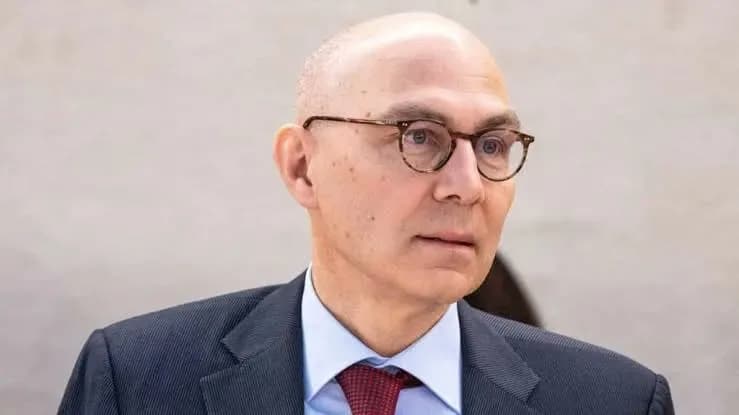







The United Nations General Assembly on Friday approved Secretary-General Antonio Guterres’ proposal to extend Volker Turk’s mandate as UN high commissioner for human rights for another four years, handing the Austrian lawyer an unprecedented second full term despite loud objections from the United States, Israel and Russia.
Member states voted 144 in favour, 10 against and 13 abstained, after earlier rejecting a US request to delay the vote and a Russian proposal that would have shortened the extension to the end of 2026.
The post, created in 1993, has never before been held for two complete four-year terms by the same person.
Also Read | ‘The future is bright’: Dinesh Karthik on the resignation of Dharmendra Pradhan
UN General Assembly votes to renew Volker Turk's 4-year term as UN high commissioner of human rights from Oct. 12, 2026 to Oct. 11, 2030, resoundingly rejecting objections by US & Russia pic.twitter.com/AoXH5qnpqB
— PassBlue (@pass_blue) July 24, 2026
Volker Turk’s record and global rights role
Turk, who has led the UN human rights office since 2022, has built a reputation as one of the organisation’s most outspoken senior officials.
He joined the United Nations in 1999 and worked in the refugee agency in postings including Malaysia, Kosovo, Bosnia and Herzegovina and the Democratic Republic of the Congo, before later taking senior roles at UN headquarters in New York under Guterres.
In the rights chief role, he has been sharply critical of Israel’s conduct in Gaza and Russia’s war in Ukraine, while also speaking on rights abuses and conflicts in Afghanistan, Sudan, Bangladesh, Myanmar and Nicaragua.
That record, while praised by rights advocates, has also made him a target for governments angered by his public criticism.
.@AmbUNReform: The UN human rights system has been losing credibility for decades.
— U.S. Mission to the UN (@USUN) July 24, 2026
Volker Türk led it to its deathbed.
Today’s vote kicked the bucket. pic.twitter.com/9yBB516mAp
Opposition from the US, Israel and Russia
The vote exposed a direct clash between Turk’s defenders and some of the UN’s most powerful critics.
Before the ballot, US deputy ambassador Jeff Bartos warned that reappointing Turk would prove the assembly “is dysfunctional” and said the United States would “immediately reassess our engagement, participation and funding.”
The US State Department separately described the move as a “process foul” and accused the UN of rushing the decision.
Israel’s foreign ministry called Guterres’ push for a second term a “moral failure,” while Russia’s deputy ambassador accused Turk of bias and said he had levelled unfounded allegations against Moscow.
Guterres, however, was backed by the European Union, many African and Latin American states, and China.
UN spokesman Stephane Dujarric said the secretary-general had acted “in a very transparent manner,” including through consultations with member states and regional groups.
Deeply grateful for the opportunity to continue serving as High Commissioner. Human rights are the antidote to today's turbulence and defeatism. I will give my all for the rights of everyone, everywhere. pic.twitter.com/d9DN9zjZcu
— Volker Türk (@volker_turk) July 24, 2026
What the second term means
The decision settles, at least for now, a procedural battle over who should guide the UN’s top human rights office as global disputes over war, repression and accountability intensify.
Turk’s first term expires in October, and the new mandate will keep him in the role through another four-year cycle, giving him the chance to become the first rights chief to complete two full terms in office.
The dispute also underscored a wider rift inside the UN over how far senior officials should go in publicly challenging major powers, and how much room there should be for political pushback when those criticisms land.
Also Read | Pralhad Joshi once chose a state board school for his daughter. Now he heads Education
FAQs
Q1: Who is Volker Turk?
Volker Turk is the United Nations High Commissioner for Human Rights, serving as the UN’s top human rights official since 2022.
Q2: Why is Volker Turk’s second term significant?
His reappointment makes him the first UN human rights chief to secure two full four-year terms since the position was created in 1993.
