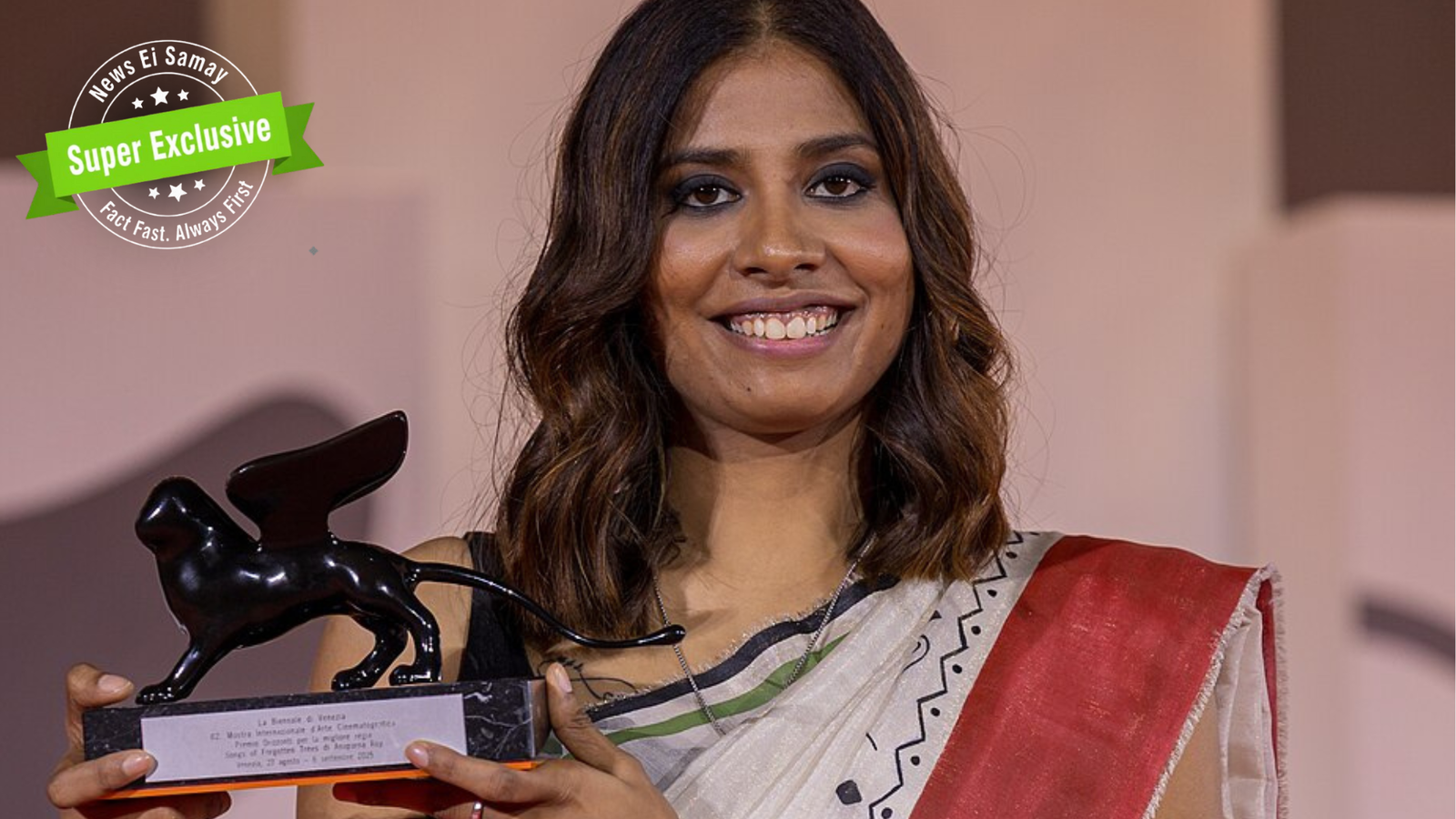
For filmmaker Anuparna Roy, cinema has never been a tool of approval, whether it be political or otherwise. It has been shaped by experience, observation, and memory, not ideology or patronage. During an exclusive interview with News Ei Samay, Anuparna said that she had already decided who her films were meant for, long before international recognition arrived.
“First of all, I don’t make films for the government,” she says. “I make films for feelings, emotion, human.”
The statement is not a reaction to awards or global attention. Roy insists that this idea existed well before she became the first Indian to win Best Director in the Orizzonti section at the Venice Film Festival. For her, cinema has always been personal, rooted in lived realities rather than external expectations.
Experience before cinema
Roy’s early career in the IT sector continues to influence how she builds characters and narratives. She does not see filmmaking as an abstract exercise, but as something deeply tied to personal experience.
“Whatever in the film, it’s all experienced,” she explains. “I’ve been seeing people like these characters who are already there in the film. I have felt something similar like these characters felt.”
Also Read | 'When I met Ahaan for the first time..’, Aneet Padda opens up amid dating rumors with Ahaan Panday
One of the women in 'Songs of the Forgotten Trees' is in IT, a profession Roy herself once worked in, and that’s why she resonates with the characters because not only has she seen such characters but also has felt similar to them.
Roy often compares filmmaking to writing, something that demands emotional proximity rather than distance.
A story born at home
At the heart of Songs of the Forgotten Trees lies a deeply personal source: Roy’s maternal grandmother. The film’s emotional core emerged from a relationship Roy witnessed closely between her grandmother and her stepdaughter.
“My inspiration came from my own grandmother,” Roy says. “She and her stepdaughter raised the whole family all alone after my grandfather died.”
Both women had married young and were close in age. Their bond, as Roy felt, held the possibility of another story, one shaped by survival rather than convention.
“I sort of over-imagined them,” she says. “I felt that it could be a relationship between two women raising a whole family without any males.”
That idea became the foundation for the film’s migrant protagonists, the women navigating displacement in a city that never fully accepts them.
“So you can say the inspiration is literally coming from her life, my grandmother’s life,” Roy says.
Feminism that arrived unannounced
Roy describes feminism not as a theory she adopted, but as something that entered her life through everyday experience, often through the systems themselves.
“Feminism came to me very organically,” she says, before adding, “or rather I’ll say it was imposed organically.”
She recalls being made to sit separately from boys in school, being weighed to determine food rations, and later watching a Dalit friend being pushed into early marriage because of government incentives.
“I cracked the whole patriarchy which is coming from the administration straight—and the administration is all run by men.” That awareness, she says, revealed how deeply power is embedded in daily life. She continues by saying that the fight is not that simple, and it is deep-rooted.
Independence as a choice
Roy has never worked as an assistant director, nor has she pursued commercial writing jobs. That decision, she says, was deliberate and possible because of her financial independence.
Her years in IT gave her the freedom to work on her own terms.
“I was privileged doing an IT job, getting my own money,” Roy says. “If I don’t get a producer. It’s okay. I’ll do it again—two, three jobs—to make another film.” That independence, she believes, protected her cinema from pressure.
Also Read | 'Aandhi banke aaya hu': Is Kolkata boy Sayantan Guha the new Dhurandhar of Indian music?
Responsibility without allegiance
Winning at Venice has expanded her visibility, but Roy insists it has not altered her direction.
She believes that making a film is definitely a lot of responsibility, but that responsibility does not extend to serving power. Her focus remains unchanged as she wants to show the lives of migrants, suppressed people, and women who exist on the margins, and this clarity, Roy believes, existed long before awards or international stages.
“I always thought I knew what kind of cinema I wanted to make,” she says. “Venice didn’t create that. It was always there.”
For Anuparna Roy, cinema is not an instrument of policy or power. It is a way of staying truthful—to memory, to experience, and to people whose lives rarely get any attention, but deserve it all the same.