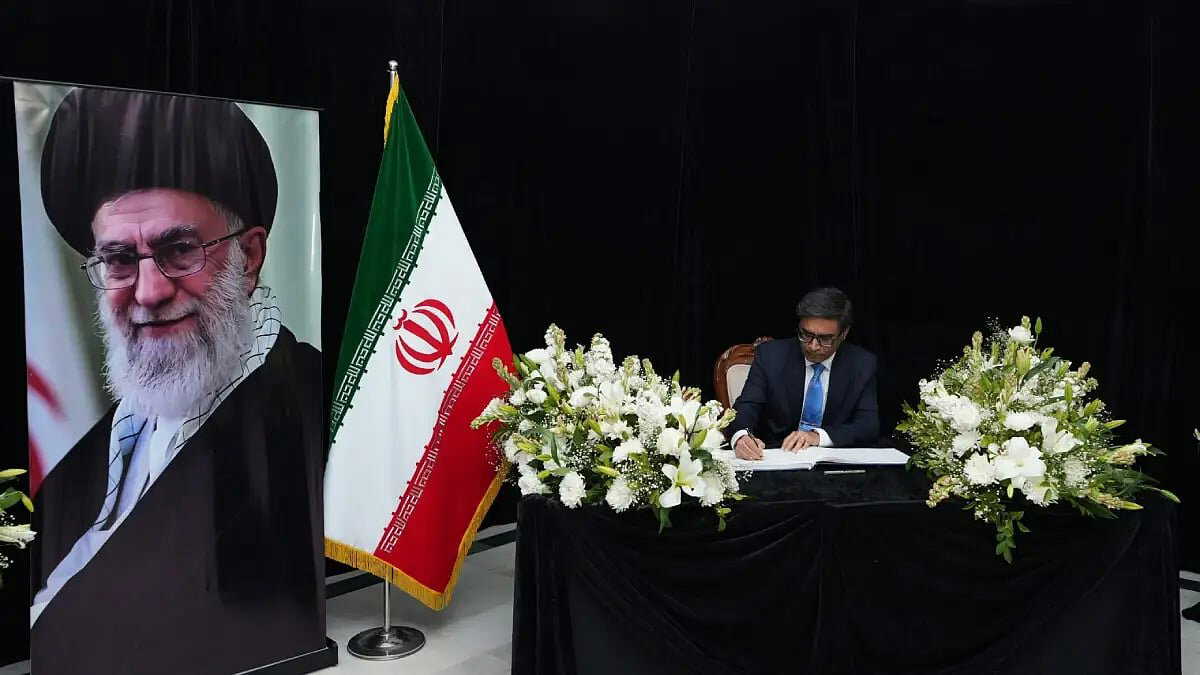
India on Thursday formally expressed condolences over the death of Iran’s Supreme Leader Ayatollah Ali Khamenei, six days after he was killed in attacks carried out by the United States and Israel. The message was conveyed by India's Foreign Secretary Vikram Misri, who visited the Iranian Embassy in New Delhi and signed the condolence book kept there.
According to diplomatic sources, Misri signed the special condolence register placed at the embassy and conveyed the Indian government's sympathies to the people of Iran. He also delivered a message expressing solidarity with the Iranian people during the current crisis in West Asia.
Khamenei was killed last Saturday during coordinated attacks by the United States and Israel on Iranian targets. Since then, the conflict in West Asia has intensified. India had initially remained silent on the issue, drawing criticism from several opposition parties.
Visit to Iranian Embassy
During his visit to the Iranian Embassy in New Delhi, Misri met senior diplomatic officials and formally recorded India's condolences. The Foreign Secretary signed the condolence book on behalf of the Government of India.
Officials said the visit was intended to convey India's respect for Iran's leadership and its concern about recent developments in the region. Diplomatic observers are seeing the move as a calculated step by New Delhi to maintain balance amid the ongoing tensions in West Asia.
Also Read | Census 2027: Amit Shah unveils digital tools, mascots Pragati and Vikas ahead of April 1
Meeting with Iranian Ambassador
Apart from signing the condolence book, Misri also held a courtesy meeting with Iran's Ambassador to India. During the meeting, he formally handed over India's condolence message to the Iranian side.
Diplomatic circles say the interaction was meant to underline India's interest in maintaining stable bilateral relations with Iran despite the tense geopolitical environment.
India and Iran share long-standing strategic and economic ties. The two countries cooperate in energy trade and regional connectivity projects, including the development of the Chabahar Port.
Also Read | ‘He hasn’t taken a day off in 25 years’: Canada PM Mark Carney praises Modi’s work ethic
Khamenei had previously made critical remarks regarding issues such as Kashmir and incidents of violence in Delhi. However, several key bilateral agreements between India and Iran, including cooperation on Chabahar, were concluded during his tenure as Iran's supreme leader. He was also regarded as the highest religious authority in Shia Islam.
Meanwhile, the Congress and several opposition parties have criticised the Indian government for not expressing condolences earlier. They argued that the death of a leader of Khamenei's stature should have been acknowledged sooner and that the attacks on Iran should have been condemned.
Diplomatic experts believe India's eventual expression of condolences may help maintain stability in India-Iran relations during a period of heightened tensions in West Asia.