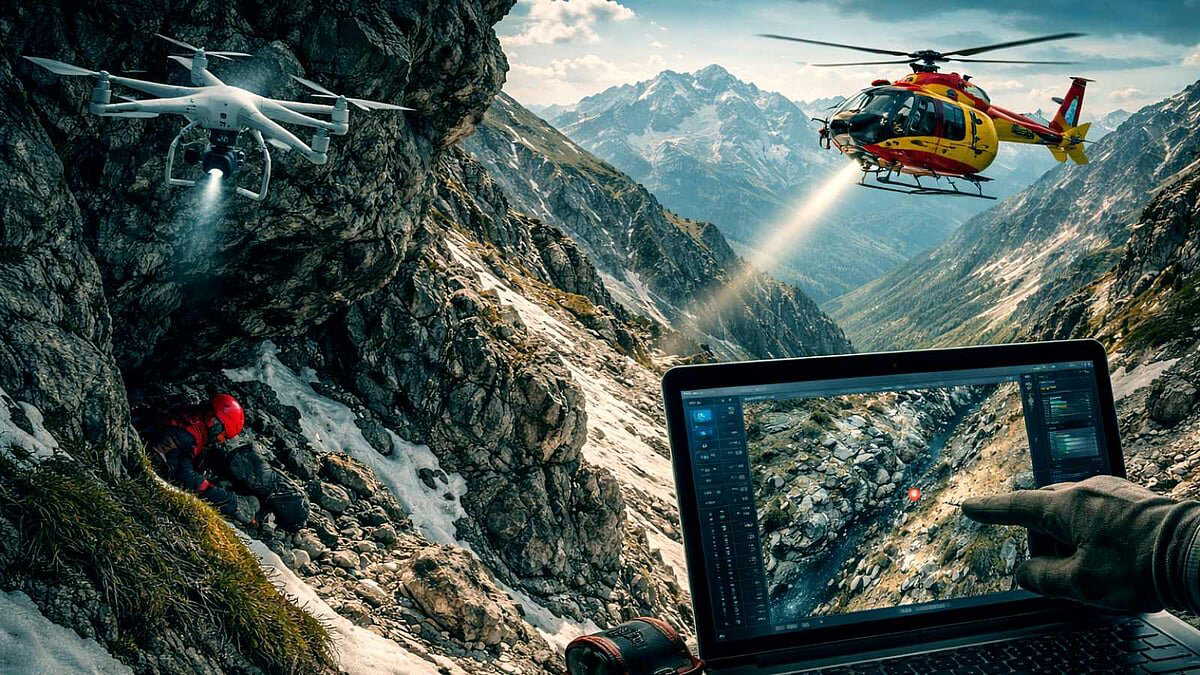
September 2024. The Piedmont region of Italy. While autumn sunlight bathed the sky-touching Alps, a deathly cold silence had settled in the deep ravines below. The silence was shattered by the whirring rotor blades of helicopters. And the vigilant eyes of a dozen rescuers were meticulously searching for 66-year-old Dr Nicola Ivaldo.
Dr Nicola Ivaldo, an orthopaedic surgeon by profession but an experienced mountaineer. He often climbed mountains. But that Monday, he didn't come to his hospital duty. Alarm bells rang. But where to search? Mountains are not some small park!
Also Read | What is Angelic Intelligence? 5 key points about this brewing term we bet you didn't know
Solving this mystery of disappearance was beyond human capability. The truth had been buried under nature. But almost ten months later, this mystery was unravelled by such a 'detective', who has no flesh and blood body, whose eyes know no fatigue. Among millions of pixels scattered across the mountainside, who else but a machine could notice that a single 'red dot' could be the last trace of a human being!
Mysterious disappearance and initial search
On his day off, Dr Ivaldo had gone to the mountains. He hadn't told anyone exactly which path he was taking. His last trace was only his car. Rescuers had found it at the edge of the Castello di Pontechianale village. From there, two giant peaks beckoned— Monviso and its neighbour Visolotto.
The last mobile phone signal also pointed toward this remote area. But the problem was this area's vast expanse. Hundreds of miles of steep rocky walls, countless hiking trail marks, and innumerable deep ravines. In this vastness, a human being was more insignificant than a needle in a haystack.
The spokesperson of Piedmont's Mountain Rescue Service, Simone Bobio, had observed, the weather was quite good on the day Ivaldo disappeared. Popular routes were crowded. But no other mountaineer had seen Ivaldo. Simone Bobio understood that Ivaldo had ventured onto such a remote path, where human feet rarely tread.
After this, fifty rescuers combed through the entire mountain for a week. Helicopters circled the sky countless times. But snowfall had begun by early October. Everything was covered with a white blanket. Hope of finding Ivaldo alive had died then. The operation was declared 'cancelled'.
AI in action and the red helmet
The year rolled to July 2025. Snow had begun melting from the steep ravines of the mountain. Ivaldo's family was still waiting— if only the body could be found! The Piedmont rescue team got to work. But this time, not humans. This time, their reliance was on Artificial Intelligence or AI.
Human eyes get tired after hours of looking at white snow and grey rocks. Attention wanders. Mistakes happen. But AI doesn't have those problems. Rescuers brought advanced drones. These drones are not ordinary toy drones. They can fly right along the mountainside.
Two drone pilots were sent up high by helicopter. Their job was to scan a remote 183-hectare area. The drones flew for hours. More than 2,600 high-resolution images were captured by cameras.
If humans had to analyse so many images, it would have taken weeks. But AI-powered software took only a few hours.
Since 2023, drone pilot Saverio Isola had been working with new AI technology-based software. He was leading this second phase of searching for Ivaldo. Isola reported, this software can detect even the slightest inconsistency in any landscape's colour or texture.
This software ultimately hit the jackpot. While analysing pixel by pixel thousands of grey rock images, the software suddenly noticed a reddish glow. A human might have thought it was merely a variation in rock colour or play of light. But fooling AI algorithms is not easy. It identified this as an 'anomaly'.
It would be wrong to say the software did everything. Actually, besides that red glow or dot, it had identified several other things as 'anomalies'. At this stage, machine intelligence combined with human experience. Verifying the software's data, rescuers selected three locations. Analysis of two of these revealed a plastic bottle, the other a colored rock.
Also Read | Apple turns to Google’s Gemini as it races to fix Siri and AI delays
However, what that red dot or reddish glow was, it couldn't be understood from home. It was in a shadowed part of the mountainside. Nearly impossible to see with the naked eye. But it didn't escape the machine's eye. The next morning, a drone was sent to that specific GPS location. The zoom lens focused on the reddish glow. After breathless waiting, what appeared on the monitor screen was not a rock; it was a helmet. A red helmet.
And right beside it, partially buried under snow, lay a human body in black clothing. Dr Nicola Ivaldo. The location was at 3,150 meters, in a deep ravine on Monviso's northern edge.
Simone Bobio said that the red helmet was the key. Even though it was lying in shadow, the software correctly identified and distinguished the red colour. Without that red dot, they might have never found him.
The role of AI in future rescues
If AI had been used from the beginning, Ivaldo might have been rescued alive. However, while unable to save Ivaldo, AI did rescue a 65-year-old elderly man with Alzheimer's in Poland. He had gone missing in the Beskid Niski mountains.
This was a 2021 incident. There was very little time. In this situation, a Polish software called 'SARUAV' analysed 782 aerial images in just four hours and found the person alive. Therefore, demands are rising to use AI technology more extensively in rescuing people lost in mountains like Ivaldo in the future.
However, the story isn't so smooth. Experts from Croatia's Mountain Rescue Team report, AI still struggles in dense forests or complex rocky areas. Algorithms get confused in the maze of tree leaves and rocks' irregular patterns.
Researchers at the University of Glasgow have advanced one step further. They are creating 'virtual agents'. That is, if someone goes missing, which path they might take, what their psychology might be— creating simulations of this, computers will show the missing person's probable location on maps.
Also Read | Here's how Meta plans to use nuclear energy to power its future AI centres
However, Italy's geo-hazard expert Daniel Jordan has raised concerns about ethical aspects. He has questioned whether taking people's photographs from above the mountains violates personal privacy. His team is now creating technology that gives drones processing capability, meaning image analysis capacity. While flying, drones will send signals to ground stations about finding the desired person. This way, time won't be wasted taking pictures and bringing them to labs for analysis.
Finding a red helmet among millions of grey rocks on mountains was once a miraculous imagination. Today it is science. The message from Dr Ivaldo's body recovery is clear. What human eyes cannot see, machine eyes now see. While rescuing Dr Ivaldo alive wasn't possible, this incident has proven, where human capability is limited in difficult circumstances new possibilities can begin from there with technology's help. This is the future.