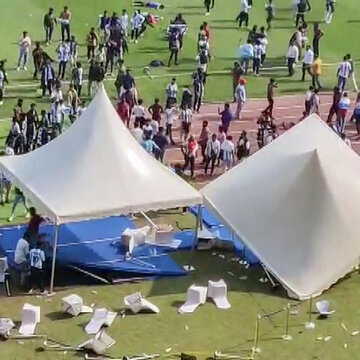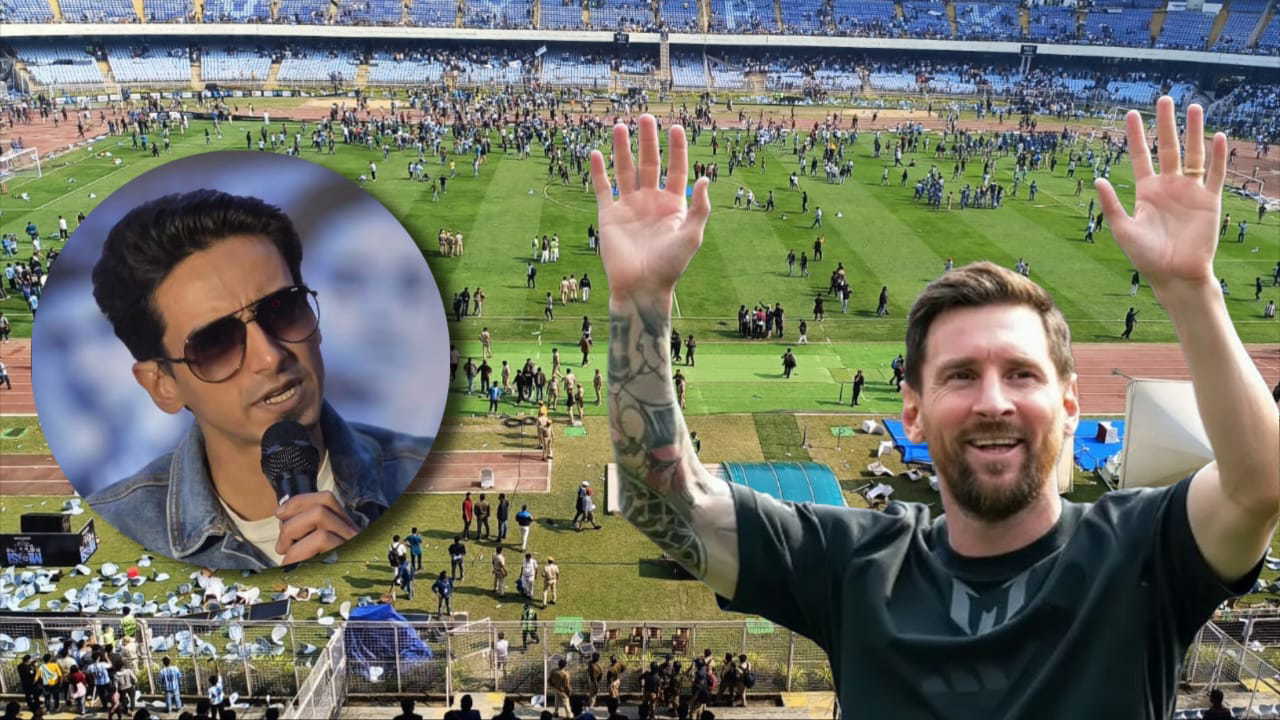
Lionel Messi’s much-anticipated visit to India as part of the G.O.A.T. India Tour took an unexpected turn on Saturday when his appearance at Kolkata’s Salt Lake Stadium ended in less than 20 minutes, triggering crowd unrest, chaos, and instances of vandalism at the venue.
Popular face of Kolkata, actor Anindya Sengupta, the host of the Kolkata leg of Messi’s GOAT Tour in India, has shared his account of what unfolded at the Salt Lake Stadium, to News Ei Samay, offering a rare inside view of how a carefully planned live event just spiralled into chaos within minutes.
Sengupta explained that his role was limited to the programming and editorial flow of the event. “I was the part of event where we were tasked with just the programming or the editorial portion of the event right,” he said, describing the production as similar to a live theatre performance with singers, dance acts, fixed cues, and precise timing. There were singers, there was a dance performance, so we were concerned about when the songs start, when the track ends.”
According to him, everything proceeded as planned until Lionel Messi entered the stadium. “Yesterday everything were going according to the plan till Messi arrived,” he said. Once Messi walked onto the field and the live streaming began, Sengupta stepped aside. “When Messi is in the field, I am not supposed to do anything, as there are live activities on the field.”
Interestingly, being the host of the event, he revealed, “Yesterday I was the anchor, I didn’t catch a glimpse of Messi as well,” he said, explaining that he remained far from the playing area while managing announcements from the sidelines.
The discord
As minutes passed, the mood in the stadium began to change. Sengupta said the team slowly realised the crowd’s frustration. Messi was surrounded by tall security personnel, making it difficult for many fans to see him clearly. He said, “We started realising that the spectators might get agitated. We kept announcing, and even Satadru Dutta asked to make space, so the spectators could see him. Even that's what was recorded."
But the situation escalated quickly. “He got close to the crowd, and then after a point of time, we could see there was proper audible agitation from the spectators,” Sengupta recalled as confusion spread among the organisers. “Me and my team members weren’t even aware of when Messi left. We don’t know what the crowd will say, what to say to them; we were confused.”
ALSO READ | 'Fans did not get to see Messi': Bhaichung Bhutia criticises Kolkata G.O.A.T. Tour mishap
Soon, the atmosphere turned dangerous. “Now the water bottles and other things started raining down,” he said.
“We had to get inside the pitch; otherwise, we would have gotten hurt. Some of us got hurt already.” Sengupta said that the team were left pondering if Messi was going to come back at all. By then, the sound console had collapsed, fallen apart, microphones stopped working, and information spread informally. “Someone told us, as news came via air molecules, that Messi isn’t coming back.”
What lesson should organisers take?
When Sengupta was asked if there was any lesson that organisers should take from this event, absorbing the weight of what had happened, he reflected on responsibility; he chose introspection over blame. “I don’t think we can blame one singular person or one individual for such chaos,” he said.
Calling it a collective moment of reckoning, he added, “All of us should take a lesson from this, because we were hosting someone in our home.”
His words carry the grief of a city that waited but couldn't fulfil its wish. In the end, Kolkata was left with heartbreak and unanswered questions, watching a moment it waited for with bated breath slip away, while Hyderabad and Mumbai got the calm, celebratory encounters that Kolkata could not.