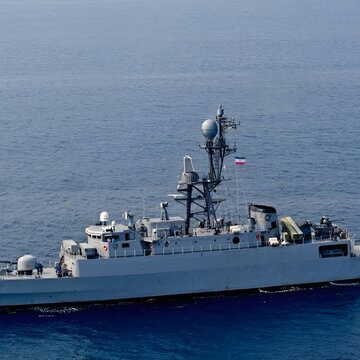
Just a few days into the conflict, the Iran war is already showing signs of becoming a prolonged battle of resources. Waves of drone attacks launched by Iran are putting sustained pressure on US and allied defenses across the Middle East, from Bahrain to the United Arab Emirates. At the centre of the conflict lies a strategic imbalance; the use of expensive interceptor missiles to destroy far cheaper drones.
Military analysts say the outcome of the conflict could ultimately depend on which side exhausts its weapons first.
Cheap drones, costly defenses
Iran has been deploying Shahed-136 one-way attack drones along with rudimentary cruise missiles in repeated strikes across the region. Since the US and Israel began air strikes on Iran over the weekend, these drones have targeted US military bases, oil infrastructure and civilian sites, Bloomberg has reported.
Air defense systems, particularly US-made Patriot missiles, have been largely effective in intercepting these threats. According to the United Arab Emirates, interception rates have exceeded 90 per cent.
However, the economic imbalance has raised concerns among military planners. "Using $4 million missiles to destroy $20,000 drones illustrates a problem that has haunted Western military planners since early in the Ukraine war."
The disparity means that even successful interceptions could drain costly weapons stockpiles much faster than the attacking side's cheaper drones.
Attrition strategy taking shape
Analysts believe Iran may be relying on a strategy of attrition, overwhelming defenses with large volumes of relatively inexpensive weapons.
"Attrition strategy makes operational sense from Iran's perspective," Bloomberg quoted Kelly Grieco as saying, a senior fellow at the Stimson Center think-tank. "They are calculating the defenders will exhaust their interceptors and the political will of Gulf states will crack and put pressure on the US and Israel to cease operations before they run out of missiles and drones."
Iran is believed to have possessed about 2,000 ballistic missiles following last year's conflict with Israel. It likely holds a significantly larger number of Shahed drones, which Russia has reportedly been able to manufacture at a rate of several hundred per day.
According to analysis by Bloomberg Economics' Becca Wasser, Tehran has fired more than 1,200 projectiles since the start of the conflict this year, many of them drones. Analysts believe Iran could be conserving its more destructive ballistic missiles for later phases of the war.
Stockpiles under pressure
The strain on missile defenses is already becoming visible. An internal analysis seen by Bloomberg News suggested that Qatar's Patriot interceptor stocks could last only four days at the current rate of use.
Also Read | 'In the dark': Massive blackout leaves millions in Cuba powerless amid deepening fuel crisis
However, Qatar's International Media Office pushed back on that assessment, saying that the "inventory of Patriot interceptor missiles held by the Qatar Armed Forces has not been depleted and remains well-stocked", reported Bloomberg.
On the offensive side, US planners may also face limits. Analysts say the United States may not have moved enough munitions into the region to sustain operations for the four weeks that President Donald Trump has suggested the conflict could last.
US Defense Secretary Pete Hegseth said at a press conference, "This is not Iraq, this is not endless."
A battle of endurance
Meanwhile, Israeli officials say they are targeting Iran's missile launch infrastructure to reduce the scale of attacks. Israeli authorities claim that about 150 missile launchers have already been destroyed.
"Over recent days we're seeing operations against the launchers, on the one hand, and strikes to cork up the tunnels out of which those launchers and missiles are meant to emerge," said Eli Cohen, a minister in Israeli Prime Minister Benjamin Netanyahu's security cabinet. "The objective is to create aerial supremacy and to tamp down the firing at the State of Israel."
Some analysts believe the conflict could eventually reach a stalemate if both sides begin to run short of weapons.
"This seems to be a likely outcome based on the first 60 hours of this war," said Ankit Panda of the Carnegie Endowment for International Peace.