Almost everyone knows that Lumbini is famous as the birthplace of Gautama Buddha. But far fewer people are aware of Tilaurakot. More than two and a half thousand years ago, Tilaurakot was the capital of the Shakya kings. In 1899, Bengali archaeologist Purnachandra Mukhopadhyay discovered the ruins of that ancient capital a few kilometres from Lumbini in Nepal.
If Lumbini marks Buddha’s birth, Tilaurakot is the place where he grew up. The site has returned to the spotlight after the discovery of an extremely ancient Buddhist temple by British archaeologist Robin Coningham.
Coningham, a professor at Durham University in England, comes from the Cunningham family lineage, the same family as Alexander Cunningham, who carried out major archaeological investigations across the Indian subcontinent in the mid-nineteenth century. In 2012, while conducting research in Nepal, Coningham identified traces of an ancient Buddhist place of worship in Tilaurakot. While Buddha is widely believed to have been born about two and a half thousand years ago, this discovery has led some historians to suggest that he may have lived at least 2,700 years ago.
Speaking to Ei Samay, Robin said, "Lumbini is established as Buddha's birthplace. But very close to it, Tilaurakot was the ancient capital of the Shakyas during Siddhartha Gautama's royal life. Historically, this place has immense importance. However, the number of visitors here is very low." He described this as "quite a good thing" for archaeological research.
ALSO READ | Muhammad Yunus returns to work after stepping down as interim chief of Bangladesh government
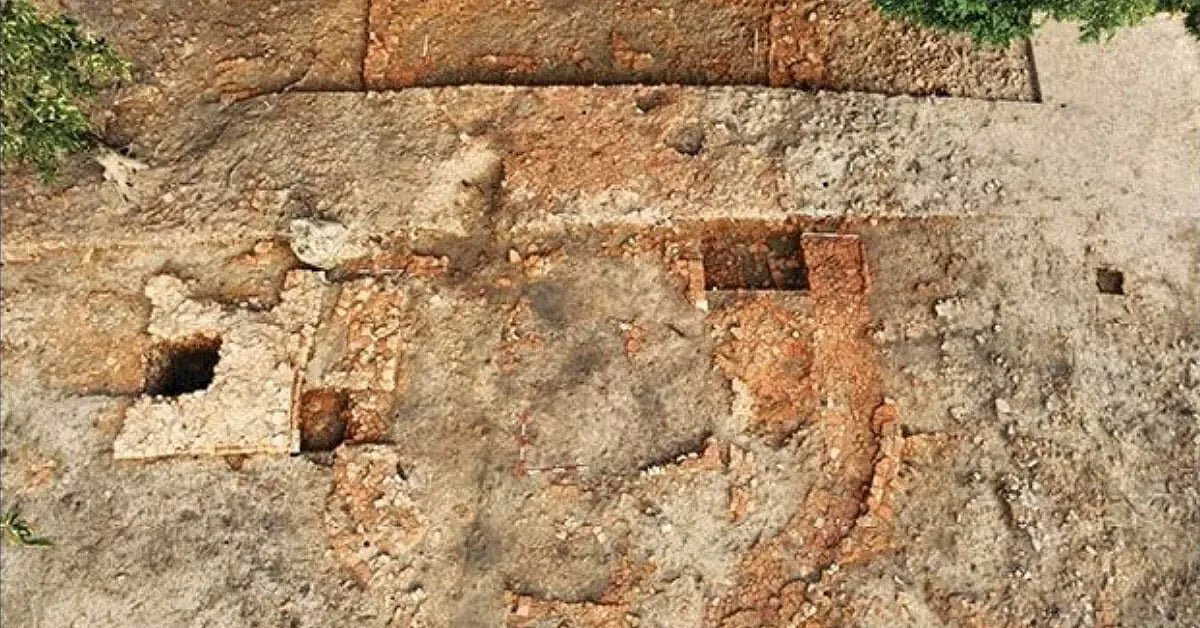
The recently discovered temple remains indicate that after Buddha’s nirvana, Tilaurakot became a pilgrimage centre for Buddhists. There was regular movement of pilgrims. Robin explained, "This semicircular temple has arches. A broken monastery has been found among the ruins of a palace complex. The temple was within it. Preliminarily, it appears this was built between the third and fifth centuries CE."
This architectural style is rare in Nepal. Terracotta lamps and begging bowls have been recovered from the temple courtyard. It is believed that pilgrims brought these objects to pay respect to Buddha. Such findings are considered strong evidence of the site’s importance, as similar memorial offerings are typically found only at major Buddhist pilgrimage centres.
The temple at Tilaurakot bears architectural similarities to the temple at Sarnath in India, where Gautama Buddha delivered his first sermon after attaining enlightenment to his five disciples- Kaundinya, Bhadiya, Vashpa, Mahanama and Ashvajit. Historians see a historical link between the two sites connected to Buddha’s life.
Between the fifth and seventh centuries CE, Chinese monks Fa Hien and Hiuen Tsang visited the region, and their accounts reportedly mention Tilaurakot. When Purnachandra Mukhopadhyay conducted the first archaeological investigation there 127 years ago, he was struck by the site’s defence system. Observing the fortified city, approximately 500 metres long and 400 metres wide, he described it as "one of the best fortresses in South Asia" and identified it as the probable capital of the Shakya kings. Later excavations uncovered ancient roads, places of worship, pottery, terracotta sculptures, stone objects and silver and copper coins dating back to the third century BCE.
ALSO READ | Russia suicide blast leaves police officer dead on war anniversary, probe underway
Despite its historical and religious significance, Tilaurakot gradually faded from public memory. Dayaram Gautam, a researcher of Buddhist philosophy at Lumbini Buddhist University, said, "Siddhartha spent 29 years of his life here and about a year after attaining Buddhahood, he returned here and gave sermons. But even after that, this place did not receive proper recognition."
While archaeological work in India was extensive under British supervision, research in Nepal was not pursued with the same intensity. Scholars believe that many archaeological treasures remain hidden in Nepal’s caves and historical sites.
Although Lumbini attracts more than one million tourists annually, Tilaurakot receives fewer than one lakh visitors each year. However, with ongoing archaeological efforts and renewed global interest, experts believe this situation may change in the coming years.