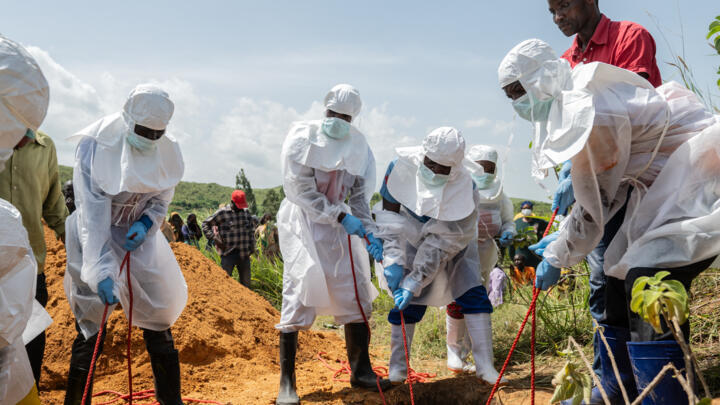
The latest Ebola outbreak in the eastern Democratic Republic of Congo is moving faster than the response, with WHO chief Tedros Adhanom Ghebreyesus saying on Monday that responders were “playing catch-up” after delays in detecting cases.
Reuters reported that Tedros said the outbreak had claimed 220 suspected deaths and was likely to get worse before it improves. Uganda has also confirmed two more cases, taking its total to seven, all linked to the outbreak centered in Congo’s Ituri province.
Also Read | 'AI must not rule humanity': Pope Leo XIV warns AI could fuel war and misinformation in first encyclical
STORY | Passengers from Ebola-affected African countries screened at Ahmedabad airport; 'nothing to panic'
— Press Trust of India (@PTI_News) May 25, 2026
Intensive screening of passengers arriving from Uganda, Congo and South Sudan is being conducted at the Ahmedabad International Airport amid the Ebola outbreak in parts of… pic.twitter.com/Dw9znYaQIL
WHO sounds the alarm
The World Health Organization has declared the outbreak of the rare Bundibugyo strain a public health emergency of international concern (PHEIC).
In its May 17 assessment, WHO said that as of May 16 there were eight laboratory-confirmed cases, 246 suspected cases, and 80 suspected deaths in Ituri, with two confirmed cases in Kampala among people who had traveled from Congo.
The agency said the event met the criteria for a PHEIC because of the risk of international spread and the uncertainty over the true scale of transmission.
Directorate General of Civil Aviation issues Standard Operating Procedure (SOP) for public health preparedness and response to Ebola disease, requiring airlines from affected countries to collect health declarations, make announcements, isolate symptomatic passengers, follow… pic.twitter.com/o3KW4LDdP8
— Press Trust of India (@PTI_News) May 25, 2026
The scale remains uncertain
The scale of the outbreak remains difficult to pin down. Researchers have struggled to estimate its real extent. An Imperial College London team puts the central estimate at around 400 cases and the upper projection near 1,400.
Anne Cori, one of the researchers, said the estimates were “probably on the low side” and that “we are only seeing a small fraction of the outbreak for now.” The paper also said the first known patient was a healthcare worker who died in Bunia between April 24 and 27, although WHO suspects the outbreak may have started weeks or even months earlier.
Also Read | US tourism takes an $8 billion hit as foreign visitor numbers fall in 2025
#WATCH | Delhi: On Ebola virus cases, Former WHO Chief Scientist, Dr. Soumya Swaminathan says, “It is a public health emergency of international concern…this is a rare strain…the challenge is that the diagnostics and therapeutics treatment options and vaccines have not been… pic.twitter.com/GW6RnDr6HT
— ANI (@ANI) May 25, 2026
Insecurity complicates the response
On the ground, health workers are facing resistance as well as insecurity.
A tent set up for suspected and confirmed Ebola cases in Mongbwalu was attacked and set on fire, after which 18 people with suspected infections left the facility and were unaccounted for.
Another treatment center in Rwampara was burned down after family members were barred from retrieving the body of a man suspected to have died of Ebola. There is no approved vaccine for the Bundibugyo virus.
Congo’s Ituri and North Kivu provinces remain highly insecure, adding to the challenge of containing the outbreak.