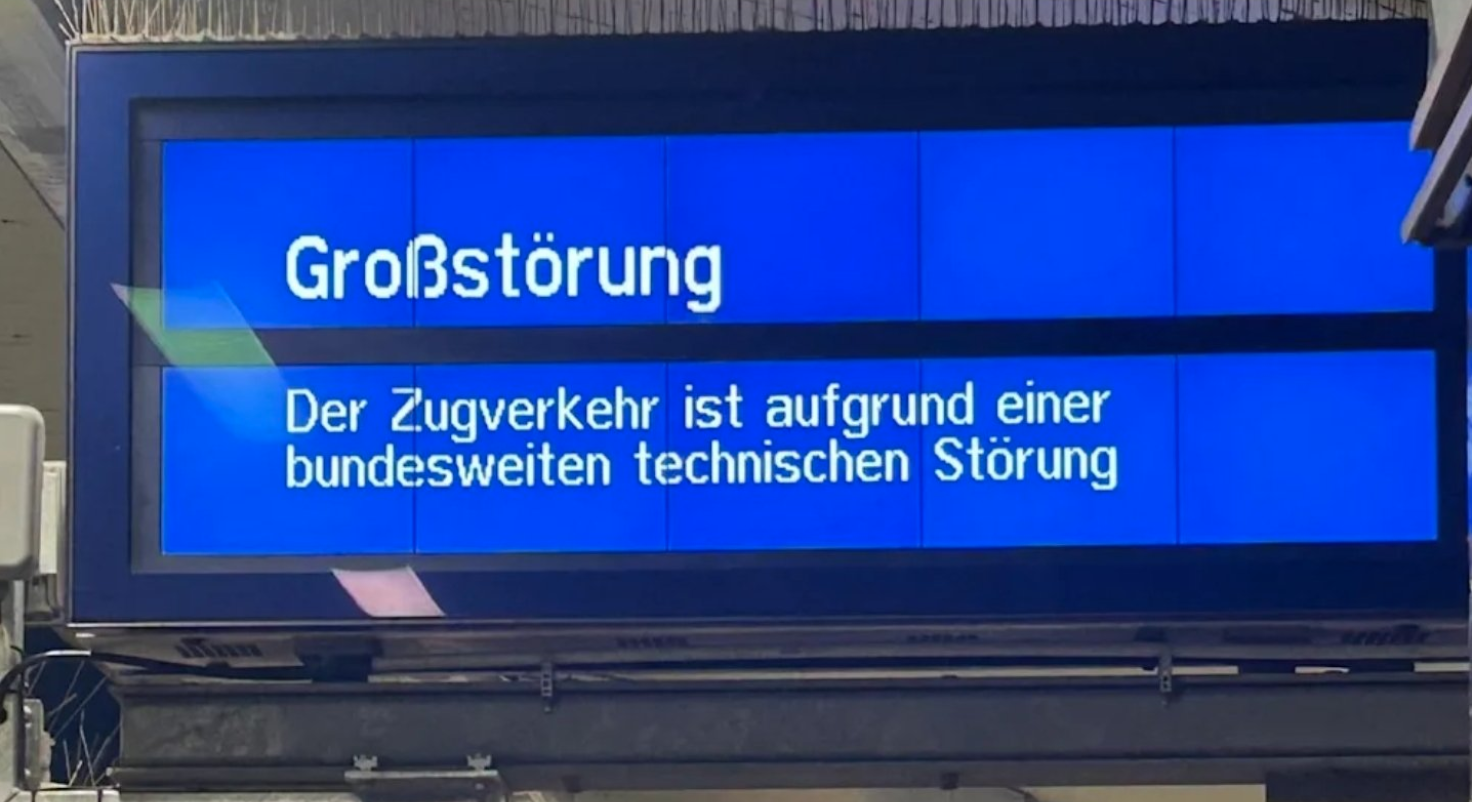
Germany's extensive railway network suffered a major disruption on Tuesday evening after a nationwide communications system failure brought train services to a halt for more than two hours, stranding passengers and causing widespread travel chaos across the country.
The disruption impacted long-distance, regional and suburban services operated by Deutsche Bahn, Germany's national railway company, forcing trains to stop at stations while authorities scrambled to activate emergency systems. Although services gradually resumed later in the night, officials warned that delays and disruptions could continue into Wednesday morning.
The incident once again highlighted the vulnerability of Europe's busiest rail networks to technical failures.
Communication system failure triggered nationwide shutdown
According to Deutsche Bahn, the disruption was caused by a fault in the Global System for Mobile Communications for Railways, commonly known as GSM-R.
The system serves as a dedicated communication network used by railway operators to coordinate train movements and maintain safety standards across international rail routes.
Once the malfunction was detected, authorities suspended train movements to avoid any operational risks. The outage reportedly lasted for nearly two-and-a-half hours before engineers managed to stabilise the system through emergency protocols.
Deutsche Bahn chief executive Evelyn Palla said the immediate priority was to ensure passengers could safely disembark and restore normal operations as quickly as possible.
The company later confirmed that the emergency system had helped stabilise the situation while investigations into the root cause were ongoing.
Also Read | Iran extends invitation to PM Modi for Khamenei's funeral next month
Major cities brought to a standstill
The disruption affected several of Germany's busiest urban centres.
According to the Hindustan Times, North Rhine-Westphalia, Germany's most populous state, saw a complete suspension of train operations for a period. Berlin, Hamburg and Stuttgart also experienced severe disruptions.
Berlin's public transport authorities confirmed that municipal, regional and long-distance Deutsche Bahn services had all been impacted. The S-Bahn suburban rail systems in Berlin and Stuttgart were also temporarily halted.
Passengers across stations received alerts asking them to seek alternative transport arrangements while authorities worked to restore services.
Many commuters found themselves stuck for hours as trains remained stationary at platforms without clear timelines for departures.
Also Read | The biggest problem for stranded ships in Hormuz isn't oil or war — it's this
2 Stunden kein #Zugverkehr und im Bahnhof bilden sich 5KM Schlangen vor der Information.
— Rechter Außenverteidiger im #WM2026-Modus (@RechterAV) June 24, 2026
Ohne diesen Informationsstand wären die wahrscheinlich vor Hilflosigkeit tot umgefallen. #DeutscheBahn
pic.twitter.com/2dBy5Szqyc
Deutsche Bahn issues compensation as investigations continue
According to the Hindustan Times, Deutsche Bahn apologised to affected passengers and reportedly distributed hotel and taxi vouchers to those unable to complete their journeys.
Although services resumed overnight, railway operators have cautioned that knock-on delays may continue for some time as schedules are gradually restored.
The incident also raises broader concerns about the resilience of Germany's ageing transport infrastructure, which has increasingly come under scrutiny due to repeated delays, maintenance challenges and technical failures.