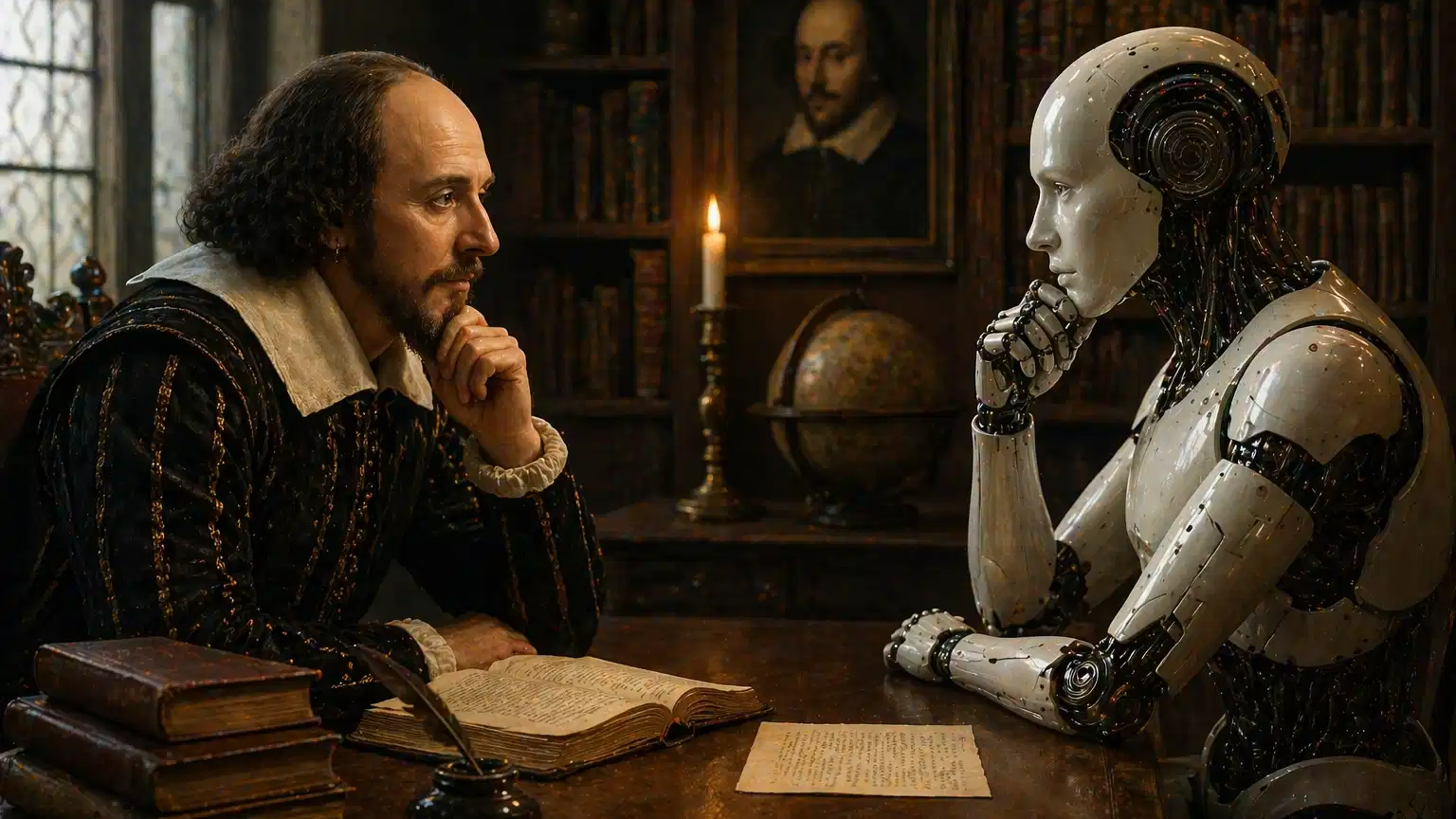
With April 23 being celebrated worldwide as English Language Day, marking the purported birthday of William Shakespeare, there is a new dialogue that is evolving around the language. But this time, there is no discussion of missing plays or any authorship theories. Instead, what is now on people's minds is whether artificial intelligence can recreate the timeless brilliance of the Bard.
From universities to technological environments and even literary communities, artificial intelligence is put to test for its capabilities against perhaps the most intricate voice in English literature ever. From crafting sonnets in iambic pentameter to even completing missing passages, the Bard finds himself placed in a totally different arena.
Can a machine learn the Bard’s voice?
A few studies have used Shakespeare's entire literary collection for training AI systems. This includes tragedies such as Hamlet and more lighthearted pieces like A Midsummer Night's Dream. The goal is straightforward, whether the machine can imitate his unique style.
Also Read | Graveyard date? Why Gen Z is choosing cemeteries over cafes for dates
Technically, everything is as it should be. It adheres to the iambic pattern, uses Elizabethan language, and has the correct structure. At first glance, it could pass as Shakespeare's work.
However, when examined further, it becomes clear that this is not the case. The result is mere imitation without any originality. While it follows the expected patterns, it doesn't have the same element of surprise as Shakespeare's literary pieces. One line alone could change the context or bring a completely new perspective to the table.
Where technology is actually transforming Shakespeare
Although issues regarding creativity are still open to debate, there is much more certainty about how technology is changing the way we research Shakespeare.
Using digital means, researchers are able to analyse early copies of Shakespeare’s work with much higher accuracy. High-tech scanning devices and text analysis software are able to detect errors, discrepancies, and even secret information contained in various versions of his plays.
The British Library, for instance, applies these technologies to explore ancient manuscripts, shedding light on possible modifications that could have occurred during the creation process. Rather than rewriting Shakespeare, it is about seeing him through fresh eyes.
The human element
Underlying this discussion is the fundamental question of whether creativity can ultimately be described through patterns.
The plays written by Shakespeare were not only structured language; they also contained emotions that were influenced by the presence of conflict, politics, humor, and human contradictions. These aspects are inherently tied into real life experiences, as opposed to linguistic structures alone.
Also Read | World Book Day 2026: 8 timeless books you should read at least once
On the other hand, while machines can identify, analyze, and generate patterns, it seems more challenging to describe the process of breaking free from them in order to create something innovative.
As discussions surrounding English Language Day bring back conversations about Shakespeare’s contributions to literature, it becomes increasingly evident that such a comparison does not really serve a purpose.