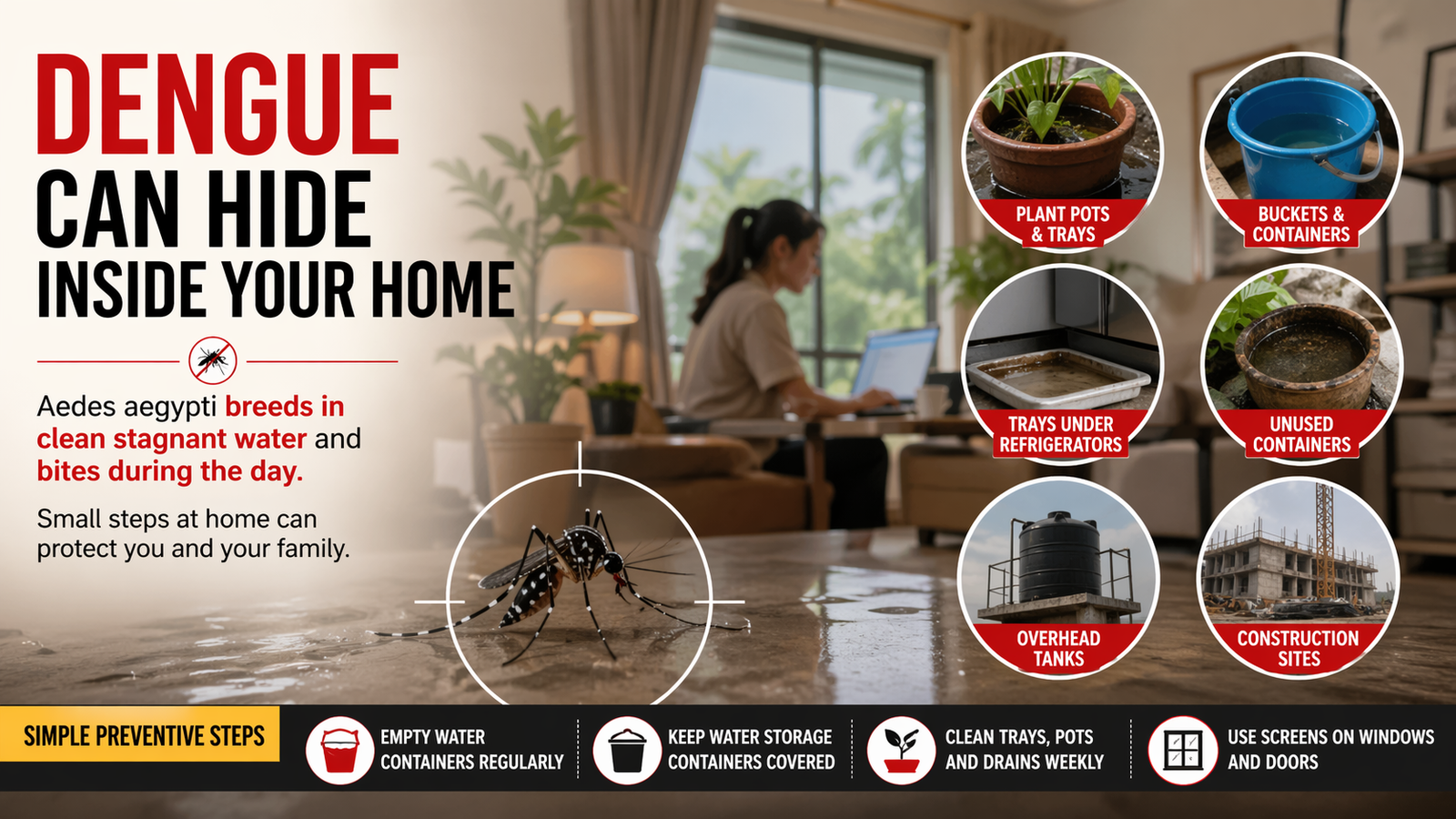
Dengue, once largely associated with outdoor exposure, is increasingly affecting people who spend most of their time indoors. Doctors warn that urban residents, including those working from home or in office settings, are now at significant risk. The shift is linked to the behaviour of the mosquito species that spreads the virus and how it has adapted to city environments.
The primary carrier of dengue, Aedes aegypti, thrives in urban spaces and prefers to stay close to human habitats. Its ability to breed in small collections of clean water makes homes and residential buildings ideal environments for its survival
Why staying indoors doesn’t offer protection
A common assumption is that staying indoors reduces the chances of mosquito bites. However, experts say this is not true in the case of dengue. The mosquitoes responsible for transmission are known to live and breed inside homes.
Explaining this, a doctor told NDTV, “Aedes aegypti mosquitoes breed in clean stagnant water.” This includes water that collects in everyday household items such as flower pots, trays under refrigerators, buckets, and even unused containers.
Also Read | What is ‘saree cancer’? Why this little-known risk deserves attention
Because these mosquitoes do not require dirty water to reproduce, even well-maintained homes can unknowingly become breeding grounds. Small, unnoticed pockets of water are enough to support their lifecycle.
Daytime biting increases risk
Unlike many other mosquito species that are active at night, Aedes aegypti mosquitoes bite during the day. This makes people vulnerable even while carrying out routine indoor activities like working, studying, or resting.
Since people are less likely to use protective measures like mosquito nets or repellents during the daytime, the chances of getting bitten increase. This daytime activity pattern is one of the key reasons dengue is spreading more widely in indoor environments.
Urban living contributing to spread
Rapid urbanisation has created conditions that favour the spread of dengue. High-rise apartments, water storage practices, and ongoing construction work often lead to multiple small water collection points.
These can include overhead tanks, construction materials, blocked drains, or even decorative items that hold water. In densely populated areas, this allows mosquitoes to breed easily and spread quickly among residents.
As a result, dengue is no longer confined to specific localities or outdoor settings. It is now being transmitted within homes, offices, and residential complexes.
How dengue spreads
Dengue spreads through the bite of an infected mosquito. When a mosquito bites a person already infected with the virus, it becomes a carrier and can then transmit the infection to others.
Also Read | Badrinath Temple reopen for Char Dham Yatra 2026: Here’s what devotees need to know
Because these mosquitoes prefer human environments and bite during the day, the risk of transmission remains high in indoor settings. People who rarely step outside may still be exposed if preventive steps are not taken
The growing number of indoor dengue cases highlights the need for awareness and simple preventive actions. Regularly checking and emptying containers that may collect water is crucial.