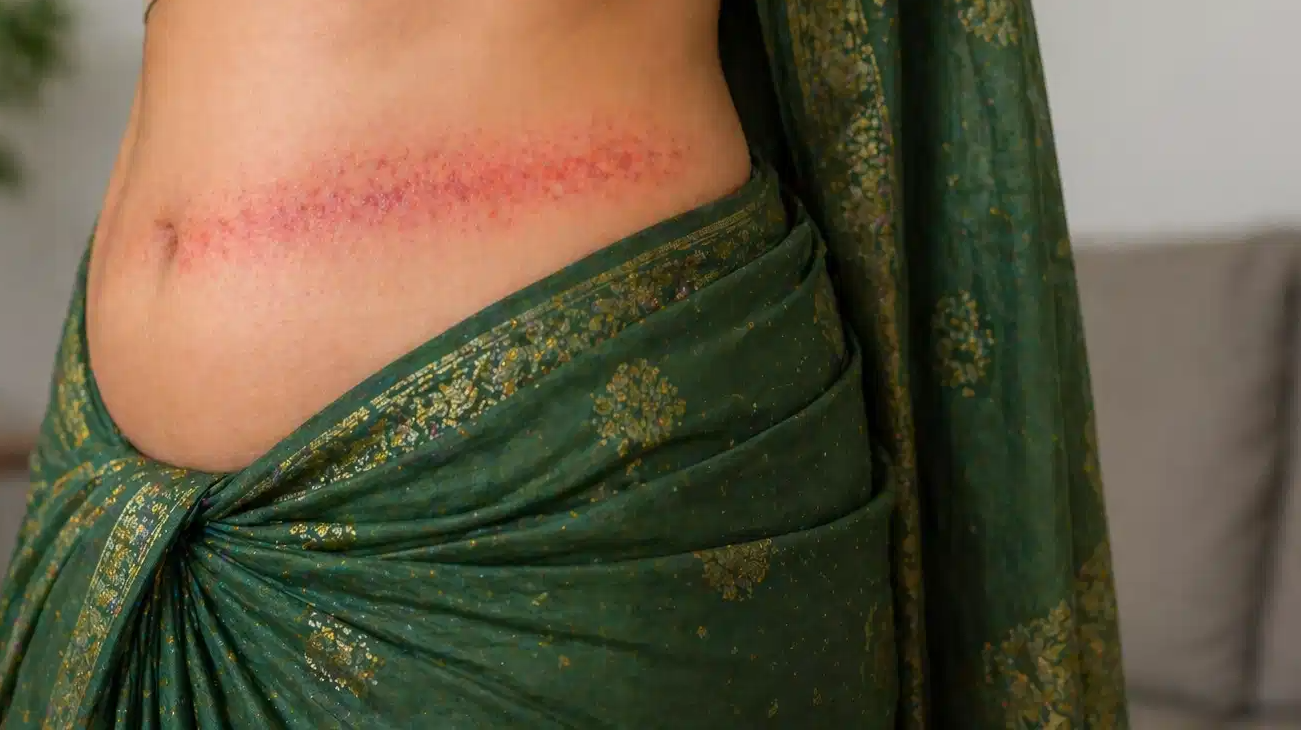
A rare skin condition, commonly referred to as “saree cancer”, has drawn attention among medical experts, who say it is linked to prolonged friction caused by tightly tied sarees or petticoats around the waist.
Speaking to Moneycontrol, Dr Arun Kumar Giri, Director of Surgical Oncology at Aakash Healthcare, explained that the term is used to describe a form of skin cancer, usually squamous cell carcinoma that develops along the waistline after years of continuous irritation.
“It is caused by wearing a saree too tightly around the waist for long periods. Continuous friction, pressure and irritation from the petticoat string can damage the skin and, over time, may lead to malignant changes,” Dr Giri said.
How the condition develops over time
As per Dr. Giri, the main reason behind it is the persistent irritation. The tight knots, constant rubbing and non-healing in the same place result in a change in the skin gradually.
Also Read | Are your words hurting your relationship? 4 phrases to avoid at all costs
Sweating, high temperatures and poor hygiene may aggravate the situation. Eventually, the affected skin will be thickened, darkened and injured, resulting in some changes in the cells.
Medically speaking, it should be noted that the development is very slow, and hence the diagnosis is always late.
Symptoms often ignored in early stages
These initial symptoms are hard to detect and might go unnoticed. They are:
Continuous itching around the waist
Darkening or thickening of the skin
Skin sores that refuse to heal
Skin bleeding or alteration
According to Dr. Giri, many women neglect these symptoms because of ignorance or fear of visiting a doctor. Such negligence could result in the disease reaching more severe stages.
Who is at risk?
Cases have been more frequently recorded in women who wear sarees regularly for several years and wrap them tightly in the same spot.
Individuals who sweat excessively or have hygiene issues or irritations in their waist regions are more susceptible. Older women constitute most of the reported patients.
Also Read | Inside India’s ‘Silent River’: Why Kunthipuzha flows untouched by human noise and pollution
Preventable and treatable if detected early
Doctors emphasise that “saree cancer” is largely preventable. Simple measures such as loosening the petticoat knot, changing its position regularly and maintaining hygiene can significantly reduce risk. Early detection plays a crucial role in treatment outcomes.
“Surgery is often the primary treatment to remove the affected skin. If diagnosed early, prognosis is good. In advanced cases, larger surgical procedures, skin grafting or even radiation may be required,” Dr Giri told Moneycontrol.
Experts advise that any skin lesion or sore that does not heal within a month should be examined by a doctor without delay.