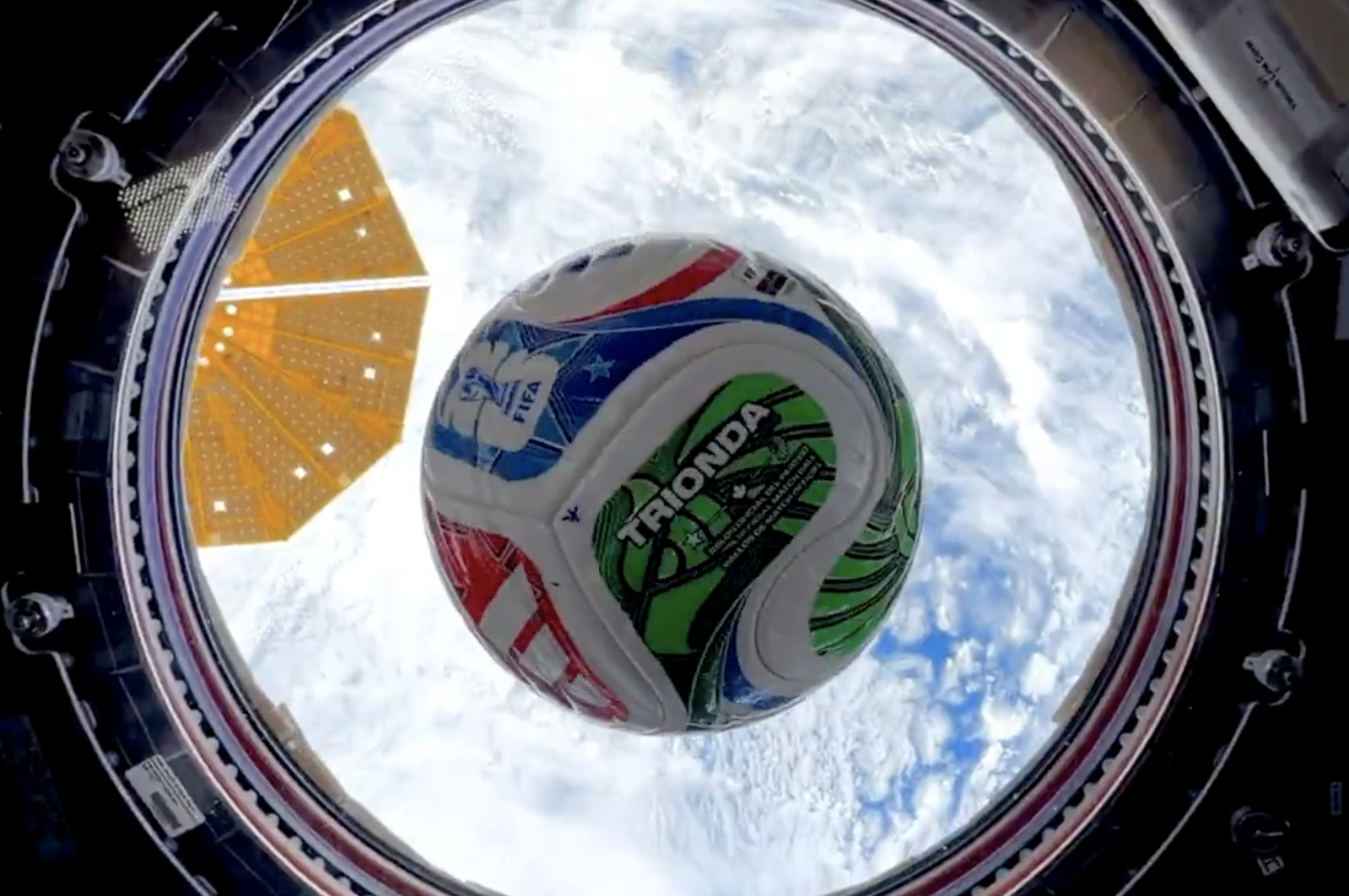
NASA has found a unique way to combine science and football by sending the official match ball of the 2026 FIFA World Cup, called Trionda, to the International Space Station (ISS).
The unusual experiment has captured global attention, with astronauts performing football drills in zero gravity to understand how the ball behaves outside Earth's environment. While the visuals have fascinated football fans, the mission is rooted in serious scientific research that could eventually improve the sport back on Earth.
NASA recreates football physics experiment in space
According to NASA, astronauts aboard the ISS recreated a scientific study first conducted in 2019 to analyse how a football's balance and centre of mass influence its movement.
Using the Trionda ball designed by Adidas, crew members examined how the ball reacts under microgravity conditions and how even slight imbalances can alter its trajectory and stability.
According to The Indian Express, NASA explained that sports engineers spend years perfecting a football's design to ensure consistent performance during professional matches.
By observing its behaviour in space, researchers can gather fresh insights into aerodynamics and motion that are difficult to replicate on Earth.
The space agency shared videos of astronauts casually passing and controlling the ball inside the ISS, instantly making the experiment a social media sensation.
Also Read | Japan crush Tunisia 4-0 as Ueda stars in historic World Cup match
Trionda symbolises three host nations
The Trionda football itself carries a special meaning.
According to The Indian Express, FIFA said the name is inspired by a Spanish phrase meaning "three waves", representing the three host countries of the 2026 FIFA World Cup, namely the United States, Canada and Mexico.
Its design prominently features red, green and blue colours associated with the host nations.
The ball has a distinctive four-panel construction that creates a triangular pattern at its centre, reflecting unity among the three countries.
Additional national symbols have also been incorporated into the design, including a maple leaf for Canada, a star for the United States and an eagle for Mexico.
Also Read | FIFA World Cup 2026 reaches 100 goals in just 33 matches, sets 68-year record
The official FIFA World Cup ball went to space!
— NASA (@NASA) June 20, 2026
We're working to inspire the next generation by showing how space exploration inspires innovation in sports science — and everyday life. Learn more: https://t.co/CWbI8MFDtp pic.twitter.com/ebJtkpD5uM
How could the experiment benefit football?
According to The Indian Express, NASA mentions that the research could have practical applications for future sports technology.
The agency is also studying how embedded sensors inside modern footballs affect performance during matches.
These findings could help engineers develop more accurate, balanced and technologically advanced sporting equipment in the future.
"Helping to improve the beautiful game is just one of the ways NASA science done on the International Space Station makes life better for people on Earth," NASA said.
The experiment has generated enthusiastic reactions online.
One social media user wrote, "A World Cup ball in space is a properly weird crossover, and somehow very NASA."
Another commented, "An actual aerodynamics study in space. Truly a work-life balance, pun intended."