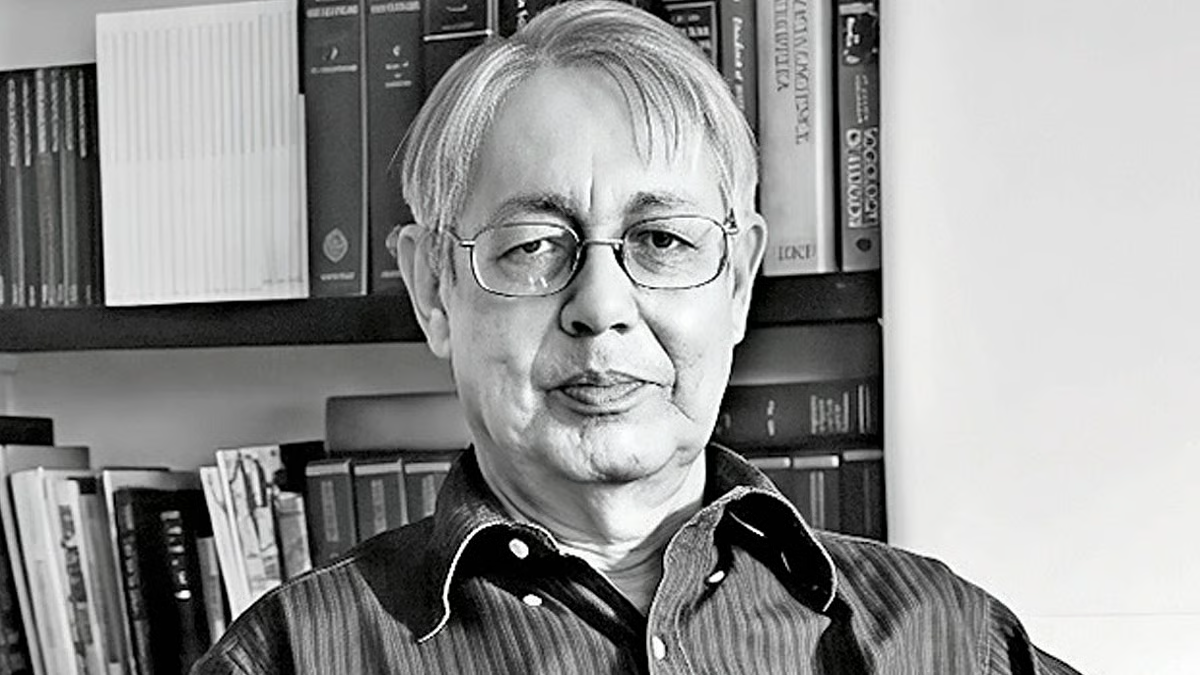
Eminent Indian sociologist André Béteille passed away on Wednesday (February 4) at the age of 91. The news was shared by historian Ramachandra Guha on X (formerly Twitter), who paid tribute to him as a moral and intellectual guide for generations of scholars.
Guha shares, "Devastated to hear that the great sociologist André Béteille is no more. He was the Indian scholar I most admired, for me (and many others) a moral and intellectual anchor."
ALSO READ | Mumbai-Pune Expressway opens after 33-hour shutdown following hazardous gas tanker mishap
Devastated to hear that the great sociologist André Béteille is no more. He was the Indian scholar I most admired, for me (and many others) a moral and intellectual anchor. Here's a tribute I published on his 90th birthday in September 2024: https://t.co/gxhwlQBdK1
— Ramachandra Guha (@Ram_Guha) February 4, 2026
Béteille was among India’s most respected social thinkers, known especially for his pioneering work on caste, class and social inequality. His field studies in a village in Tamil Nadu became foundational texts for understanding Indian society.
A life dedicated to studying society
Over a career spanning more than four decades, Béteille taught sociology at the Delhi School of Economics and later became the first Chancellor of Ashoka University. He also taught or held emeritus positions at some of the world’s leading institutions, including Oxford, Cambridge, the University of Chicago, the London School of Economics, UC Berkeley, Erasmus University Rotterdam and the Institute of Advanced Study in Berlin.
His books, such as 'Caste, Class and Power', 'Inequality and Social Change' and 'Antinomies of Society', continue to shape how students and researchers understand social hierarchy and equality in India. Beteille wrote, “The Brahminical tradition of learning was not only narrowly focused intellectually, it was also socially very exclusive. Women and members of the lower castes had little or no access to it. The new centres of learning – the colleges and the universities – opened up new fields of knowledge, and also opened their doors to excluded sections of society.”
Béteille was highly regarded for his groundbreaking research on caste, class and social hierarchy, particularly his detailed fieldwork in a village in Tanjore, Tamil Nadu. In young age he wrote, “Although the Brahmins, the Non-Brahmins and the Adi-Dravidas have each an identity of their own, this does not mean that they constitute homogeneous units. The Brahmins can be regarded as a unit only in relation to the Non-Brahmins and the Adi-Dravidas. Internally, there are many subdivisions among the Brahmins, just as there are among the Non-Brahmins.”
ALSO READ | Japanese students visit Shillong for dialogue on India–Japan ties, Northeast’s role in focus
Béteille received several honours for his contribution to academics and public thought. He was awarded the Padma Bhushan and Padma Vibhushan, served as Chairman of the Indian Council of Social Science Research, and was appointed to the Prime Minister’s National Knowledge Commission. He was later named National Professor.
Born in 1934 in Chandannagore, then under French rule, Béteille studied anthropology at the University of Calcutta before joining Delhi University under sociologist M.N. Srinivas. Beyond academics, he had a deep love for literature and music and was a keen singer of Rabindranath Tagore’s songs.
His passing marks the end of an era in Indian sociology, but his ideas and writings will continue to guide future generations.