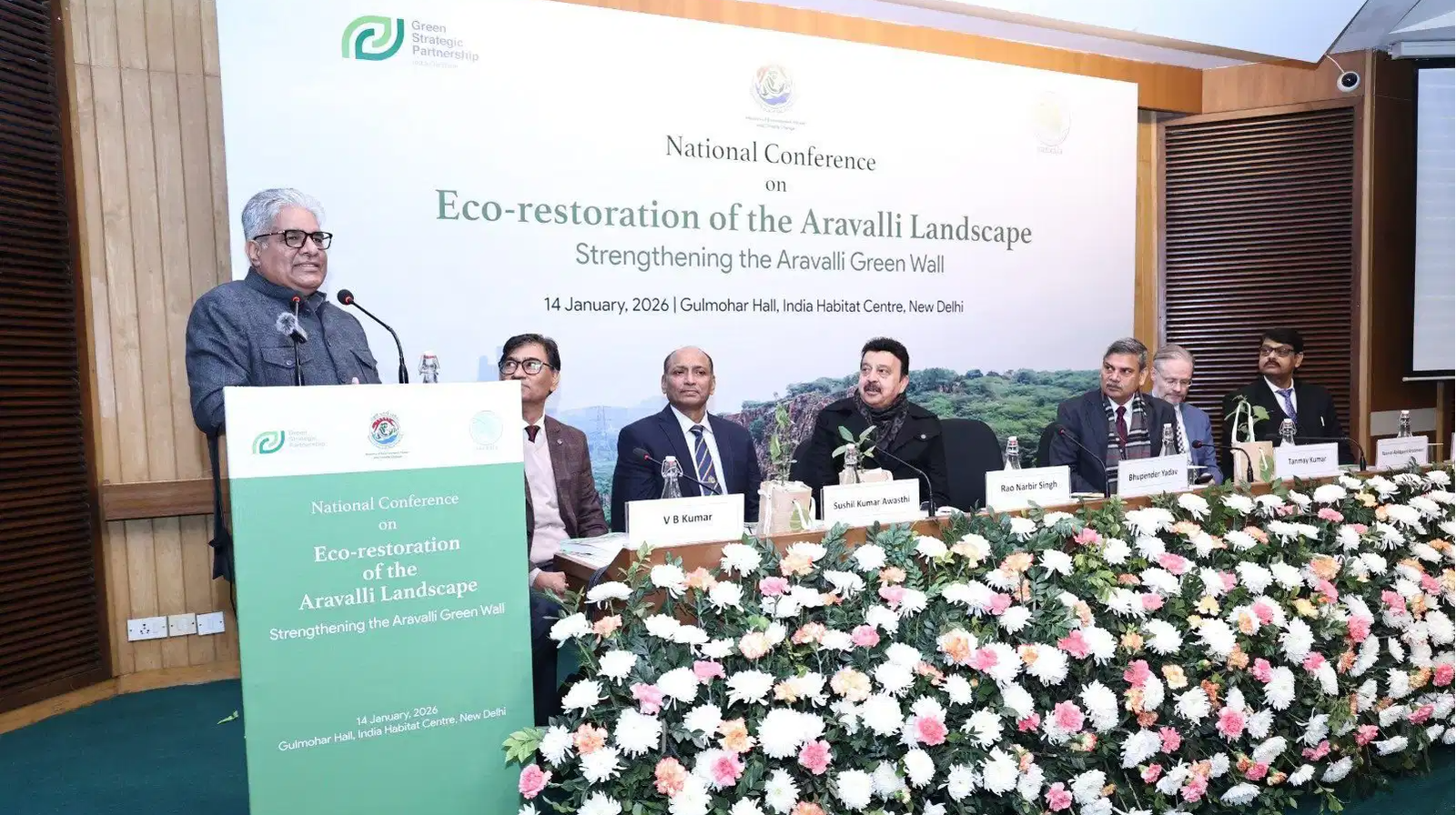
Organisations that help restore degraded forest land in the Aravalli range and achieve at least 40% canopy cover within four to five years will be eligible to earn green credits under the Centre’s Green Credit programme, Union environment minister Bhupender Yadav said on Wednesday.
Speaking at the release of an eco-restoration framework for the Aravalli landscape, Yadav said private and government entities could approach the Union environment ministry to take up afforestation projects in degraded forest areas in accordance with forest department management plans.
“If any organisation wants to take up afforestation in degraded forest land as per the management plan of the forest department and is able to achieve 40% canopy cover in four to five years, it can obtain green credits,” Yadav said.
He added that the programme has already been initiated in parts of Haryana’s Aravalli belt, covering around 750 acres in Gurugram and another 250 acres near the Manesar Industrial Area.
The minister also sought to address concerns around mining in the region. “Many misconceptions have been spread, but neither is mining allowed in the Aravalli region in Delhi, nor will it ever be allowed,” Yadav said, adding that mining would also not be permitted in most districts of Haryana.
According to the environment ministry, nearly 97 square kilometres of Aravalli revenue land in Haryana, stretching from Naurangpur to Nuh, has been identified for afforestation and notified as Protected Forest. Officials said several degraded patches across this stretch could be taken up under the Green Credit programme.
Eco-restoration plan outlines scale of degradation
The eco-restoration framework released by Yadav is based on pilot projects carried out in four Gurugram villages like Sakatpur, Naurangpur, Shikohpur and Gairatpur Bas. The report, titled A Report on Eco-restoration of the Aravalli Landscape, was prepared by Delhi-based think tank Sankala Foundation following field surveys and stakeholder consultations.
The framework proposes a multi-pronged approach involving forest and biodiversity management, control of invasive species, water resource management, livelihood diversification, urban planning and adaptive monitoring. Officials said the model would be used to develop a larger restoration plan that could be replicated across all four Aravalli states including Delhi, Haryana, Rajasthan and Gujarat, covering 29 districts.
Also Read | Australia raises visa scrutiny for Indian students, shifts India to AL3
Field surveys found that forest patches in the study areas are severely degraded and fragmented, with invasive species such as Prosopis juliflora, Lantana camara and Parthenium hysterophorus suppressing native biodiversity. The report also highlighted heavy dependence on groundwater for irrigation and forest resources for firewood, fodder and medicinal plants, particularly among women.
The report underlined the wider ecological crisis facing the Aravalli range, which acts as a climate barrier against the eastward spread of the Thar Desert. It noted that over 40% of forest cover has been lost since 1970, with mining, construction and infrastructure projects fragmenting habitats. In Haryana alone, more than 5.7 lakh hectares of Aravalli land had been lost by 2019, with projections suggesting further degradation if restoration efforts are not scaled up.