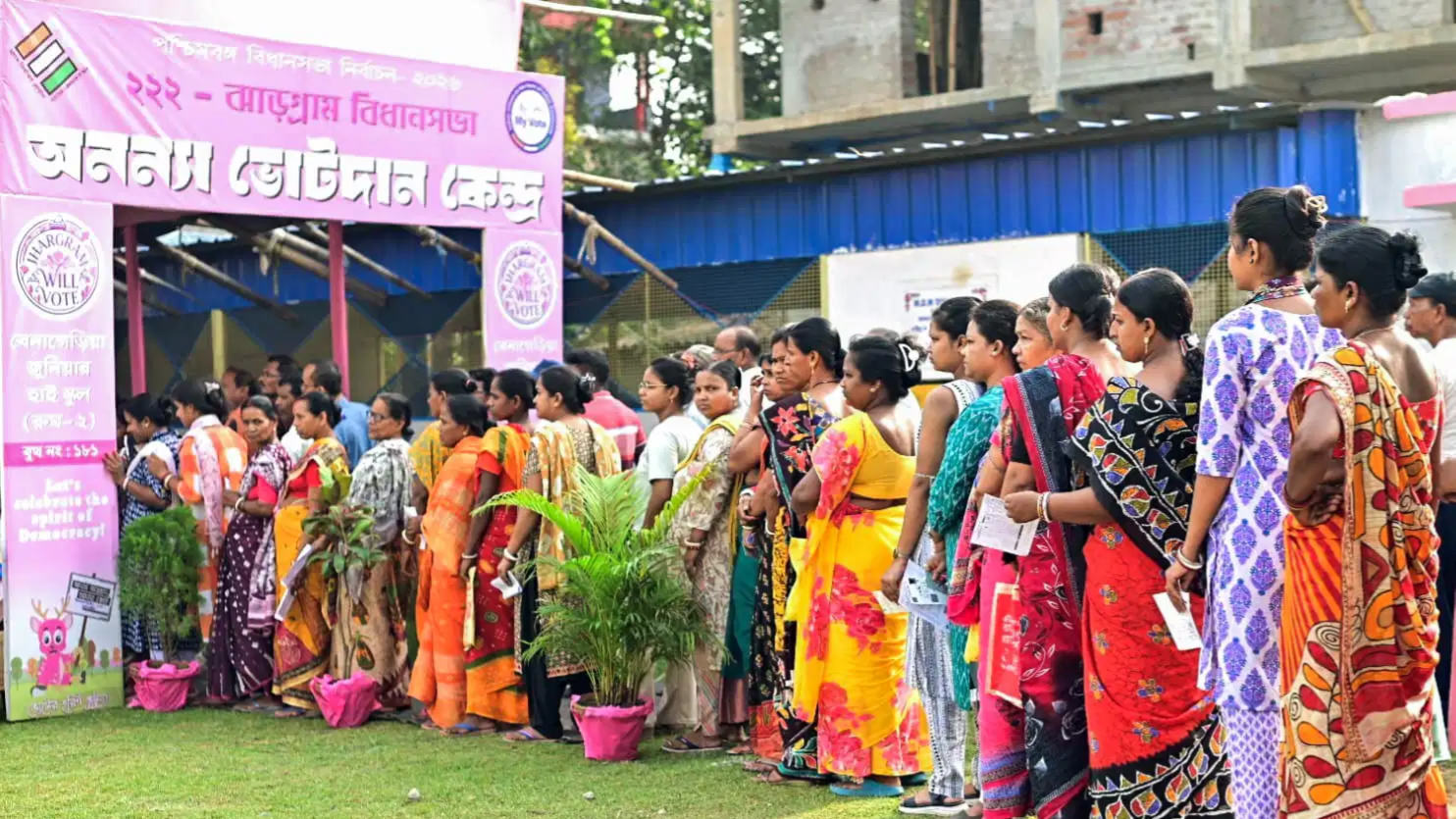
The Election Commission (EC) has reported that not a single repoll has been recommended across thousands of polling stations in West Bengal and Tamil Nadu, marking a departure from trends seen in previous elections.
According to EC sources cited by The Times of India, none of the 44,376 polling stations in West Bengal or the 75,064 polling stations in Tamil Nadu required repolling. This comes as a notable shift, particularly in West Bengal, where earlier elections often saw multiple repolls due to political violence and allegations of electoral malpractice.
Also Read | PM Modi on how Jadavpur University lost its way: 'The name of the campus used to be...'
Record turnout in both states
Both states also recorded high voter participation during polling. West Bengal registered nearly 92.9 per cent turnout in the first phase, even after the deletion of around 83 lakh electors from the state's voter rolls following SIR.
Tamil Nadu too witnessed strong voter turnout, contributing to what officials describe as a smooth polling process across both states.
Three-tier verification in Bengal
To curb irregularities historically associated with elections in West Bengal, commonly referred to as 'chaapa', 'source jamming' and 'booth jamming', a three-level verification system was introduced at all polling stations.
The first layer of checks covered the area surrounding polling booths. Section 163 of BNSS (which corresponds with Section 144 of the erstwhile IPC) was enforced within a 200-metre radius. Entry into this zone was restricted, with identity documents of individuals verified before allowing access.
The second level of verification took place at the entry point of polling stations. Booth-level officers, along with volunteers from NSS and NCC, screened voters before they could join the queue. This included verifying identity documents such as voter cards and slips, TOI reported.
Also Read | Which sectors are worst hit as heatwaves intensify across India?
Special provisions were also made for 'pardanasheen' women, with female staff assigned to verify their identity in accordance with EC guidelines.
Final checks inside booths
The third stage involved the standard identity verification inside polling booths. Polling officers conducted the final checks before voters were allowed to have their fingers inked and cast their ballots, TOI reported.
The layered system, combined with security measures, appears to have contributed to a polling process that did not require any repolling in either state.