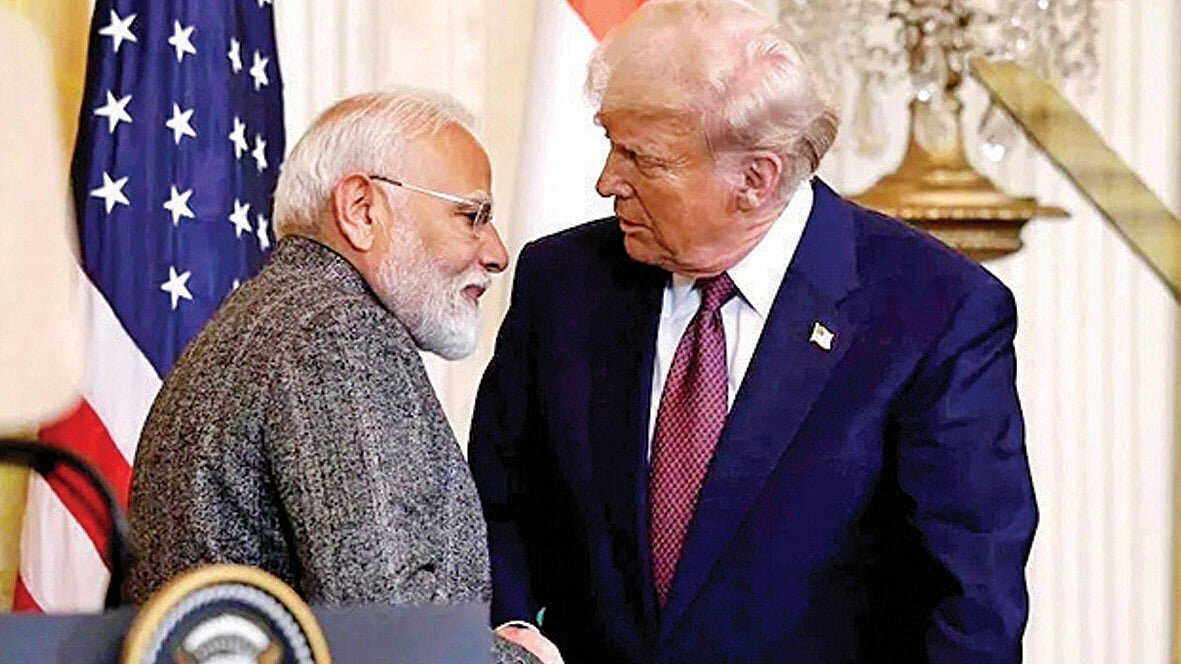
America has once again increased pressure on India's position regarding oil imports from Russia. US President Donald Trump made it clear that if cooperation is not received regarding the purchase of Russian oil, more tariffs could be imposed on India. Speaking to journalists on the special US presidential aircraft, Air Force One, Trump praised Narendra Modi but made no pretense about maintaining commercial pressure. Trump's straightforward words: 'Prime Minister Modi is a very good person. He is a wonderful person. But he also knew that I am not happy. It is important to keep me happy.' At the same time, the US President has indicated that India conducts large-scale trade with America.
If America increases tariffs, it could be extremely damaging for India. Earlier, in October last year, Trump had claimed that India would stop buying Russian oil, saying that Prime Minister Modi had given him assurance. Trump had also highlighted this demand in the context of the Ukraine war to corner Moscow internationally. However, New Delhi has not moved toward stopping the purchase of cheap Russian oil to prioritize domestic interests and ensure the country's energy security. The Indian government made it clear that priority would be given to the country's energy, security, and common people's interests.
Foreign Ministry spokesperson Randhir Jaiswal had said at that time, 'For a major oil and gas importing country like India, protecting its own and customer interests remains the fundamental basis of import policy amid instability in the international fuel market.' The Trump administration began increasing pressure after India clarified its position. Last August, the Trump administration imposed tariffs of up to 50 percent on Indian goods imported into the country. Washington also announced that an additional 25 percent 'punitive tariff' would be imposed for purchasing Russian oil. Amid this tug-of-war, discussions continued between India and America regarding a bilateral free trade agreement. However, despite repeated rounds of talks, no final agreement has been signed between the two countries.
New Delhi has repeatedly stated that no compromise will be made on national interests regarding the terms of the free trade agreement. However, there are also indications that India is taking steps to maintain diplomatic balance. Last October, India increased crude oil imports from America to nearly 540,000 barrels daily, the highest since 2022. According to data from 'Kpler', a global energy market data and statistics provider, India wanted to signal through this that it wishes to maintain good diplomatic and commercial relations with America. At the same time, India's state-owned and private oil refining companies have significantly reduced Russian oil imports compared to before.
Particularly, India has stopped oil imports from two Russian oil-producing companies 'Rosneft' and 'Lukoil' that have been hit by US sanctions. However, oil imports continue from Russian oil companies that have not been sanctioned. According to news agency reports, the center has asked the country's oil refineries to submit detailed accounts of oil purchases from Russia and America on a weekly basis. The Global Trade Research Initiative (GTRI) has stated that India will have to take a clear position on Russian oil without any hesitation to avoid US tariffs. The organization has indicated that pressure is mounting within America regarding this issue.
US Senator Lindsey Graham is pressuring for the initiation of legal processes to impose high tariffs on countries importing Russian oil. He has proposed imposing these tariffs on countries that import Russian oil and gas if Russia does not declare a ceasefire against Ukraine within 50 days.
This would significantly increase export costs for countries that have commercial relations with America. However, GTRI has dismissed the possibility that Washington's pressure will ease if Russian oil imports stop. According to the organization, America would then want to press its demands on issues like agriculture, dairy product market access rights, digital trade, or data governance.
Government sources indicate that Russian oil imports may be gradually reduced, keeping in mind a possible trade agreement with America, and could fall below 1 million barrels daily. However, what decision will ultimately be taken in this equation will depend on international politics, fluctuations in fuel market prices, and the country's domestic economic needs. Maintaining balance between America's pressure on one side and the need for cheap fuel on the other is now India's biggest diplomatic challenge.