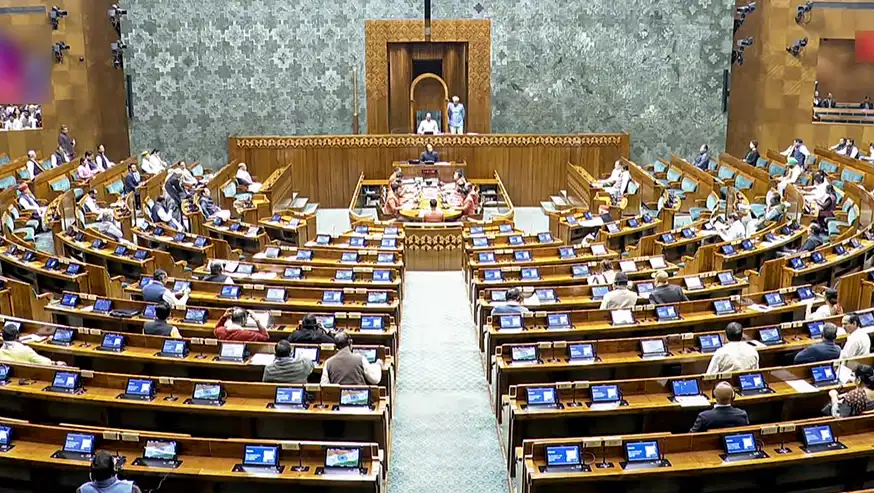
In a significant setback for the Union government, the Lok Sabha on Friday rejected the Constitution (131st Amendment) Bill, 2026, which sought to expand the strength of the House and revise the framework for delimitation and implementation of women’s reservation.
The bill did not get the two-thirds majority required, with 298 votes for and 230 against, from among the 528 members who participated in the voting process.
After this defeat, the Union Minister Kiren Rijiju has stated that he would withdraw both the Delimitation Bill, 2026, and the Union Territory Laws (Amendment) Bill, 2026.
What the Bill proposed
The Constitution amendment Bill sought to substantially enhance the strength of the Lok Sabha from 543 to 850 members, whereby 815 would be from states and the remaining 35 from Union Territories.
Also Read | 'I am the recently removed deputy leader': Raghav Chadha taunts AAP from Rajya Sabha over leadership change
It also proposed key changes to delimitation rules by amending Article 82, removing the requirement to wait for the first Census after 2026. This would have allowed the Centre to proceed with delimitation based on existing data, particularly the 2011 Census.
Finally, the Constitution amendment Bill sought to amend Article 334A to allow for an instant implementation of the 33% reservation for women immediately after conducting the delimitation.
Reasons for opposition to the move
Opposition parties strongly opposed the move, arguing that delimitation based on the 2011 Census would disproportionately impact southern and north-eastern states.
They pointed out that some states might suffer more because of poor population control than other states who would enjoy the benefits of having more seats.
The timing of the move was questioned considering that 2026-2027 Census exercise was already underway.
Delimitation Bill withdrawn after defeat
Under the now-withdrawn Delimitation Bill, 2026, there were plans to constitute an administrative commission comprising a sitting judge of the Supreme Court or former judges of the same, as well as other election commissioners, to redraw the electoral constituencies of Parliament and State Assemblies.
The exercise involved readjusting the distribution of parliamentary and assembly seats using the population statistics of the 2011 Census rather than continuing with the previous system of allocating seats through the data of 1971 Census and the 2001 Census for the delimitation exercise.
Also Read | Roosevelt House reopens in Delhi after 5 years; 10,000 flag-clad autos to hit roads in unique campaign
Additionally, it was planned to implement the reservation of seats for the Scheduled Castes and Scheduled Tribes, as well as one-third reservation for women in general as well as in reserved constituencies on a rotational basis.
The development comes a day after the Centre notified the Constitution (106th Amendment) Act, 2023, bringing into force the law providing 33% reservation for women in Lok Sabha and state assemblies from April 16, 2026.
However, the implementation of that law remains linked to a delimitation exercise following a future Census, which has been a point of contention.