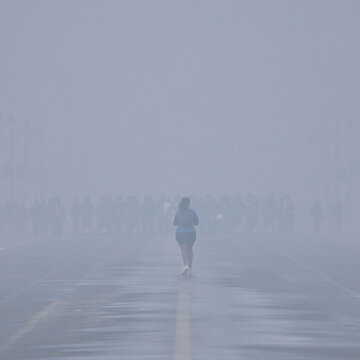
The government on Friday opposed tax relief for air purifiers – a plea made to the Delhi High Court – citing the horrid toxic smog that has blanketed the city over the past few weeks.
What happened at the court?
According to NDTV, Additional Solicitor General N Venkataraman appeared for the government. Justice Vikas Mahajan and Justice Vinod Kumar were chairing the session. The government argued for a plea to reduce GST on air purifiers from 18 per cent to five per cent. It would help to make them more affordable for poorer families. It is untenable because rates are applied by the Goods and Services Tax Council after a process involving deliberation by stakeholders, licensing, and regulation, and this cannot be 'scuttled' through a writ petition.
The government also argued the GST Council is not empowered to determine if air purifiers are 'medical devices.’ It is a classification that triggers the lower tax rate. The government mentioned that it could only be decided by the Health Ministry.
Also Read| Supreme Court halts Aravalli judgment amid mining concerns, asks Centre to resolve complexities
A 'Pandora's box' will be opened
A 'Pandora's box' will be opened if taxes on air purifiers are cut, ASG Venkataraman remarked. The ASG offered a caveat in which he said the government had not made a final decision.
The court handed the government a choice: 'provide fresh air or reduce GST on air purifiers' on Thursday. A division bench of Chief Justice DK Upadhyaya and Justice Tushar Rao Gedela mentioned reducing taxes was the "minimum" the government should do in the middle of a 'health emergency'. The court underscored the public health context.
The court pointed out that an air purifier is priced between Rs 10,000 and Rs 15,000. The court questioned the government as to why taxes could not be reduced to a level that would make them affordable for even the poorest sections. Advocate Kapil Madan filed the petition. He maintained it was not adversarial and argued that even a bare reading of the relevant notifications. He spoke about Schedule I, which attracts the five per cent GST. It would show that air purifiers are being taxed under an incorrect category.
Also Read| Tata Nagar-Ernakulam Express AC coaches catch fire in Andhra Pradesh, 1 dead
Hazardous air quality in Delhi has been linked to nearly 15 per cent of all deaths in 2023, making it the city's single largest health risk, according to Global Burden of Disease (GBD) data. Air purifiers have, thus, become an indispensable product in most homes, at least for those who can afford them. But lakhs of others, including the city's homeless population, have no protection from the toxic air or access to medical care when they develop respiratory diseases.