Fitch Ratings has warned that El Nino may continue into early 2027, raising the risk of economic disruption across a range of sovereign economies and adding to concerns over food inflation.
The assessment, reported by ANI, comes at a time when global crop yields are already facing uncertainty because fertilizer prices have climbed amid supply disruptions linked to the West Asia conflict.
Fitch said the weather pattern could intensify fiscal, growth, inflation, and external liquidity pressures for more vulnerable sovereigns.
Also Read | Chhattisgarh BJP leader among three killed after SUV set ablaze amid sand mining feud
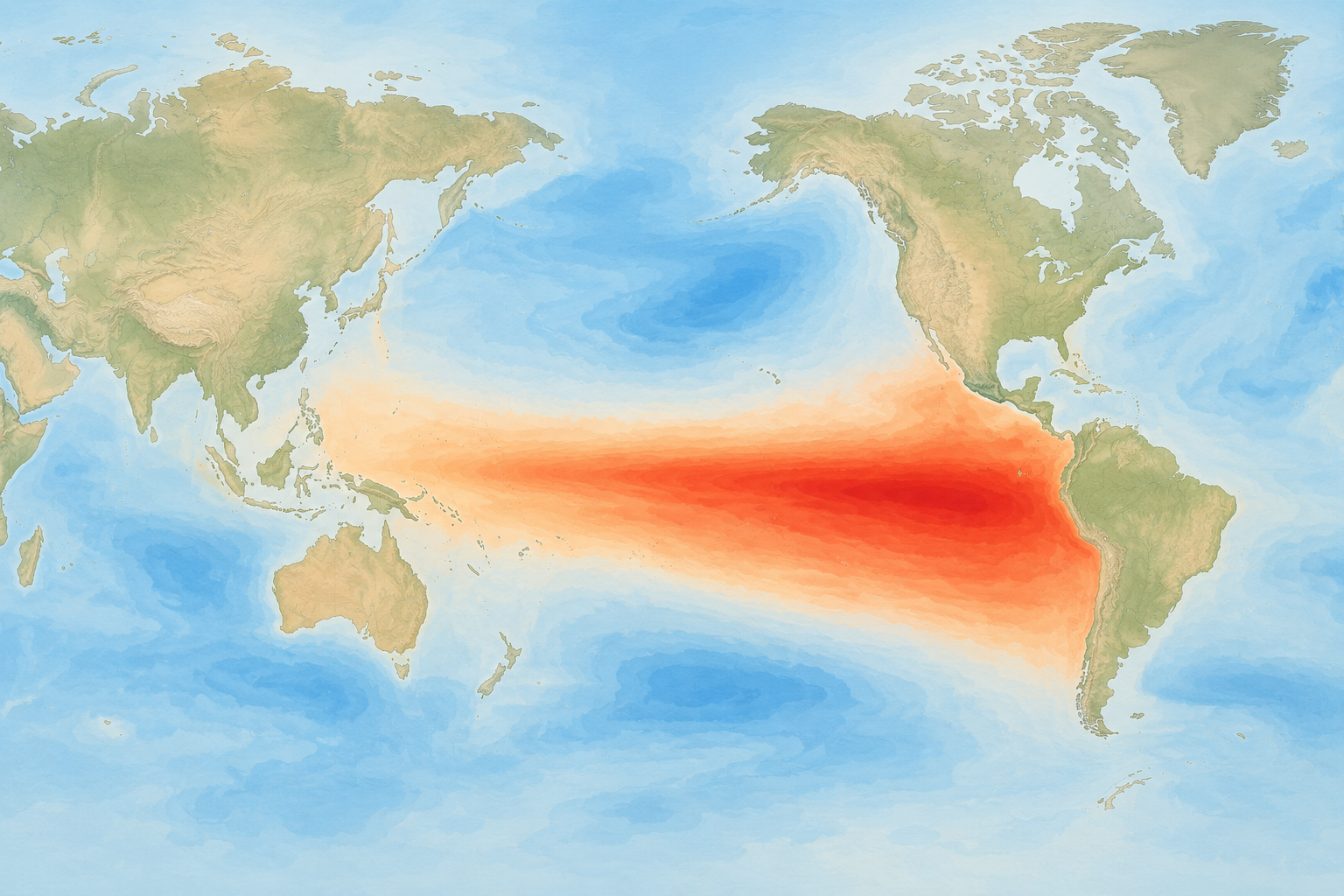
El Niño was sparked by a Kelvin wave that shifted huge amounts of warm water from west to east across the undersea Pacific since April.
— Ben Noll (@BenNollWeather) June 17, 2026
And now, a new Kelvin wave is forming.
Yet more warm water will move toward the eastern Pacific and El Niño forecasts may trend even stronger. pic.twitter.com/Me2Y8sItWd
Forecasts grow rather firm
Per the rating agency, the US Climate Prediction Center’s 8 June projections indicate a 96% chance that El Nino will continue through the December 2026-February 2027 period.
Fitch said sustained shortages could “amplify risks to globally traded food commodity prices” and potentially affect inflation even in highly rated sovereigns. The agency added that while some regions may benefit from increased rainfall and better crop output, others could face drier conditions, weaker agricultural production, and higher food prices.
The Pacific keeps its counsel
Climate scientists and forecasters are watching the tropical Pacific after the North American Multi-Model Ensemble, or NMME, indicated the possibility of a powerful El Nino developing later this year and persisting into 2027.
The outlook for the November-December-January 2027 period projects sea surface temperature anomalies exceeding 2C across large parts of the central and eastern Pacific, with some model outputs indicating warming of more than 5C in certain regions.
Scientists classify a strong El Nino when temperatures in the Nino 3.4 region rise between 1.5C and 1.9C above average, while anomalies above 2C are associated with very strong events.
El Niño is strengthening. Should last into 2027. https://t.co/nZnLfMzTnK
— ⭕️ CyberMike ⭕️ (@CyberMikeOG) June 11, 2026
A note of caution from the experts
Prof. Anjal Prakash, public policy professor at FLAME University and an IPCC author, told NDTV that “The NMME forecasts are a useful early signal, but they are not definitive.”
He said the multi-model approach reduces single-model bias and offers a more robust view of climate trends but also cautioned that predictability drops sharply beyond a few months because of internal climate variability and ocean-atmosphere uncertainties.
Prakash said the projections should be treated as an early warning and argued that sectors such as agriculture, water resources, fisheries, and disaster management should be prepared.
Signals worth watching closely
Raghu Murtugudde, Earth System Scientist and former professor at the University of Maryland and IIT Bombay, said, “At this lead time, nobody can say a super El Niño is guaranteed.” He added that when multiple models converge on a strong warming scenario, it becomes a signal worth monitoring closely.
Mahesh Palawat, vice president, meteorology and climate change, at Skymet Weather, told El Niño conditions are likely to strengthen in the coming months and that sea surface temperatures in parts of the eastern and central Pacific are already running around 1.5C above normal.
Economic clouds gather
The credit impact of El Niño would depend on how severely it affects growth, inflation, public finances, and foreign exchange reserves.
Fitch said it is unlikely to link rating actions directly to El Niño unless the effects are clearly reflected in credit metrics but warned that environmental stress could weigh more heavily on lower-rated sovereigns, especially those in the “B” category or below with limited market access.
For now, the central concern is not just weather volatility but the possibility that a prolonged El Niño could keep food prices elevated and complicate inflation management into 2027.
Also Read | India-UK FTA opens door for 3.78 lakh British car imports at lower tariffs over 15 years
FAQs
Q1: What is El Nino and why is it important?
Ans: El Nino is a climate pattern marked by unusually warm Pacific Ocean waters that can disrupt weather worldwide, affecting rainfall, agriculture and food production.
Q2: How could a prolonged El Nino impact India?
Ans: A prolonged El Nino could affect monsoon rainfall, reduce crop yields and increase food inflation, putting pressure on household budgets and the economy.