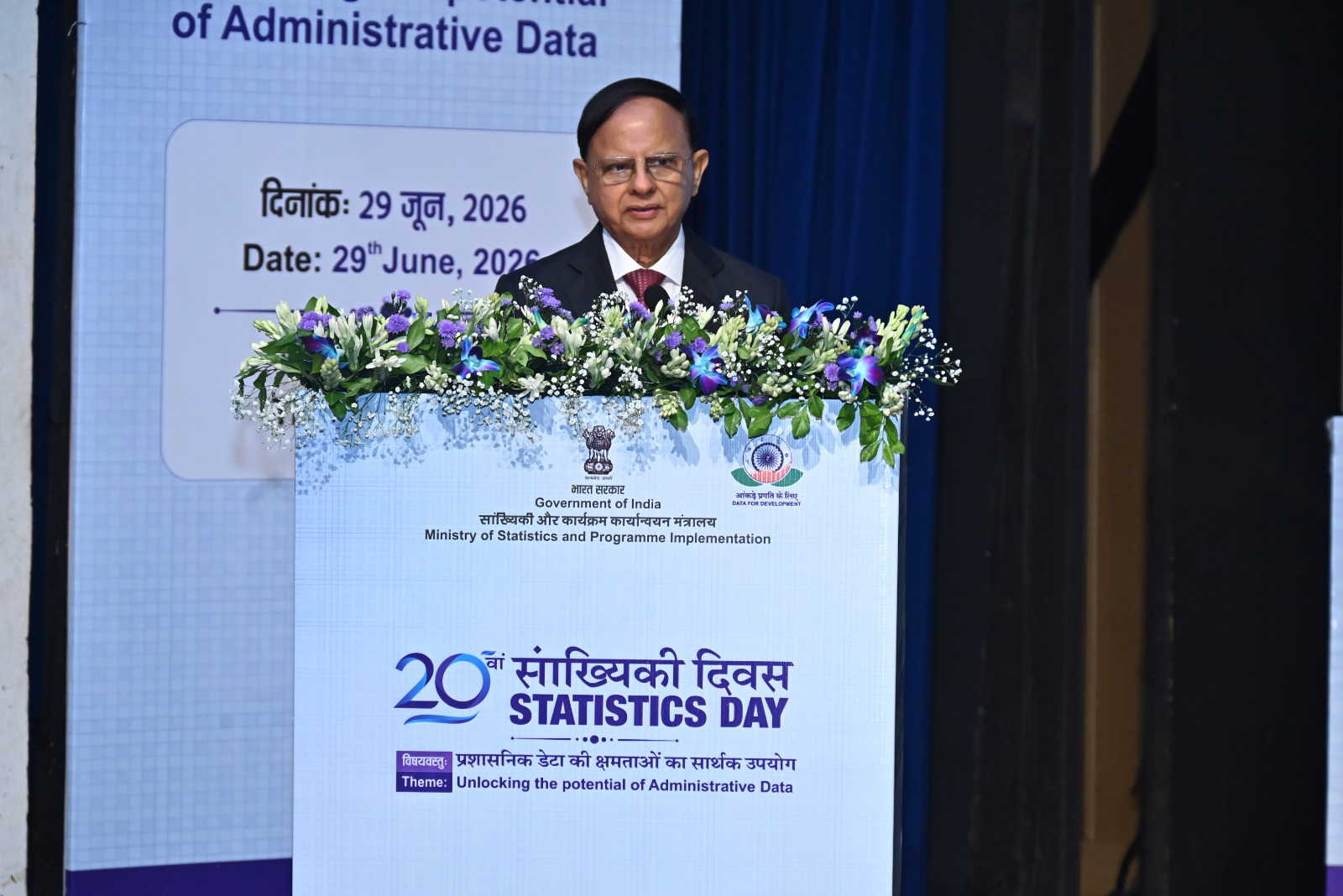
British mathematician Clive Humby said "Data is the new oil." Like oil, data is valuable. Principal Secretary to the Prime Minister Dr. P.K. Mishra on Monday said administrative data must be treated as a “strategic national asset” if India is to deepen evidence-based policymaking, improve governance, and move closer to its 2047 development goals.
Speaking as the chief guest at the 20th Statistics Day celebrations, he framed data-driven governance as central to the Viksit Bharat agenda and linked the quality of official statistics directly to program design, targeted delivery, and timely decisions.
Also Read | Petrol, diesel sale curbs to end from July 1 as Centre eases wartime fuel restrictions
Dr. P. K. Mishra, Principal Secretary to PM, highlighted that the Hon'ble Prime Minister's vision of Viksit Bharat 2047 is rooted in robust data driven decision making. He appreciated the reform initiatives of the National Statistical System undertaken by MoSPI and the… pic.twitter.com/yYEla8W36k
— Ministry of Statistics & Programme Implementation (@GoIStats) June 29, 2026
A tidy affair in the house of statistics
Mishra also congratulated the Ministry of Statistics and Programme Implementation for releasing its Vision Document 2026–31, the Progress Report on the Sustainable Development Goals, and India’s first city-level estimates of labor markets and informal enterprises.
He felicitated Professor Arup Bose with the Sukhatme National Award at the event. In his remarks, he said this year’s theme, “Unlocking the Potential of Administrative Data,” reflects a “transformative step” towards strengthening the statistical ecosystem and evidence-based policymaking.
Ministry of Statistics and Programme Implementation (MoSPI) celebrated the 20th Statistics Day, on 29 June 2026 at Dr. Ambedkar International Centre, New Delhi, commemorating the birth anniversary of Prof. P. C. Mahalanobis. The theme for this year's Statistics Day was "Unlocking… pic.twitter.com/F8AMsqJ3v4
— Ministry of Statistics & Programme Implementation (@GoIStats) June 29, 2026
Old foundations, renewed ambition
Recalling India’s early statistical institutions, Mishra said the country built one of the world’s finest survey-based statistical systems in the 1950s, with the National Sample Survey later becoming a globally recognized model.
He paid tribute to statisticians, including P.C. Mahalanobis, C.R. Rao, and P.V. Sukhatme, for their contributions to statistical science. At the same time, he acknowledged the pressures that had accumulated over time in the system, including outdated datasets, delays in data dissemination, fragmented architecture, and uneven data quality.
Those concerns, he said, led to a comprehensive reform exercise by MoSPI, which accepted 216 recommendations for time-bound implementation.
Now comes the machinery of modern governance
According to Mishra, reforms introduced between 2020 and 2025 modernized the statistical ecosystem through new surveys, updated macroeconomic indicators, improved dissemination, and procedural changes.
He said the Prime Minister’s Office had acted as a catalyst in helping MoSPI strengthen the statistical framework. Mishra added that administrative data could only become a powerful national asset if supported by strong standards of quality, privacy, and transparency while also emphasizing the need for interoperable data ecosystems across ministries, states, and Union Territories.
He said MoSPI has already modernized surveys through computer-assisted personal interviewing, introduced district-level estimates and high-frequency surveys, and cut the time taken to release official statistics.
He also cited initiatives such as National Metadata Structure 2.0, Open APIs, e-Sankhyiki, GoIStats, PAIMANA, and e-SAKSHI as tools improving accessibility and interoperability. Looking ahead, he said artificial intelligence offers transformative opportunities, but its use must be governed by frameworks that preserve accountability, explainability, and the integrity of official statistics.
Also Read | Fresh China incursion in Arunachal? Army says reports are 'incorrect and without any basis'
FAQs
Q1: What did P.K. Mishra say about administrative data?
Ans: P.K. Mishra said administrative data should be treated as a strategic national asset to strengthen evidence-based policymaking and support the Viksit Bharat vision.
Q2: What reforms has the Ministry of Statistics introduced in recent years?
Ans: The ministry has introduced new surveys, faster data dissemination, updated indicators and digital platforms to modernise India's statistical system.