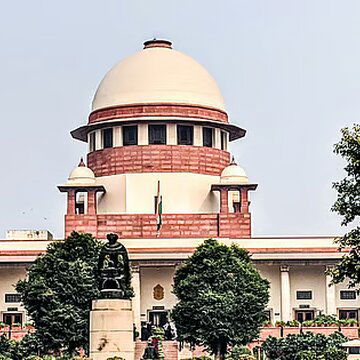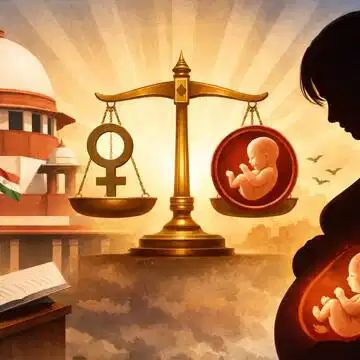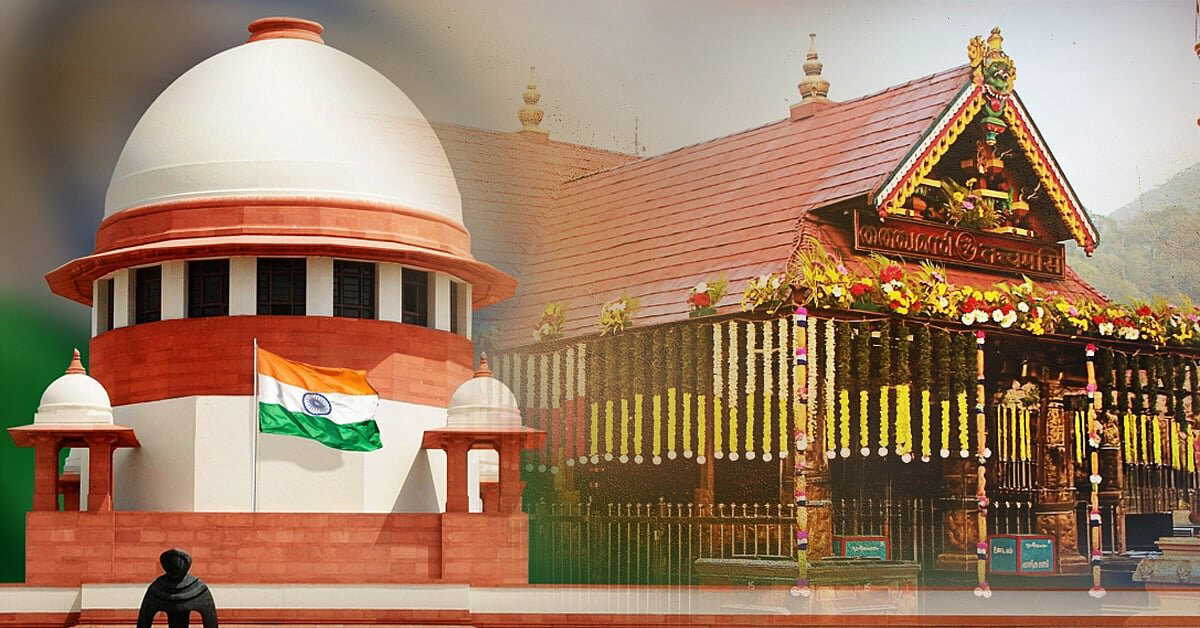
The Supreme Court's verdict on opening the doors of Sabarimala for women of all ages was nearly eight years ago. However, the legal battle over religious practice is far from over. The landmark ruling by the 2018 Constitution Bench faced nearly 67 review petitions, leading the issue to surface on the court’s calendar.
On February 16, a bench led by Chief Justice of India Surya Kant, along with Justice Joymalya Bagchi and Justice Bipul M. Pancholi, said the matter will be heard from April 7 at 10:30 am. The hearings are scheduled to conclude on April 22.
Also Read | 'India looks forward to your visit': PM Modi welcomes Emmanuel Macron as France President lands in Mumbai
Why a nine-judge constitutional bench
The case is now being placed before a nine-judge constitutional bench, which is rare. Under Article 145(3) of the Constitution, a minimum of five judges must hear cases involving substantial questions of constitutional interpretation. A nine-judge bench is constituted only when issues have far-reaching implications, including possible impact on the country’s constitutional framework or fundamental rights.
The Supreme Court’s bench structure ranges from division benches of two judges to larger benches of three, five, seven and nine judges. When an earlier judgment of a larger bench requires reconsideration on significant constitutional principles, a bigger bench may be formed.
Why large benches are rare
The Supreme Court currently has a sanctioned strength of 34 judges, including the Chief Justice. Constituting a nine-judge bench means assigning nearly one-third of the court’s strength to a single matter. Since the Chief Justice prepares the master roster and allocates cases, such a move requires careful consideration.
Larger benches are also avoided unless necessary because greater numbers can lead to more fragmented opinions, potentially affecting doctrinal clarity.
The largest bench in the court’s history was the 13-judge bench in Kesavananda Bharati v. State of Kerala, which laid down the basic structure doctrine, holding that while Parliament can amend the Constitution, it cannot alter its basic structure.
Why the nine-judge bench matters in this case
The present reference goes beyond the question of women’s entry into Sabarimala. It touches upon the scope of judicial review in matters of religion and the interpretation of the “essential religious practices” doctrine.
Lawyers argue that since 1950, courts have examined whether a practice claimed to be religious is essential and whether it violates constitutional rights. The nine-judge bench will consider the extent of judicial authority in determining what constitutes an essential religious practice.
Its ruling is expected to have implications not only for Sabarimala but potentially for other religious institutions, including temples, mosques, churches and gurudwaras across the country.