
The social psychologist Jonathan Haidt’s book The Anxious Generation has added fresh weight to the long-running debate over whether smartphones are driving a mental-health crisis among adolescents.
Haidt’s central claim is that the spread of smartphones, social media, and addictive online gaming has helped produce what he calls the “Great Rewiring of Childhood.”
Also Read | Is buffet food really fresh? Chef Sanjeev Kapoor breaks buffet myths: leftovers, ladles and hygiene truths
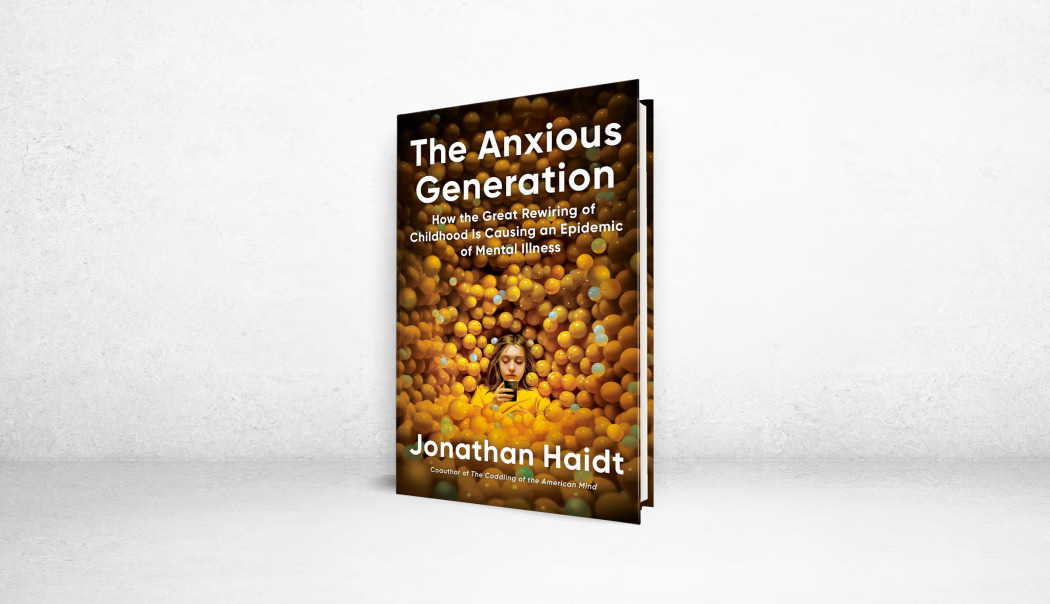 The Anxious Generation Book by Jonathan Haidt. X
 Playground chaos turns screen glow
Jonathan Haidt's “The Anxious Generation: How the Great Rewiring of Childhood Is Causing an Epidemic of Mental Illness” argues that adolescents traded a "play-based childhood" for a "phone-based" one somewhere between 2010 and 2015, with devastating consequences for their mental health. Rates of depression, anxiety, self-harm, and suicide rose sharply after more than a decade of relative stability, more than doubling in the early 2010s.
Haidt, a professor of ethical leadership at NYU's Stern School of Business, presents a striking case built on graphs charting precipitous drops in adolescent well-being that track, almost precisely, the mass adoption of smartphones and social media.
He traces the disappearance of what he calls a "play-based childhood." The mammalian norm for roughly 200 million years; to the 1990s, arguing it was effectively dead by 2010 and swiftly replaced by a phone-centered existence.
Also Read | What happened today (May 3) in history? Key events to look back on
Konservatiiviseen (oikeistolaiseen) maailmankuvaan nojaava kasvatus tuottaa onnellisempia lapsia kuin vasemmistolainen, sanoo Jonathan Haidt.
— Mikko Välimaa (@Uutistoimittaja) May 3, 2026
Onko siis ihme, että suomalainen vasemmistoliberalismia myötäilevä koululaitos tuottaa huonoja tuloksia?
Lisäksi lapset ahdistuvat.
1/x https://t.co/g4phz9W5Eb
Not every anxious teen is a phone casualty
Yet we cannot take the thesis wholesale. A large majority of Gen Z do not, in fact, have anxiety disorders. And of those who do, close to half would likely have developed them regardless of smartphone use.
We also cannot dismiss Haidt's concerns. No parent would comfortably hand a child any substance known to carry a one-in-ten chance of triggering a mental disorder within years. Data also indicate that even children without clinical disorders are reporting rising loneliness and other troubling outcomes.
Correlation ≠ causation
Developmental psychologist Candice Odgers of UC Irvine and Duke University, writing in Nature, argued that most empirical evidence on social media and mental health does not reveal a large or consistently negative effect.
The correlation between rising smartphone use and declining mental health reflects reverse causation, meaning already struggling teens may simply be turning to their phones, not the other way around.
Odgers warned that blaming social media risks distracting from identifying the real drivers of the mental health crisis in young people.
The fix is basically a throwback
Haidt's prescriptions are concrete. No smartphones until high school, a delay on social media access until at least 16 with mandatory age verification, and a return to greater independence and free play in the physical world.
The most alarming feature of Haidt's data is not any single statistic but the trajectories themselves. In almost every measure, things are getting worse.
That tension has made Haidt one of the most prominent voices in a wider policy fight over children’s access to screens.