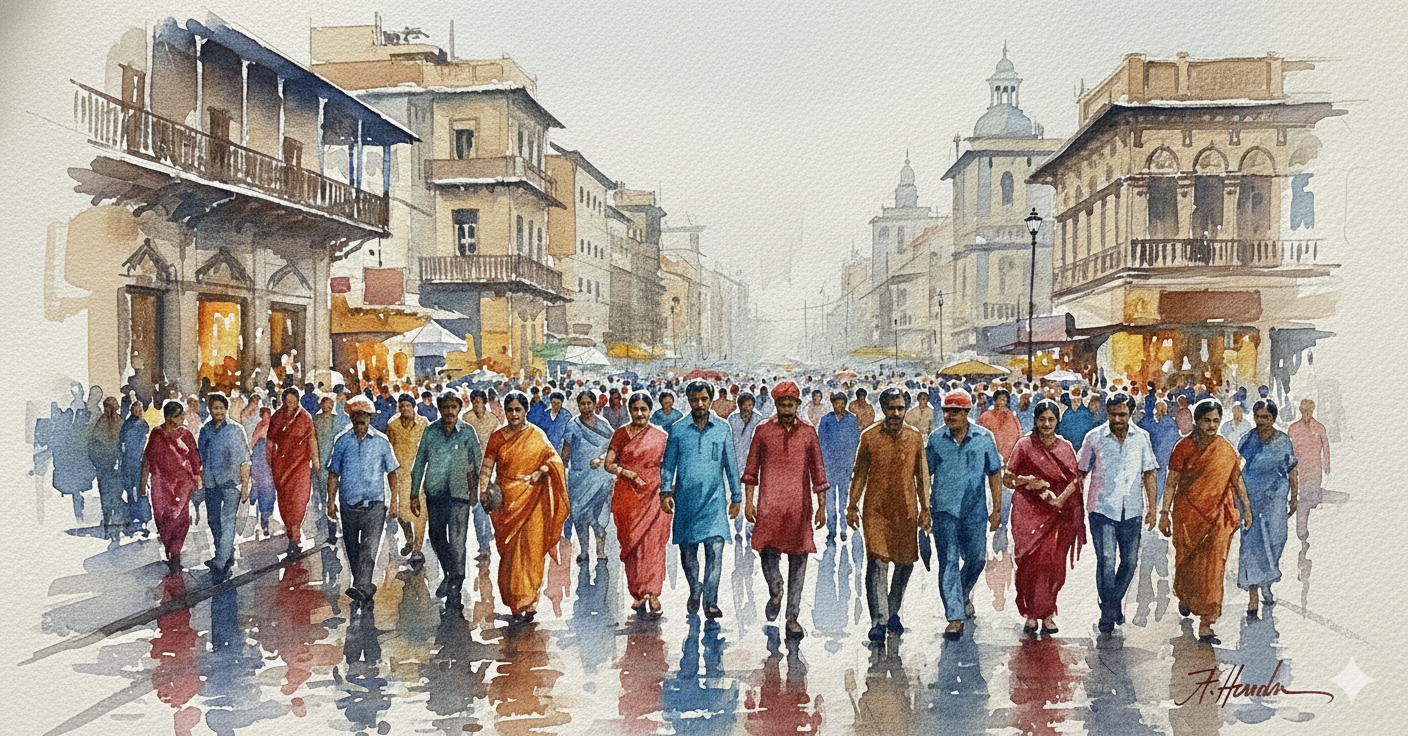
At the heart of the country today, workers, daily-wage labourers, social activists, academicians, and other members of the civil society gathered collectively to give a clarion call to oust and repeal the Viksit Bharat- Guarantee for Rozgar and Ajeevika mission(gramin), in short, VB-G Ram G bill, introduced in the Lok Sabha on 16th December, 2025. This bill was introduced by Shivraj Singh Chouhan, the Union Minister for Agriculture & Farmers' Welfare in the Lok Sabha, and since then has attracted a pool of dissent, debate, and demonstrations as it seeks to repeal the long-time welfare-right-based Mahatma Gandhi National Rural Employment Guarantee Act (MGNREGA), which has been a guarantor of 100 days of work in rural areas since 2005.
Also Read | Dyed in blue, drenched in hope: Walking in the white silence of Gurudongmar
There is a list of key changes that the VB-G Ram G bill would bring in, replacing the existing MGNREGA, and these need to be examined.
• Increase in the Number of Guaranteed days of employment: MGNREGA guarantees at least 100 days of employment in a financial year to every rural household whose adult members volunteer for unskilled manual work. This Bill raises the guarantee to 125 days. Additionally, under MGNREGA, if a person seeking work is not provided employment within 15 days, the state government is required to pay them an unemployment allowance. This Bill retains this existing provision.
• Fund sharing: Under the existing MGNREGA, the central government is responsible for the entire cost of wages for unskilled manual work, up to three-fourths of the material cost, including the payment of wages to the skilled and semi-skilled workers. State governments provide one-fourth of the material cost, administrative costs, unemployment allowance, and compensation in the event of a delay in payments of wages. The VB-G Ram bill provides that the scheme will be implemented as a centrally sponsored scheme. However, the fund-sharing between the central government and state governments will be 60:40 for majority of the states and union territories, while the North-eastern and the Himalayan states and the UTs (Uttarakhand, Himachal Pradesh, and Jammu &Kashmir) would have 90:10. In this ratio, the cost of wages, material costs, and administrative costs would be shared by the centre and the state. However, the state government will continue to pay unemployment allowance and compensation.
• State governments to bear expenditure in excess of normative allocation: According to Section 4(5) of the bill, it is being unequivocally stated that the central government will determine state-wise normative allocation for each financial year. The normative allocation is the ‘allocation of the fund made by the centre to the state.’ Earlier, all the states presented their annual work plan and labour budget to the Union Ministry of Rural Development. And finally, it is the state government that will bear any expenditure incurred in excess of this allocation.
Also Read | Football hijacked: When Messi came, and hope left the stadium
• Pause during Agricultural season: this bill proposes to pause the employment during peak agricultural seasons to facilitate adequate agricultural labour availability. Under subsection (2) of Section 6(1) of the bill, “Notwithstanding anything contained in this Act or rules made thereunder, and to facilitate adequate availability of agricultural labour during peak agricultural seasons, no work shall be commenced or executed under this Act.” Thus, the state governments will have to notify in advance, a period of 60 days in a financial year that covers the peak agricultural seasons of sowing and harvesting, during which the works under this act would be stalled.
• Role of the lower-level bodies: According to the Bill's provisions, all projects under the new scheme will come from Viksit Gram Panchayat Plans that have been combined at the Block, District, and State levels. These projects will then be combined into the Viksit Bharat National Rural Infrastructure Stack, which will encompass an extensive list of projects aligned with national development priorities.
Four thematic focus domains would be included in the Viksit Bharat National Rural Infrastructure Stack: (a) water security through water-related works;
(b) essential rural infrastructure; (c) infrastructure linked to livelihoods; and (d) initiatives to lessen the impact of extreme weather events.
It further plans to integrate it with the PM Gati Shakti National Master Plan.
• Formation of National-level steering committee: A National-level steering committee would be formed to recommend decisions relating to normative allocations to States and to advise on matters requiring inter-ministerial consultation, including the convergence framework, and to provide high-level oversight for the effective implementation of this Act. Alongside it would also review the performance of the state, and bring in corrective measures.
• Technological incorporations: Introduction of biometric authentication of workers, functionaries, and transactions, geospatial technologies, mobile applications, digital public disclosure systems, and technology-driven social audit mechanisms, as may be specified by the central government.
Also Read | A morning of faith, an afternoon of chaos: What the Messi event at Salt Lake Stadium revealed
Given the wide array of new changes to be introduced for the purpose of achieving the goal of Viksit Bharat by 2047, several key concerns surround the replacement of MGNREGA by the VB-G Ram G bill. At the first instance, as has been flagged by many leaders in the Lok Sabha, this bill forms a part of their political rhetoric at the Hinduization of the political climate of the country by making an acronym crafted to iterate a specific ideology. This inarguably works on the plane of hegemonization of the political discourse, which seeks to replace the work and labour of Gandhiji from the discourse of Indian politics and society. However, the apprehensions surrounding this bill extend far beyond to some serious concerns about the Indian economy. The MGNREGA scheme has been grappling with low wage rates, delays in payments, digital exclusions through Aadhaar-based bank payments, and digital attendance verification for quite some time. This was further exacerbated by the declining budgetary allocations over the last five years and the striking fact that only an average of 7.4% of the households registered for the scheme were able to complete the 100 days' wage work in the last few years. It is also at this juncture that the recently published World Inequality Report ranks India amongst its worst performers globally, where the richest 10% hold 65% of the country's wealth, with the top 1% having a share of approximately 40%. In such a state of affairs, the repeal of a social welfare demand-driven scheme like MGNREGA raises crucial concerns that arise from the proposed changes. It is clear that there is an increasing centralisation, despite detailed mechanisms for the institutionalisation of state-level, block-level, and district-level bodies, with a National-level body at the Centre. Under the provisions of the new bill, it would now fall under the jurisdiction of the Union ministry for the normative allocations to be made to each state, whilst transferring the burden of implementation and execution to the latter. Given the decreasing rate of budgetary allocations for social service schemes that we have been witnessing over the years since 2014, this centralisation raises serious concerns about the future of such a scheme, which was based on the logic of demand-driven employment. This centralisation also defeats the philosophy behind the federal structure enshrined in the Constitution, which its drafting committee had crafted with such care. To corroborate this, none of the stakeholders, including civil society organisations, trade unions, workers' groups, and state governments, were consulted before the proposal of such a bill in the Lok Sabha. Now, with the Centre attaching the allocation to itself and leaving the states to bear the cost of excesses and implementation, it nonetheless points to a direction of no return, wherein the very idea behind MGNREGA hangs by a thread. With a budgetary cap in place, the entire schema of things takes a U-turn towards a supply-driven enterprise. From guaranteed employment, there is an attempt, as is evident from the proposed bill, to transform it into a disbursement scheme. It is also crucial for us to note that, given the Centre-state clashes in fund allocation for various schemes over the years, apprehension and ambiguity arise about the breakdown of this entire employment scheme in the event of a tussle between the two, which would impact those dependent on daily-wage labour.
Also Read | All the Vice-President's Men: The Dick Cheney phenomenon
Two other concerns arise from the aspect of the mandatory technology usage and pause during the agricultural season. While it arrives as a measure to ensure no constraint in agricultural activity, the unequivocal announcement of barring any work under this scheme during the peak agricultural season brings concerns over the agriculture and allied activities that sustain a major portion of the tribal and marginalised communities engaged in work under MGNREGA. Secondly, Technological inclusion is a crucial measure for delineating and organising any mechanism. However, given the pool of workers from rural, marginalised regions of the country, the possibility of wide-scale exclusion due to the unavailability of required technical know-how raises a concern. The recent incident regarding the deletion of about 27 lakh MGNREGA workers during the compulsory e-KYC drive by the central government justifies the concern.
Thus, despite the portrayed well-intentioned efforts of the VB-G Ram G bill 2025, several issues encompassing the country's political, economic, and social climate raise serious concerns. As of now, various NGOs, Social organisations, Activists, researchers, academics, and workers’ collectives, such as the NREGA Sangharsh Morcha, and various other collectives, have resisted the enactment of such a bill under a joint platform. It is therefore only a matter of time and patience to witness what happens to the decade-old employment scheme rooted in the ideas of inclusive growth, social welfare, and socioeconomic justice.