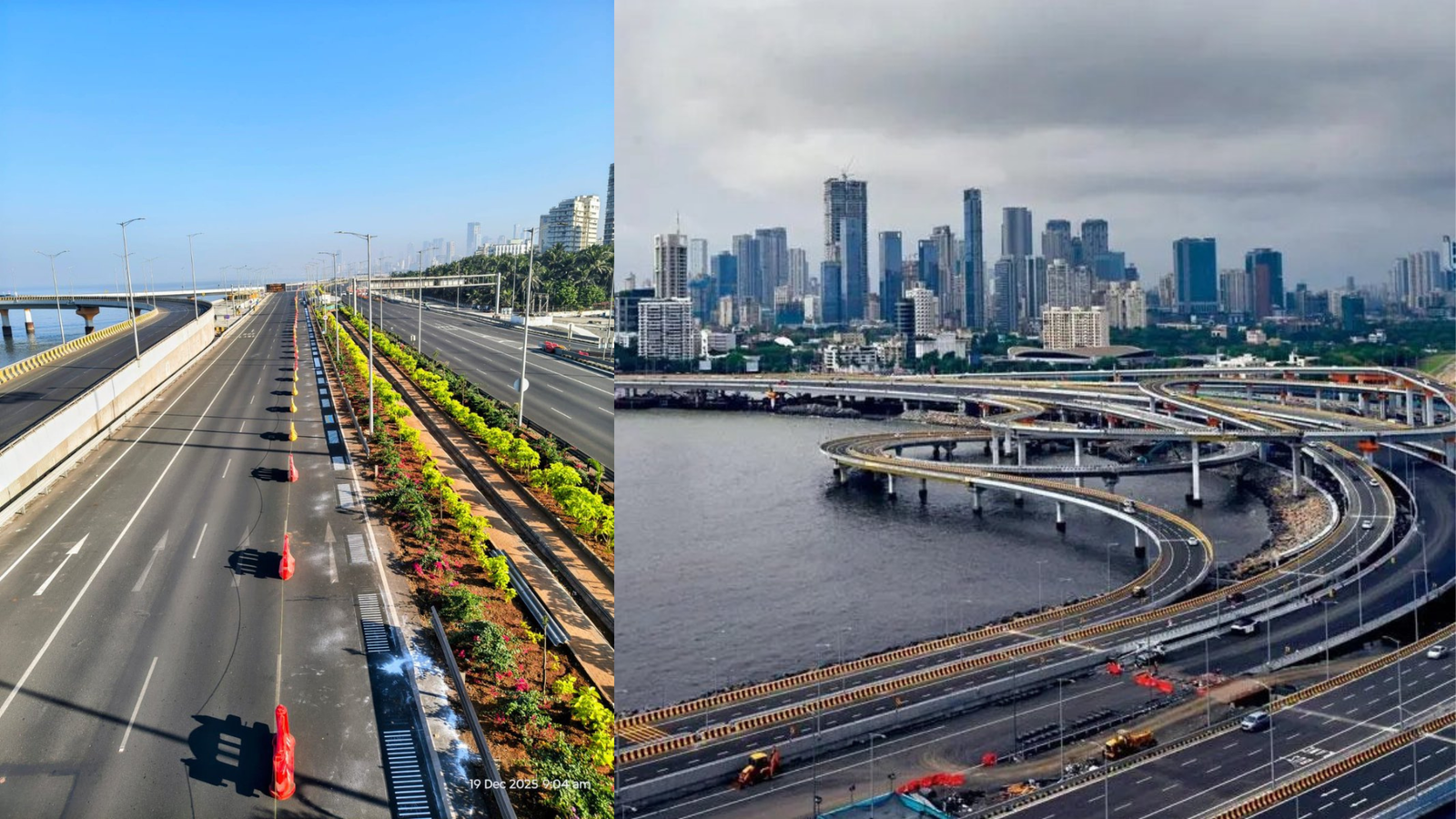
Imagine driving along the scenic Coastal Road in Mumbai with the sea flashing in the corner of your windscreen. As you settle at a steady pace, the tyres begin to hum. No, this is not the sound from your car's stereo. It's the road beneath singing!
That's true. Initially a low rhythm, it picks up pace within seconds and plays the Oscar-winning song 'Jai Ho'.
On February 11, India got its very first musical road. Maharashtra Chief Minister Devendra Fadnavis and his deputy Eknath Shinde inaugurated the stretch on Wednesday.
According to the Brihanmumbai Municipal Corporation (BMC), this is the fifth such road in the world and the first-of-its-kind in India.
Also Read | Annular solar eclipse 2026: Will India see the ‘ring of fire’? Check timings, visibility details
This is a 500-metre stretch on the northbound road between Nariman Point and Worli, just after vehicles exit the coastal tunnel. The musical section plays its tune when vehicles travel at roughly 60–80 km/h. Signboards placed inside the tunnel at 500 metre, 100 metre and 60 metre before the stretch guide motorists to keep the right speed. They also alert drivers to the upcoming musical feature.
How does this work exactly?
According to a report by The Hindu, BMC officials stated that grooves and rumble strips with specific dimensions and spacing have been added to the northbound lane of the Dharamveer Swarajya Rakshak Chhatrapati Sambhaji Maharaj Coastal Road.
"When vehicles travel over these strips at 60-80 km/h on 'Sangeet Marg' from Nariman Point to Worli, sound waves created by the friction of the wheels let passengers hear the melody of the patriotic song 'Jai Ho' from the film Slumdog Millionaire," a BMC official was quoted as saying by The Hindu.
So far, similar ideas have been used in Hungary, Japan, South Korea, and the United Arab Emirates, but this is the first time such an innovation has appeared in India, the official was further quoted saying.
The Mumbai installation uses specially designed rumble strips. These are grooves cut into the asphalt at specific depths and distances to create sound through tyre friction.
Officials say the project used Hungarian technology and expertise. Hungary has experimented with melody roads that blend traffic management with creative design for a long time.
It looks same as an ordinary road
To a casual observer, this musical road looks exactly the same as an ordinary road. It is usually indicated by equally spaced marks. However, these marks are placed in such a way that they react in a very specific way with a car's tyres. When the tyres roll over the marks, they start to vibrate similar to the sound one gets when they drag a stick through the fence's bars.
The space from one groove to another determines the rhythm of these vibrating sounds. Tightly placed ridges produce quick jolts, resulting in higher sounds, whereas wider spaces produce lower sounds. Engineers have calculated this space so that when a vehicle is moving at a certain speed, these sounds are produced in the form of music.
Once we are inside the car, the metallic structure will maximise these vibrations and convert them to sound waves recognised by the human ear as a song or tune. The speed also plays an important part in that it is either too slow, which causes the stretching of the song, or too fast, which causes its compression and alteration. This concept is formed on the basis of standard rumble strips designed mainly for road safety purposes.