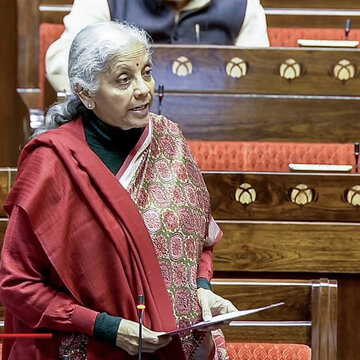
Every year, the Union Budget lays out the government’s plans to raise, allocate, and manage funds. However, for many of its readers, the budget coverage appears to be chock-full of technical terms that can confuse rather than inform on what really matters. This year, Finance Minister Nirmala Sitharaman will present the Union Budget for 2026-27 on February 1, at 11 am.
This guide breaks down key budget terms in simple, easy-to-follow language.
What kind of budget is being presented?
Interim Budget: When elections are looming, the government might give the country an Interim Budget. This is a stopgap budget that ensures salaries are paid and services continue until a new government is formed.
Vote on Account: A Vote on Account permits the government to spend money for a limited time without introducing the full budget to Parliament.
Annual Financial Statement (AFS): At the centre of the Budget is the Annual Financial Statement (AFS)- a comprehensive report of the government’s projected income and expenses for the year.
Demands for Grants: Ministries submit their Demands for Grants to undertake their activities.
Finance Bill and Appropriation Bill: After changes in taxation are announced, the Finance Bill gives these changes the force of law, while the Appropriation Bill grants the government permission to withdraw funds from the public account.
Also Read | Here are some lesser-known facts we bet you didn't know about the Union Budget
Where does the government’s money come from?
The primary sources of government earnings are two: tax revenue and non-tax revenue.
Tax revenue: It consists of direct taxes such as income tax and corporate tax, and indirect taxes such as GST, customs duties, and excise duties.
Non-tax revenue: Sources in it include dividends from public sector enterprises and surplus transfers from the RBI.
Direct taxes: Direct taxes are levies paid straight to the government from an individual’s income or a business’s profits, with the responsibility of payment falling directly on the taxpayer.
Goods and Services Tax (GST): An indirect tax charged on most goods and services consumed across the country.
Corporation Tax / Corporate Tax: Tax paid by companies on the profits they earn.
Customs Duty: Tax levied on goods imported into the country.
Excise Duty: Tax imposed on goods manufactured within the country.
Dividends from PSUs or the RBI: Profits transferred by public sector enterprises or the RBI to the government.
Also Read | From paper piles to tablet: Here's a look at how Union Budget went digital
How does the government spend money?
Government expenditure is divided into two categories: revenue expenditure and capital expenditure.
Revenue expenditure: This includes all kinds of day-to-day expenses, including salaries, pensions, subsidies, and social welfare schemes.
Capital expenditure: Involves investing in infrastructure such as roads, railways, hospitals, and power sectors.
Plan Expenditure: Funds spent on development and welfare programmes.
Non-Plan Expenditure: Spending on fixed commitments such as salaries, pensions, and interest payments.
Subsidies (food, fertiliser, fuel): Financial support provided to keep essential goods affordable.
Defence Expenditure: Spending on national security, including armed forces salaries, equipment, and operations.
Social Sector Expenditure: Spending on health, education, and services aimed at improving the quality of life.
Infrastructure Spending: Investment in public facilities such as roads, bridges, railways, airports, and power supply.
Also Read | Which ministry received the highest allocation in the 2025-26 Union Budget? Here's a look
Understanding deficits and gaps in finances
Fiscal Deficit: The gap between the government’s total income and total expenditure in a year.
Revenue Deficit: Occurs when the government’s regular income is not enough to meet its routine expenses.
Primary Deficit: Fiscal deficit calculated after excluding interest payments on past loans.
Budget Deficit: The overall gap between total income and total expenditure.
Gross Domestic Product (GDP) Ratio: A measure showing income, spending, or deficit as a percentage of the country’s GDP.
Borrowing and debt explained
Borrowing: Money raised by the government to meet expenses or bridge deficits.
Market Borrowings: Funds raised by issuing bonds and treasury bills to investors.
Public Debt: The total outstanding borrowings accumulated over time.
Treasury Bills: Short-term government securities issued for up to one year.
Government Securities (G-Secs): Long-term bonds issued by the government to raise funds.
External Borrowings: Loans taken from foreign governments or international institutions.
Also Read | Is the stock market open on Budget Day 2026? Here's what we know about NSE, BSE operations on Feb 1
Centre–state financial relations
Transfers and Federal Finance: Funds provided by the Union government to states and local bodies.
Devolution to States: Sharing of tax revenues between the Centre and states.
Finance Commission: A constitutional body that recommends how taxes should be shared between the Centre and states.
Centrally Sponsored Schemes (CSS): Schemes funded mainly by the Union government but implemented by states.
Grants-in-Aid: Funds given to states or local bodies for specific purposes, without repayment.
Taxes, compliance, and policy tools
Tax Policy and Compliance: Rules governing taxation and mechanisms to ensure taxes are properly paid.
Tax Slabs: Income ranges are taxed at different rates.
Tax Exemptions: Income or activities excluded from taxation.
Also Read | Why is the Union Budget presented on February 1? Here’s the reason behind the shift
Deductions: Specified amounts allowed to be subtracted from income to reduce tax liability.
Surcharge: An additional charge levied on high-income taxpayers.
Cess: A tax collected for a specific purpose.
Tax Buoyancy: A measure of how tax revenue grows in relation to economic growth.
Widening the Tax Base: Expanding the number of taxpayers to increase revenue.
Managing growth and fiscal discipline
Growth Projections: Estimates how much the economy is expected to grow.
Medium-Term Planning: Financial and policy planning for the next three to five years.
Fiscal Responsibility: Managing public finances prudently to limit excessive borrowing.
The Budget Management (FRBM) Act: A law that sets targets to control fiscal deficit and debt.
Medium-Term Fiscal Policy: A roadmap for managing revenue, spending, and borrowing over the medium term.
Medium-Term Expenditure Framework: A plan that outlines sector-wise spending limits for the next three to five years.