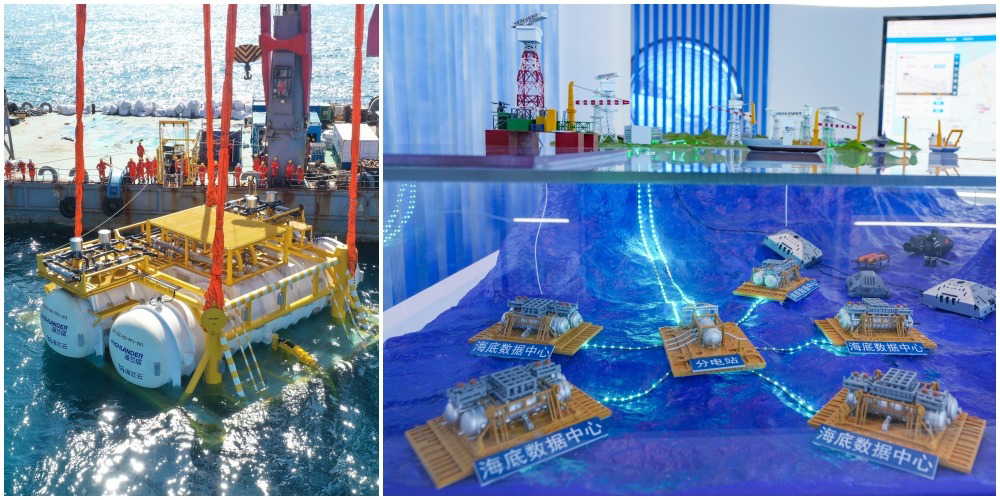
China has begun operating what it calls the world’s first wind-powered underwater data centre, a demonstration project off the coast of Shanghai that is designed to serve the country’s fast-growing artificial intelligence sector.
The Shanghai Lingang undersea datacentre, which launched in May and started operations this week, has a capacity of 24 megawatts and is run by HiCloud Technology and China Communications Construction.
It is located more than 6 miles from shore in the Lingang Special Area and sits about 10 metres below the surface, with power supplied by a nearby offshore wind farm.
Also Read | Extreme lunar heat, long Moonwalks: How Prada is helping NASA prepare for Artemis
China has around 450 data centers, way fewer than the US but still a solid number four globally. Most of their big facilities are shifting west through the “Eastern Data, Western Computing” project, putting them in places like Inner Mongolia, Gansu, and Ningxia where there’s tons… https://t.co/cTc0LtzAiB pic.twitter.com/zewnLY46n8
— Patricia 🇺🇸 (@1109Patricia) June 12, 2026
A neat answer to AI’s thirst for power
According to the Chinese government, the facility reduces power consumption by more than one-fifth compared with land-based data centres, largely because seawater provides natural cooling and reduces the need for energy-intensive chillers.
The launch comes as governments and technology companies face mounting pressure over the water and electricity demands of AI infrastructure.
In a conventional land-based data centre, 25% to 40% of electricity use can go toward pumping chilled water through servers to prevent overheating.
The experiment gathers a second wind
The Shanghai project follows an earlier HiCloud underwater data centre in Hainan, which was launched in 2023, but the Shanghai installation is the company’s first to be powered by offshore wind.
The idea is not entirely new: Microsoft ran a pilot underwater data centre project in Orkney in 2018 and later reported promising results before the effort stalled.
“Microsoft was earlier in proving the concept,” said Dr Hanjiang Dong of Hong Kong Polytechnic University, while Prof. Rick Stafford of Bournemouth University said, “An underwater datacentre is likely a good idea.”
🇨🇳|China Deploys World’s First Operational Underwater AI Data Center
— Aprajita Nafs Nefes 🦋 Ancient Believer (@aprajitanefes) June 12, 2026
China has achieved a major technological breakthrough: the first operational underwater AI data center near the coast of Shanghai.
•- 2,000 servers housed in sealed, submarine-grade steel capsules
•-… pic.twitter.com/EfLqwjlibx
A few ripples in the grand design
The project has also renewed environmental concerns.
The Guardian said experts believe underwater data centres may disturb sediments or heat seawater, while other reports warned that such facilities could contribute to toxic algae blooms or deoxygenated conditions that harm marine life.
The United Nations University Institute for Water, Environment and Health warned this week that the water footprint of data centres could reach 9.3 trillion litres by 2030.
The Chinese facility houses 2,000 servers, and a 500-megawatt expansion is already being planned, though the project is still being framed as a commercial test case rather than a large-scale replacement for conventional data centres.
FAQs
Q1: What is China’s underwater data centre project?
Ans: China has launched the world’s first wind-powered underwater data centre off Shanghai, using seawater cooling and offshore wind energy to reduce power consumption.
Q2: Why are underwater data centres considered important for AI?
Ans: Underwater data centres can lower cooling costs and energy use, helping support the growing computing demands of artificial intelligence systems.