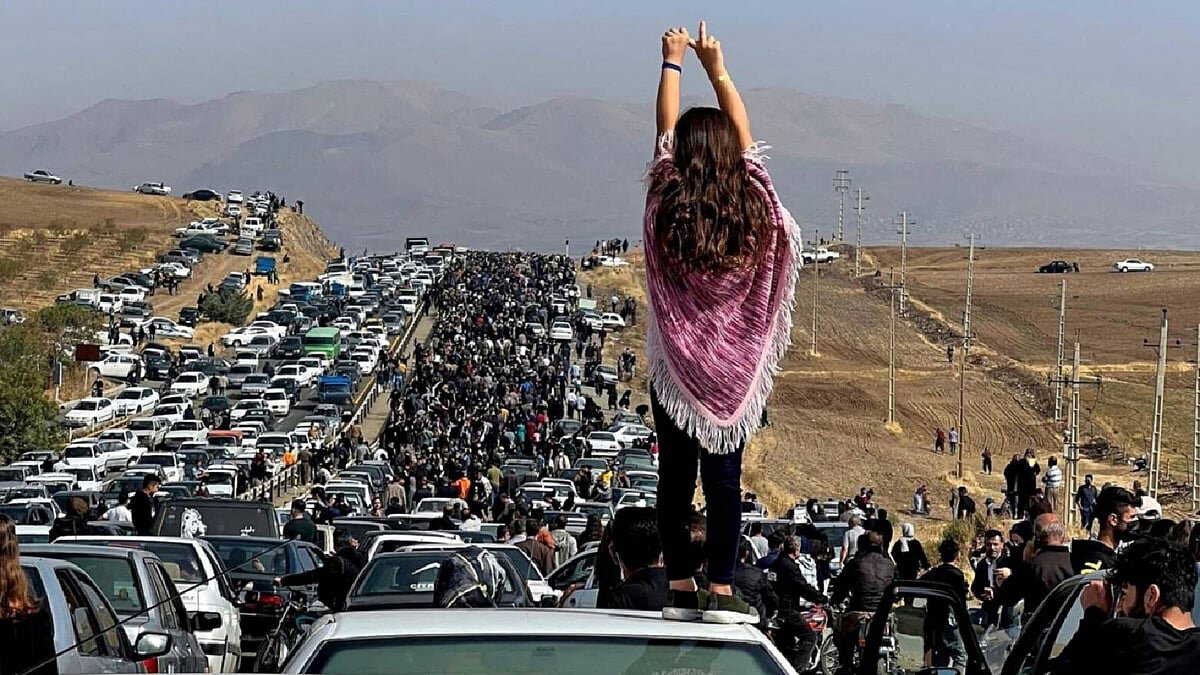
Iran has been tense over the past two days, as ordinary citizens have taken to the streets in protest against the government. Chants like "Mullahs go away" and "Down with dictatorship" echo across the cities. Protesters carry placards and posters, roaming through entire urban areas. Anger against the government, led by Supreme Leader Ayatollah Khamenei, has reached its peak. However, many observers suggest that the United States may be playing a role behind the unrest.
What is happening in Iran?
Several fragmented images have emerged from the protests. According to some diplomatic experts, when pieced together, a clear picture emerges: the anti-hijab movement that began after Mahsa Amini's death has now evolved into a mass uprising. Tehran's highways have come to a standstill. Bridges are devoid of vehicles; only crowds of people fill the streets.
Police have intensified efforts to suppress the movement. Security forces have repeatedly clashed with protesters in Tehran and Mashhad, using batons indiscriminately and firing tear gas. At Tehran's Grand Bazaar, protesters chant, "Don’t be afraid, we are all together," while shouting "Shame, shame" at the security forces.
Also Read | Third killing in two weeks: Hindu security guard shot at Bangladesh garment unit
Why the movement?
Iran has a population of approximately 90 million. The public's frustration has been building over years of deteriorating law and order, compounded by worsening economic conditions. The Iranian rial now stands at 42,125 per US dollar, inflation is at 42 percent, and commodity prices have skyrocketed while incomes have not kept pace. This economic strain has contributed to widespread anger, spilling onto the streets.
US involvement behind unrest?
Iran is currently in a severe financial crisis, and many believe that US President Donald Trump is partly responsible. The United States has pursued a 'maximum pressure' policy against Iran, imposing successive economic sanctions to isolate the country and curb its nuclear and ballistic missile programs. Oil exports have been effectively halted, adding to Iran's economic strain.
Also Read | Third killing in two weeks: Hindu security guard shot at Bangladesh garment unit
Iranian intelligentsia against Khamenei
Iran's intellectual community has also voiced strong opposition to the Islamic Republic. Iranian-American journalist Masih Alinejad wrote on X, "I'm seeing countless videos from Iran. People are chanting together, 'Mullahs must leave Iran, down with dictatorship.' This is the voice of the people. People no longer want the Islamic Republic."
Some informed sources claim that Khamenei's government has never faced such a large-scale mass movement before. Recent developments, including the Iran-Israel conflict, the reinstatement of UN sanctions, and ongoing US pressure, have gradually reduced the regime's economic and political space. Trump has warned that Iran will face attacks if Hamas does not lay down arms. Economist Amir Hossein Mahdavi adds, "Income has decreased, prices have increased. Life has become a daily struggle to calculate expenses. If we don’t protest now, then when?"