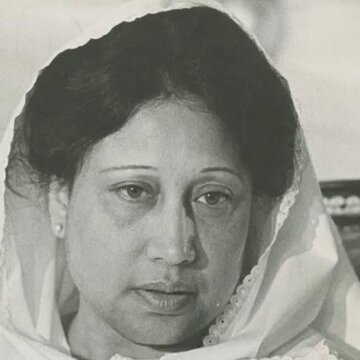
Former Bangladesh Prime Minister and BNP matriarch Begum Khaleda Zia died on Tuesday in Dhaka after a prolonged illness. The country's first woman Prime Minister, she rose to prominence after the death of her husband, former President Ziaur Rahman. Her passing comes at a time when Bangladesh is experiencing political turbulence, as anarchist elements seek to attain power.
To understand what her death could mean for Bangladesh and the surrounding region's politics, and how it would affect the dynamics of power, News Ei Samay spoke to political scientist and author Dr. Zaad Mahmood, Assistant Professor at the Department of Political Science, Presidency University, Kolkata.
'End of an epoch'
"First of all, as students of politics, the death of Khaleda Zia marks the end of an epoch in Bangladeshi politics. Khaleda Zia and Sheikh Hasina - they were the two central figures in Bangladesh politics. Sheikh Hasina is outside the country, and Khaleda Zia is dead. It is the end of an era in Bangladesh's politics in the sense that Khaleda Zia is dead," Dr. Mahmood said.
He added, "Secondly, now what happens is with Tarique Rahman coming back to Bangladesh and taking over the helm of the BNP, and that he was not there for 17 years; although, he controlled the party in some way from London - this marks a period of uncertainty, because we knew what Khaleda Zia did or did not do, what she wanted, what her political position was. It was very clear. Now we're getting into a period of uncertainty, in the sense that Bangladeshi politics becomes more uncertain."
Dr. Mahmood noted that Khaleda Zia had been ailing for a while now, yet her presence made a difference. "Khaleda Zia was suffering from ailments for a long time, but that she was living carried a symbolic meaning in its own. Like Sonia Gandhi, who has also been suffering for quite some time, her presence made a difference. It opens up possibilities as well as uncertainties, on which way Bangladesh will go," he said.
Also Read | Khaleda Zia's death may galvanise BNP ahead of polls, says international affairs expert
'Woman Prime Minister in a third-world country'
Dr. Zaad Mahmood highlighted, "A new crop of young leaders, we see, has come up from the July Revolution, like Sharif Osman Hadi. We can also see a new crop of leaders coming up for BNP, which is the biggest party right now. The banning of the Awami League is absolutely farcical and undemocratic."
He added, "The death of Khaleda Zia would mean, number one, that a woman Prime Minister in a third-world country has passed away. That itself says a lot about her achievements, in the sense that her husband (Ziaur Rahman) formed the party, and she took over after he was assassinated."
Dr. Mahmood talked about the legacy that Khaleda Zia is leaving behind. "From a housewife to becoming a leader of a country, and then being one of the central axes of Bangladesh's politics with Sheikh Hasina. So, that is her legacy. But it opens up quite a bit of uncertainty in terms of which way Bangladesh goes," he said.
'Sorrow brings us together'
When asked about if he thinks that the BNP cadre will galvanise around Tarique Rahman more after Khaleda Zia's death, Dr. Mahmood remarked, "One thing that happens in personality-based parties, when you have the patriarch or the matriarch going, then generally it has to be the family that has to take over. Death can have a very powerful impact in galvanising people. Sorrow brings us together. Khaleda Zia's death could act as a cementing force for the workers of BNP. On the other hand, it also opens avenues for power-grab within a personality-based party. This is true for all personality-based parties."
He analysed, "We will have to wait and see whether Tarique Rahman got enough time to consolidate his authority. If the mother had been there, who was accepted as a leader, then that consolidation would have been easier. Mother handing the baton to the son. A sympathy vote carries significant importance in politics, and it will be there. But the 'two begums' politics of Bangladesh comes to an end as Sheikh Hasina is not in the country, and Khaleda Zia has passed away. We will have to wait and watch how this affects the stability."
'Generational shift in politics'
News Ei Samay asked Dr. Mahmood about the number of female leaders in South Asia, which was on the rise till the recent past, but the number has practically vanished now. To this, he replied, "For South Asia, one dimension is the women leaders assuming power, then dying or losing control. But, the rise of these women leaders does not necessarily mean that structures of male dominance were ever questioned. These women became leaders because of the death of the male patriarch, and they were considered the natural heir. Khaleda Zia gained prominence because of the death of Ziaur Rahman. Sheikh Mujib and his whole family's death catapulted Sheikh Hasina. But, there was an effect of the representation. A generational shift is happening now."
He added, "The generational shift causes two things. If you talk to people in the security apparatus, they will say that they had contacts with BNP, Awami League, talking from the Indian perspective. Now suddenly, they will have to establish relationships with new people, and new leaders. Khaleda Zia was the first female Prime Minister of Bangladesh. She came to power after HM Ershad's military rule. Bangladesh looked like it was moving towards stability. BNP held an election under a caretaker government, which was won by Awami League. Then, Awami League removed the provision of the caretaker government. Awami League's domination began after that."
"It is a sensitive time for Bangladesh, but BNP should get some benefit out of the death of Khaleda Zia," Dr. Mahmood said.
Who is better for India: Awami-BNP or NCP-Jamaat?
"When you have an institutional, large party in power, that is always better compared to a non-institutionalised party coming to power. NCP was formed after the July Revolution. They have not crystallised that well; they have multiple factions fighting amongst themselves. Compared to that, a long-term, stable party like the BNP coming to power is better for any country," Dr. Mahmood said. He added, "Putting simply, this is the difference between stability and potential instability. I am not judging anyone's ideology, but BNP had a standpoint against 'India's dominance.' But we (India) interacted with them when they were in government. BNP is one of the largest parties in Bangladesh, and we had diplomatic channels with them. From an Indian strategic point of view, all of these channels will have to be developed anew if some party like the NCP comes to power. It is already developed in the case of BNP, so that is a benefit."
Dr. Zaad Mahmood ended the conversation, raising a possibility of contestation on taking over the reins of the chariot of Bangladeshi politics. He said, "Whoever is democratically elected, we will have to engage with them. But, there is a certain anger against Sheikh Hasina, for which the July Revolution happened. Now, the matriarch opposite to her, Khaleda Zia, is dead. I believe that since Khaleda Zia has been sick for a while, Tarique Rahman has expanded his control. People don't readily accept someone as the leader from outside the party, but the death of a patriarch or matriarch opens up some space for contestation."
Khaleda Zia served as Bangladesh's Prime Minister on three occasions. After the fall of HM Ershad's military rule, elections brought the BNP to power, and the country had its first woman Prime Minister.