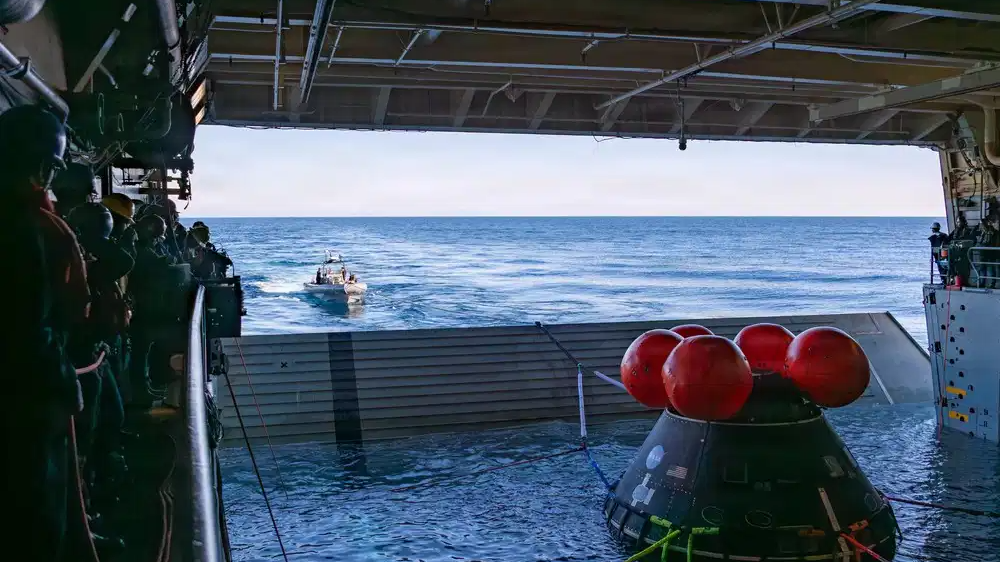
The four astronauts aboard Artemis II are preparing for a high-speed return to Earth after completing a record-setting journey around the Moon. The crew comprising Victor Glover, Reid Wiseman, Christina Koch and Jeremy Hansen travelled more than 4,05,000 km from Earth, going farther than any humans before them and surpassing the long-standing record set by Apollo 13.
After a 10-day mission, the astronauts are now set to re-enter Earth's atmosphere in NASA's Orion capsule, aiming for a splashdown off the coast of San Diego.
A 'fireball' return through Earth's atmosphere
Re-entry is the most intense phase of the mission. The Orion capsule will hit Earth's atmosphere at speeds of up to 40,000 km/h, reported ABC News. As it descends, friction with the atmosphere will generate temperatures exceeding 2,500 degree Celsius, forming superheated plasma around the spacecraft.
Also Read | 'We've lost the keys': Iran trolls Trump's Hormuz threat in viral meme war
Writing for The Conversation, hypersonics expert Chris James explained the scale of the challenge. "A shock wave will envelop the spacecraft, creating air temperatures of 10,000 degrees Celsius or more — about twice the temperature of the surface of the Sun," he said.
"The extreme heat turns the air that crosses over the shock wave into electrically charged plasma.
This temporarily blocks radio signals, so the astronauts will be unable to communicate during the harshest parts of their descent," he said.
During this phase, communication blackout is expected as plasma interferes with signals.
Slowing down from extreme speeds
Once through the most intense heating phase, Orion will begin a carefully timed descent using a series of parachutes. 11 parachutes will deploy in stages to reduce speed from hundreds of kilometre per hour to a safe landing velocity.
At around 6,700 metre, initial parachutes will deploy, followed by pilot chutes at 3,000 metre. These will pull out three massive main parachutes, each over 35 metre wide. By splashdown, the capsule is expected to slow from approximately 209 km/hr to roughly 27-30 km/h, reported ABC News.
NASA has also prepared for different landing scenarios. The capsule may land upright, sideways or even upside down, but built-in airbags will automatically right it to ensure safe crew recovery.
Concerns over heat shield addressed
Despite the mission's success so far, concerns have been raised about the spacecraft's heat shield. Former NASA engineer Charlie Camarda told ABC News that the mission could be "playing Russian roulette" with astronaut safety, citing similarities with past shuttle disasters.
The concerns stem partly from the Artemis I test flight in 2022, where the uncrewed Orion capsule showed signs of damage, including cracks on its heat shield.
However, NASA leadership has expressed confidence. Administrator Jared Isaacman said he had "full confidence" in the system following detailed analysis and improvements.
Building on Apollo, pushing limits
While modern technology has advanced significantly since Apollo 11, Orion's heat shield is based on Avcoat, a material derived from Apollo-era designs. However, Artemis II is pushing those limits further, with re-entry speeds higher than earlier missions.
Also Read | 'I know I overspent this month so...': Microsoft employee breaks down Rs 1.36 lakh monthly spending
This return marks the fastest re-entry ever attempted with astronauts on board.
As the capsule descends towards the Pacific Ocean, the mission stands as a major milestone in human spaceflight: combining legacy technology with new ambitions for deep space exploration.