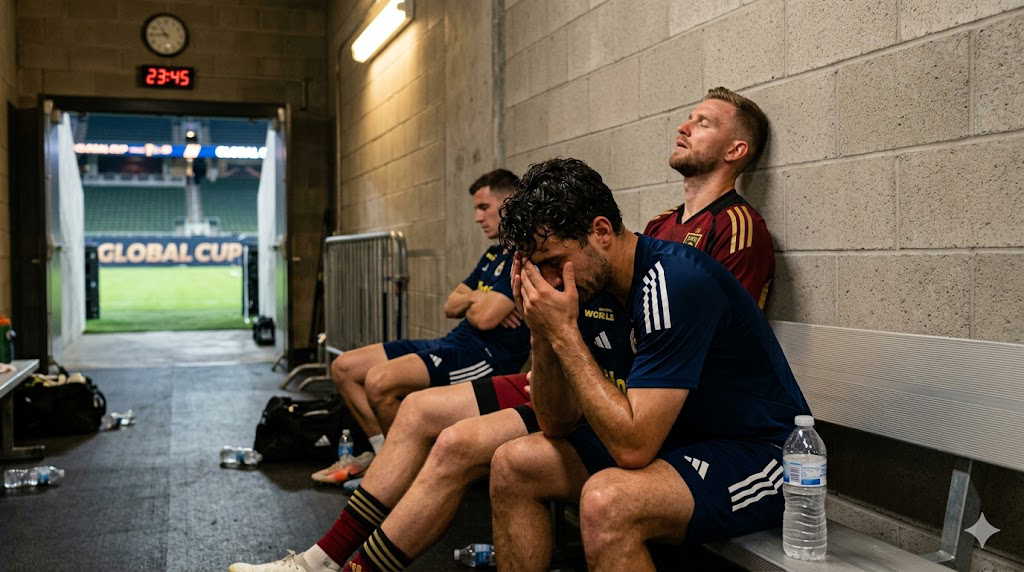
The FIFA World Cup has always been football’s ultimate test, but in 2026, players may find themselves battling an opponent they cannot dribble past or tackle into submission: fatigue.
The expanded tournament arrives at a time when football’s calendar is more congested than ever. Elite players now juggle domestic leagues, continental competitions, international fixtures and the recently expanded Club World Cup. By the time they step onto World Cup pitches across the United States, Canada and Mexico, many will already have accumulated thousands of minutes of competitive football in their legs.
The concern is no longer theoretical. Players, managers and performance experts have repeatedly warned that the relentless schedule is pushing athletes closer to their physical limits.
A relentless football calendar leaves little room for recovery
According to the Hindustan Times, several of the tournament’s biggest stars enter the World Cup after marathon seasons. Netherlands captain Virgil van Dijk has played more minutes than any player in Europe’s top five leagues over the past year, while England midfielder Declan Rice and Spain’s Martin Zubimendi have also logged extraordinary workloads.
For many players, the issue is not just the volume of matches but the absence of meaningful recovery periods. There were only a handful of days between the end of the European club season and the beginning of World Cup preparations.
Modern footballers are expected to move seamlessly from club commitments to national duty, often travelling across continents with little time to rest or adapt physically. The result is a growing concern that players may arrive at the tournament already fatigued.
Also Read | New to football? Here’s your crash course before the FIFA World Cup kicks off
North America presents a unique challenge
According to the Hindustan Times, unlike Qatar 2022, where teams operated within a compact geographical area, the 2026 World Cup will stretch across an entire continent.
Travel between venues could involve long flights, multiple time zones and disrupted recovery schedules. Teams may find themselves spending as much energy managing logistics as preparing tactically.
The summer climate also adds another layer of difficulty. Many matches are expected to be played in high temperatures and humidity. While mandatory cooling breaks will help players cope with the heat, they cannot entirely offset the physical toll of competing in demanding conditions.
Also Read | FIFA World Cup 2026 for free: Where Indian fans can watch key matches without paying?
Endurance could decide the champions
According to the Hindustan Times, historically, successful World Cup campaigns have often been built on careful preparation and adaptation. Brazil’s famous 1970 squad spent months preparing for the conditions in Mexico, while previous tournaments generally offered players longer recovery periods after club seasons.
The modern game offers better sports science, nutrition and medical support, but it also demands far more from players. The expanded format means eventual champions must navigate an additional knockout round, increasing the physical burden even further.